
INFINITE SYSTEMS INSIGHTS:
School Turnstile Systems in the Philippines: Campus Access Control and Entrance Planning
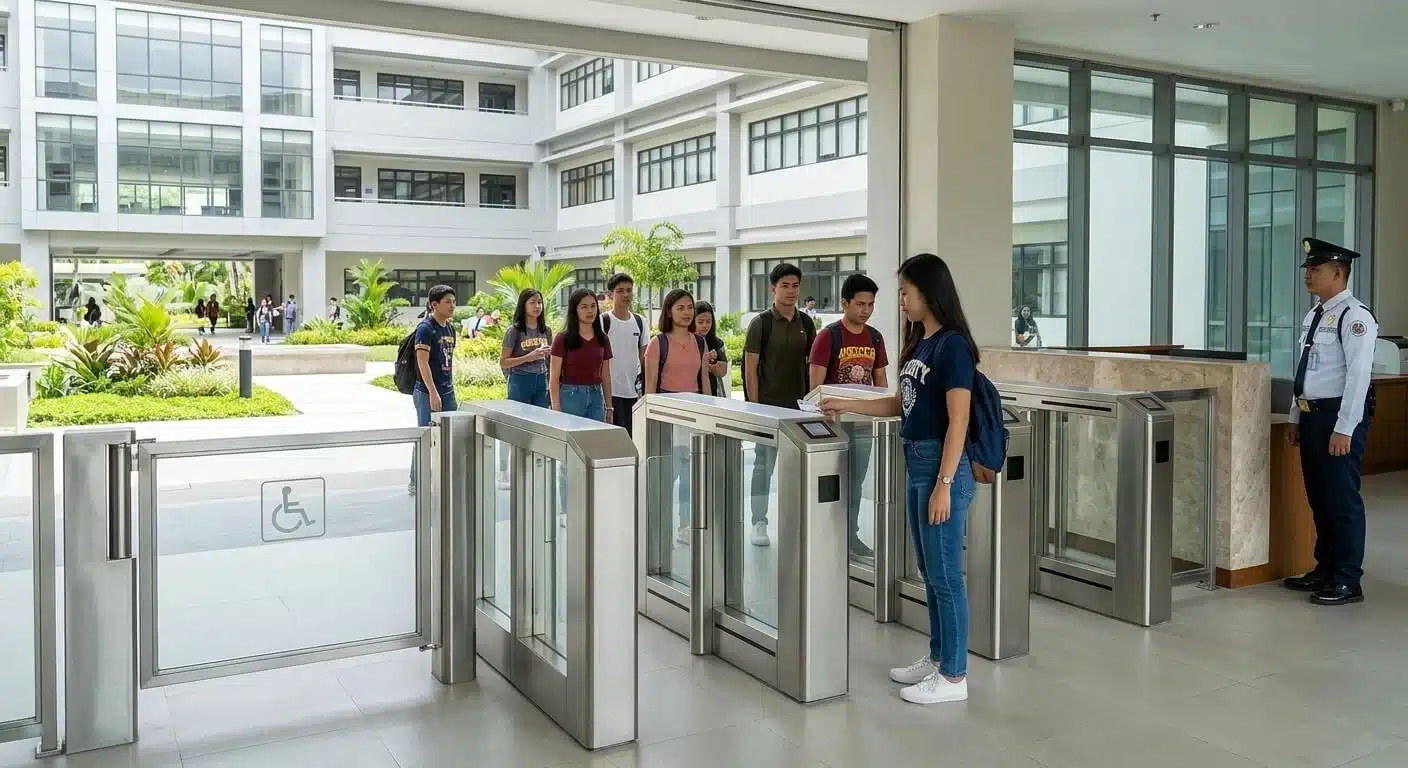
A school turnstile system must do more than control who enters a campus. It should help administrators manage student arrivals, verify authorized access, support visitor screening and maintain safe pedestrian movement during busy school hours.
For Philippine schools, colleges and universities, choosing the right turnstile requires an assessment of the entire entrance operation. Student population, arrival schedules, visitor procedures, available lobby space, accessibility and emergency requirements all influence the appropriate system design.
CAMPUS ENTRANCE PLANNING PRINCIPLE
Design the entrance around actual student movement and school security procedures before selecting the turnstile equipment.
01 / PEDESTRIAN FLOW
Assess Student Traffic During Peak Hours
School entrances experience concentrated pedestrian traffic during class arrival, dismissal, breaks and special events. A turnstile arrangement that works during quiet periods may create queues when hundreds of students arrive within a short time.
Before determining the number of lanes, assess:
Arrival and dismissal
Estimate the number of students passing through the entrance within the busiest time intervals.
Different user groups
Identify separate movement requirements for students, faculty, staff, parents, visitors and deliveries.
Credential presentation
Consider the time needed to present an ID card, scan a credential or resolve an access-denied event.
Queue and circulation space
Allow enough room for waiting students without obstructing walkways, reception areas or emergency routes.
Actual lane capacity depends on the selected gate, credential process, user behavior and operating procedures. Manufacturer throughput figures should therefore be treated as reference values rather than guaranteed campus performance.
02 / TURNSTILE SELECTION
Choose the Right Turnstile for the Campus Entrance
The appropriate turnstile depends on the school’s pedestrian volume, available space, security requirements and expected level of supervision. Different gate types offer different advantages, so selection should be based on the actual entrance environment.
Speed Gates
Suitable for organized, high-traffic entrances where fast credential verification and a modern lobby arrangement are priorities.
Consider: Lane configuration, sensor coverage, glass-panel movement, maintenance and accessible passage.
Tripod Turnstiles
May suit controlled entrances where a compact footprint and straightforward access verification are important.
Consider: Pedestrian comfort, bag or equipment movement, accessibility and suitability for younger students.
Swing Gates
Can provide a wider passage for wheelchair users, mobility aids, bulky items and supervised movement.
Consider: Clear opening width, operating method, safety sensors and integration with the access control system.
A school may use a combination of gate types rather than relying on one configuration for every user. The accessible passage should be included in the entrance design, not treated as an afterthought.
03 / STUDENT AND STAFF ACCESS
Integrate Student IDs and Authorized Credentials
Student identification cards can be associated with RFID or other supported credentials to control access through designated campus entrances. Faculty and school personnel may also receive credentials with access rights based on their roles and assigned areas.
A properly planned credential process should cover the complete user lifecycle:
- Enrollment: Register the student’s or employee’s credential and associate it with the correct access profile.
- Authorization: Assign access permissions according to the school’s approved entrance and schedule policies.
- Replacement: Suspend lost or damaged cards before issuing replacements, where supported by the platform.
- Status changes: Update or withdraw access when a student graduates, transfers or is no longer authorized, or when an employee leaves the institution.
- Review: Periodically check active credentials and access permissions to identify outdated or unnecessary accounts.
Important system consideration
Confirm that the selected turnstile controller and access control platform support the intended RFID technology, credential format, software integration and reporting requirements. Not every reader or card type is automatically compatible with every system.
04 / VISITOR MANAGEMENT
Establish a Controlled Visitor Entry Process
Visitors should follow a separate approval process from regularly enrolled students and authorized employees. Parents, suppliers, contractors, guests and first-time visitors may need to register at the reception or security desk before being allowed through the controlled entrance.
A typical visitor workflow may include:
STEP 01
Registration
Visitor provides the required information at the designated reception point.
STEP 02
Verification
Security or authorized school personnel confirms the purpose of the visit and host approval.
STEP 03
Authorization
A temporary credential or other approved entry authorization is issued.
STEP 04
Entry and exit
Visitor movement is recorded according to the school’s approved procedures.
QR codes or temporary access cards may be used where supported by the visitor management and access control platforms. Schools should also provide a manual verification option for visitors who do not have a smartphone or cannot use a digital credential.
05 / SAFETY AND EMERGENCY PLANNING
Coordinate Fire Alarm Response, Power Loss and Emergency Egress
Turnstiles are part of the campus security arrangement, but they must not compromise the school’s approved emergency evacuation strategy. The entrance design should clearly distinguish routine access control from emergency exit requirements.
Before installation, coordinate the following with the architect, electrical contractor and fire-safety team:
- Fire alarm interface: Define the approved gate response during a fire alarm event and verify the required release or opening behavior.
- Power interruption: Confirm what happens to the gate when normal power is lost, including whether the mechanism releases, remains locked or requires another approved action.
- Manual override: Establish an accessible and documented procedure for authorized personnel to respond to equipment faults or emergencies.
- Accessible passage: Provide a suitable route for wheelchair users, mobility aids and other users who cannot pass through a standard turnstile lane.
- Exit arrangement: Keep required emergency exits and evacuation routes unobstructed and independent of routine credential verification where required by the approved design.
Do not assume all turnstiles behave the same during emergencies
Fail-safe and fail-secure behavior depends on the equipment, controller, wiring and approved interface design. The project team must verify the actual emergency operation and test it during commissioning. A product description alone does not establish compliance with the building’s life-safety requirements.
06 / NETWORK AND INFRASTRUCTURE
Prepare the Power, Cabling and Network Infrastructure
A campus turnstile installation requires more than the gate cabinets and card readers. The supporting infrastructure must be planned to provide reliable operation, maintainability and communication with the access control platform.
Electrical supply
Confirm power requirements, protective devices, grounding and equipment isolation based on the selected models.
Network connectivity
Provide suitable network connections between controllers, management computers and supported integrated systems.
Cabling routes
Coordinate concealed or protected cable routes, floor penetrations and access for future maintenance.
Operating continuity
Define procedures for network interruptions, reader failures, controller faults and temporary manual operation.
For schools that operate multiple buildings or entrances, confirm whether the access control platform can centrally manage credentials and events across the required locations. Network and controller capacity should be checked against the planned number of gates, readers and users.
07 / COMMISSIONING AND HANDOVER
Test the Complete Campus Entrance Before Turnover
Commissioning should verify the complete access process, not just whether the turnstile opens when a card is presented. Testing should involve the actual gate configuration, access control software, visitor procedures and emergency interfaces included in the project scope.
Recommended witness tests include:
Campus Turnstile Commissioning Checklist
Credential verification
Test authorized student and staff credentials, invalid cards, suspended credentials and access-denied events.
Visitor procedures
Verify visitor registration, approval, temporary authorization and the school’s manual entry procedure.
Gate and sensor operation
Check opening and closing movement, sensor response and anti-tailgating functions where available.
Accessible lane
Verify the intended clear passage, operating method and access procedure for users who need the wider lane.
Emergency and fault response
Test the approved fire alarm interface, power-loss response, manual override and recovery procedure.
Documentation and training
Turn over as-built drawings, configuration records, administrator access, operating instructions and maintenance requirements.
Schedule installation and testing around the school’s academic calendar and building operations. Work in occupied campuses may require coordination for restricted areas, noise, dust control, student safety and temporary entrance arrangements.
08 / OPERATIONS AND MAINTENANCE
Maintain the Turnstile System After Installation
A school entrance operates repeatedly throughout the academic year. Regular inspection helps identify mechanical wear, sensor problems, reader issues and changes in access requirements before they interrupt normal operations.
A maintenance plan should address:
- Inspect gate mechanisms, glass panels, barriers and mounting points for visible damage or abnormal movement.
- Check reader performance, credential response and communication with the access control platform.
- Clean sensors and equipment according to the manufacturer’s instructions.
- Verify safety functions and approved emergency-release operation at scheduled intervals.
- Review access permissions when students enroll, graduate, transfer or change status.
- Maintain configuration backups, service records and an inventory of recommended spare parts.
Maintenance frequency should follow the equipment manufacturer’s recommendations, usage level and actual site conditions. Schools should also assign responsible personnel for reporting faults and coordinating service visits.
09 / COMMON PLANNING MISTAKES
Avoid These Mistakes When Planning a School Turnstile System
Even suitable equipment can produce an inefficient entrance when the surrounding workflow is overlooked. Common planning mistakes include:
- Selecting gates based only on price: Ignoring peak-hour traffic, safety functions, accessibility and long-term maintenance.
- Underestimating student volume: Providing too few lanes or insufficient queue space for arrival and dismissal periods.
- Leaving out visitor screening: Allowing visitors to follow the same process as enrolled students without registration or approval.
- Ignoring accessible passage: Failing to provide an appropriate route for wheelchair users and people with mobility needs.
- Overlooking emergency operation: Failing to define and test the required gate response during fire alarms and power interruptions.
- Skipping commissioning and training: Turning over equipment without verifying actual operating scenarios or preparing school personnel to manage faults.
10 / PROJECT PLANNING
What Should Schools Prepare Before Requesting a Turnstile Quotation?
Providing basic site and operational information helps the supplier or systems integrator recommend a suitable configuration and prepare a more accurate project scope.
School Turnstile Project Information
- Number of entrances and proposed turnstile locations
- Estimated student, faculty and staff population
- Peak arrival and dismissal schedules
- Preferred credential type, such as RFID cards or other supported credentials
- Visitor registration and approval requirements
- Available floor space, entrance dimensions and site photographs
- Required accessible passage and emergency exit arrangement
- Existing access control, network and fire alarm systems, if any
- Installation schedule and preferred implementation phases
The final quotation should clearly identify the equipment, readers, controllers, software or licenses, cabling, installation, integration, commissioning, training and any civil or electrical works included in the project. Items outside the supplier’s scope should also be identified to avoid misunderstandings during implementation.
11 / FREQUENTLY ASKED QUESTIONS
School Turnstile System FAQs
Can student ID cards be used to operate turnstiles?
Yes, provided the ID cards use a credential technology supported by the selected readers and access control platform. The card format and system compatibility should be confirmed before implementation.
Are speed gates suitable for schools?
Speed gates can be suitable for school entrances that require organized pedestrian flow and electronic access verification. The selection should consider student volume, supervision, safety sensors, accessible passage and available space.
Can visitors use the same turnstile entrance as students?
They may use a designated controlled entrance, but visitors should follow the school’s registration and approval process. Reception or security personnel should verify their authorization before temporary access is granted.
What happens to turnstiles during a power interruption?
The response depends on the selected equipment and its configured control system. The project team should define the required behavior, manual procedures and emergency operation before installation, then verify them during commissioning.
Do schools need a separate accessible lane?
The entrance design should provide an appropriate accessible route based on the building’s approved accessibility and life-safety requirements. A wider swing gate or another suitable arrangement may be considered depending on the site design.
Can turnstiles be integrated with an existing access control system?
Integration may be possible when the turnstile controller, reader technology and existing access control platform have compatible interfaces. Confirm the supported connection method, software requirements and integration scope before purchasing equipment.
12 / RELATED SOLUTIONS
Explore Campus Security and Access Control Solutions
Pedestrian entrance control for schools, offices and other facilities.
Access Control Systems
Manage authorized users, credentials and controlled entry points.
Visitor Management Systems
Organize visitor registration, approval and entry records.
CCTV and Video Surveillance
Support campus monitoring and security operations.
Preventive Maintenance Services
Help maintain the reliability of installed security systems.
RELATED ARTICLES
More Guides on Turnstile and Visitor Access Control
- Turnstile Access Control System Philippines: Buyers Guide
- RFID Turnstile Installation Guide Philippines
- Turnstile Tailgating Prevention Philippines
- Visitor Management System Philippines: Faster Lobby Check-In
- Visitor Management Kiosk Philippines: QR Check-In
PLAN YOUR CAMPUS ENTRANCE
Looking for a Turnstile System for Your School?
Infinite Systems can assist with campus entrance assessment, turnstile selection, access control integration, installation and commissioning. Discuss your school’s pedestrian flow, security requirements and site conditions with our team.