
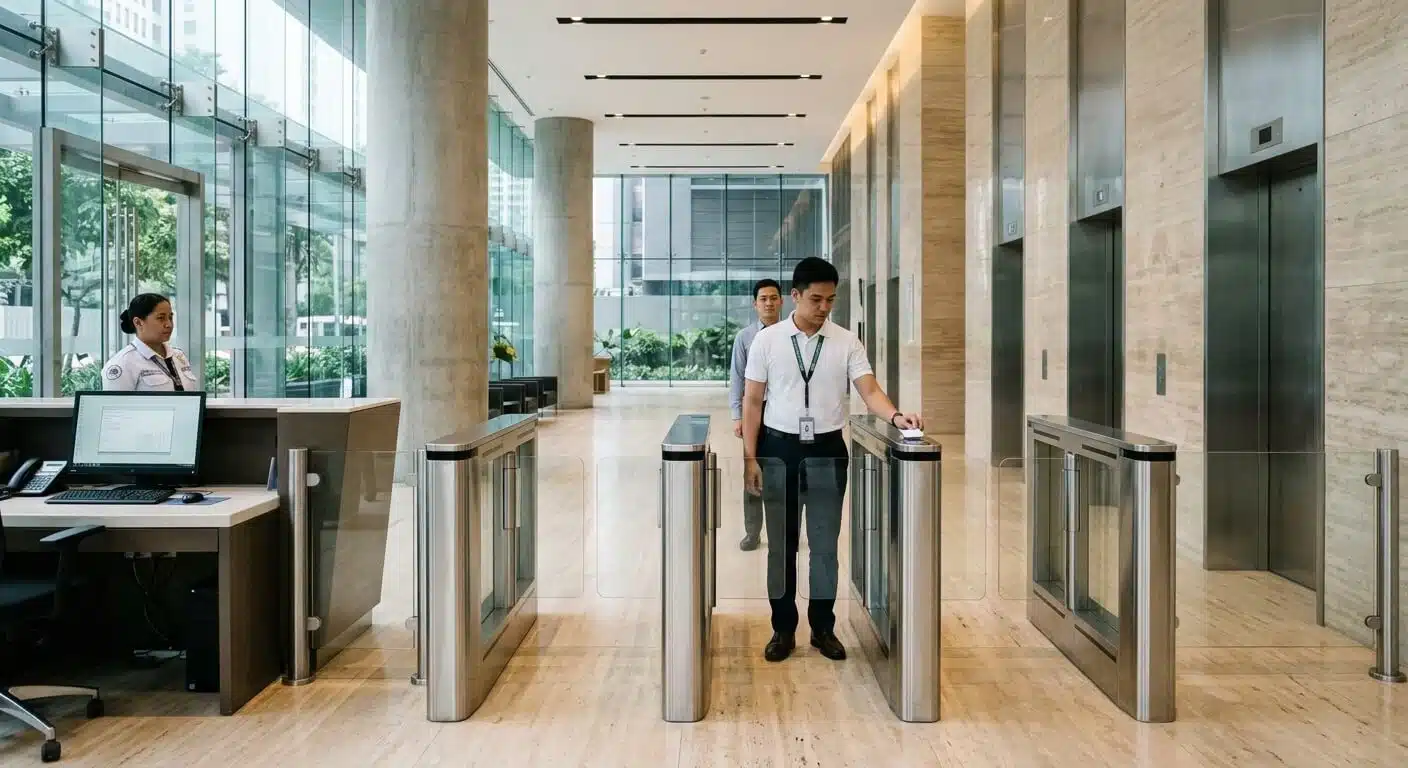
INFINITE SYSTEMS INSIGHTS:
Turnstile Tailgating Prevention: Sensors, Access Control and Secure Lobby Design
Turnstiles help regulate the movement of people into offices, commercial buildings and secured facilities. However, controlling the gate alone does not eliminate tailgating. Effective prevention combines passage-detection sensors, credential verification, physical lane design, CCTV monitoring and clear security procedures to identify and respond to unauthorized entry attempts.
PLANNING PRINCIPLE
Secure the complete passage, not just the turnstile. Tailgating prevention requires coordination between the access-control system, gate sensors, surrounding barriers, adjacent doors and security personnel. A properly configured gate can detect suspicious passage behavior, but the overall lobby design must also prevent people from bypassing the controlled lane.
01 / UNDERSTANDING THE SECURITY RISK
What Is Tailgating at a Turnstile?
Tailgating occurs when an additional person attempts to enter a controlled area using another person’s valid authorization. Instead of presenting an individual credential, the unauthorized person follows closely behind an authorized user through the same passage.
This can happen deliberately or accidentally, particularly in busy entrances where people are rushing, carrying items or entering in groups. Without appropriate detection and security procedures, the system may register a valid credential while allowing more than one person to pass.
Common situations that should be considered during system design include:
- Two people attempting to pass through one authorized opening.
- A person following closely behind an authorized user.
- Reverse movement through a controlled lane.
- A person attempting to enter before the gate has completed its previous passage cycle.
- Unauthorized entry through an adjacent door or an open area beside the turnstile.
The objective is to identify abnormal passage behavior while allowing legitimate users to move through the entrance efficiently.
02 / SENSOR-BASED DETECTION
Use Sensor-Based Passage Detection
Modern speed gates and selected optical turnstiles use multiple sensors along the passage to monitor movement. These sensors help the controller determine whether a person has entered, moved through or exited the lane in accordance with the expected passage sequence.
Depending on the model, sensor configuration and controller logic, the system may identify abnormal conditions such as multiple-person passage, unauthorized movement or reverse entry.
Important sensor and configuration considerations
Sensor Coverage
Confirm that the detection zones cover the intended passage area and support the required direction of travel.
Passage Logic
Verify how the controller handles authorization, entry, passage completion, reverse movement and abnormal sensor activity.
Lane Configuration
Match the gate and sensor arrangement to the required lane width, operating mode and expected user behavior.
Sensor-based detection should be evaluated using the manufacturer’s supported specifications. Not all turnstiles offer the same detection capabilities, and performance may vary with passage geometry, user behavior and installation conditions.
Technical note: A standard tripod turnstile, a full-height turnstile and an optical speed gate have different mechanical and detection arrangements. Do not assume that all models provide the same tailgating detection or alarm functions.
03 / CREDENTIAL VERIFICATION
Coordinate Credential Authorization Before Passage
The access-control reader should be positioned where users can present an approved credential before entering the controlled lane. Depending on the selected system, credentials may include RFID cards, mobile credentials, PINs, biometric verification or other supported identification methods.
The turnstile controller and access-control platform should coordinate the authorization signal with the gate’s operating sequence. One valid authorization should permit only the intended passage, subject to the gate’s supported operating logic.
Access-control design considerations
- Position the reader before the controlled passage, with clear visibility and convenient reach.
- Configure access permissions according to the organization’s security policy.
- Verify the communication and control interface between the access-control system and turnstile.
- Define how repeated credential presentation is handled.
- Confirm how denied access, timeout and abnormal passage events are reported.
- Test both normal authorization and unauthorized entry scenarios.
Credential verification and passage detection serve different purposes. A valid credential confirms that a user has permission to enter, while passage sensors help determine whether the physical movement through the gate follows the expected sequence.
04 / LOBBY AND PHYSICAL LAYOUT
Design the Lobby Around the Turnstile Line
A properly configured turnstile can still be bypassed if the surrounding lobby has open gaps, uncontrolled side corridors or adjacent doors that allow people to enter without authorization.
The physical layout should guide visitors and employees through the intended access-control point. Coordinate the turnstile arrangement with reception counters, walls, partitions, doors and other access routes.
Side Gaps
Check the spaces between the gate and adjacent walls, counters or partitions to prevent unauthorized bypass.
Reception Area
Position reception and visitor-management functions so that visitors are directed to the correct authorization point.
Adjacent Doors
Review nearby entrances, emergency exits and service doors to ensure their operation does not create uncontrolled access routes.
Physical barriers should be coordinated with the overall building layout and applicable fire and life-safety requirements. Emergency egress must remain available in accordance with the approved building design and relevant regulations.
05 / ACCESSIBILITY AND VISITOR MOVEMENT
Provide an Accessible Lane Without Creating a Security Bypass
Some facilities require a wider passage for wheelchair users, visitors with mobility needs, deliveries or other authorized movement. This route should be included in the security design rather than treated as an uncontrolled opening beside the turnstile line.
Where required, provide an appropriately sized accessible passage with suitable access-control arrangements and monitoring. Depending on the project requirements, this may use a wider speed gate, a controlled swing gate or another approved accessible entrance arrangement.
Consider the following:
- Provide adequate clear passage width for the intended users.
- Coordinate the reader location and authorization method with the accessible route.
- Define whether the lane is monitored, supervised or operated by security personnel.
- Confirm that the selected gate supports the required safety and emergency-release functions.
- Maintain compliant emergency access and egress arrangements.
The objective is to provide an inclusive entrance while maintaining consistent access-control and security procedures across the facility.
06 / ALARM AND SECURITY RESPONSE
Configure Alarms and Define the Security Response
Tailgating detection is useful only when the event produces an appropriate response. Depending on the turnstile and access-control platform, abnormal passage activity may generate a local audible or visual indication, a controller event, a security workstation notification or an integrated CCTV event.
Before implementation, define which events should be reported and who is responsible for responding.
Examples of security events
- Multiple-person or suspected tailgating detection.
- Unauthorized or reverse-direction movement.
- Forced gate opening or abnormal gate status, where supported.
- Passage timeout or incomplete passage.
- Repeated access-denied attempts.
Security procedures should identify how guards or reception personnel verify an event, approach the situation and document incidents. Alarm thresholds and response actions should be configured to balance security with normal user movement.
07 / VIDEO VERIFICATION
Integrate CCTV for Monitoring and Incident Investigation
CCTV can support turnstile security by providing visual information about the entrance, helping operators verify alarms and investigate repeated unauthorized passage attempts.
Camera placement should cover the relevant approach and passage areas while providing useful views of user movement. The selected camera position, lens and mounting height should be based on the lobby layout and required level of identification or observation.
Entrance Overview
Capture the approach area to observe people arriving, forming queues and presenting credentials.
Passage Monitoring
Provide a suitable view of the controlled lane to help review suspicious or abnormal passage events.
Event Review
Where supported, coordinate CCTV recording or operator notifications with relevant access-control events.
Camera integration should follow the site’s privacy, recording, access-permission and data-retention policies. Avoid unnecessary monitoring of areas unrelated to the security objective.
08 / COMMISSIONING AND TESTING
Test Real Passage Scenarios Before Handover
Commissioning should verify that the turnstile, reader, controller, sensors and monitoring functions operate together as intended. Testing should reflect the actual entrance layout and expected user behavior rather than relying only on a basic card-access demonstration.
Recommended test scenarios
- Normal authorized passage: Verify that one valid credential permits the intended user to pass.
- Unauthorized access: Confirm that invalid or unrecognized credentials do not grant passage.
- Closely spaced users: Test the selected gate’s supported detection behavior when people move close together.
- Reverse movement: Verify how the system handles movement against the authorized direction.
- Hesitation and incomplete passage: Check the response when a user enters but does not complete the passage.
- Items and luggage: Evaluate representative user behavior involving bags or carried items, within the manufacturer’s recommended test procedure.
- Alarm reporting: Confirm that relevant events are displayed or reported through the configured monitoring platform.
- Emergency operation: Verify safety functions, emergency release and approved egress behavior.
Use manufacturer-supported settings when adjusting sensor sensitivity and passage logic. Do not disable important detection functions simply because alarms appear inconvenient. Investigate the cause of unwanted alarms and adjust the configuration within the equipment’s supported operating limits.
Commissioning record: Document the test scenario, expected behavior, actual result, configuration changes and outstanding issues. Include the approved settings and final operating procedure in the project handover documents.
09 / PROJECT PLANNING
Turnstile Tailgating Prevention Checklist
Use this checklist when evaluating an existing entrance or preparing a new turnstile access-control installation.
Gate and Lane
- Turnstile type and operating mode
- Lane width and passage geometry
- Sensor coverage and detection logic
- Reader position and mounting
- Accessible passage arrangement
Physical Layout
- Reception and visitor flow
- Side gaps and bypass routes
- Adjacent doors and corridors
- Queue and waiting areas
- Emergency access and egress
Security Operations
- Access-control integration
- Alarm and event configuration
- CCTV coverage and verification
- Guard and reception procedures
- Commissioning and test records
For project procurement, the scope should also identify gate quantities, lane dimensions, reader and controller requirements, integration interfaces, CCTV coverage, installation works, testing and commissioning activities, and any site-specific civil or electrical requirements.
10 / RELATED SOLUTIONS
Related Infinite Systems Solutions
Effective entrance security combines controlled pedestrian access, credential management and visual monitoring. Explore related solutions for an integrated facility security design.
Turnstile Systems
Explore controlled pedestrian entrance solutions for offices, commercial buildings and secured facilities.
Access Control Systems
Manage credentials, access permissions and controlled entry points across your facility.
CCTV and Video Surveillance Systems
Support entrance monitoring, security-event verification and incident investigation.
11 / FREQUENTLY ASKED QUESTIONS
Frequently Asked Questions About Turnstile Tailgating Prevention
Can speed gates detect two people using one credential?
Many modern speed gates use multiple sensors and passage logic to identify abnormal or closely spaced movement. However, detection capabilities depend on the selected model, sensor arrangement, lane configuration and operating settings.
Does a wider lane increase tailgating risk?
Lane width affects passage geometry and sensor coverage. A wider passage should use equipment specifically designed and configured for that width and intended application. The overall security arrangement should also consider the types of users and items passing through the lane.
Where should the card reader be installed?
The reader should be positioned where an authorized user can present a credential before entering the controlled lane. Its location should be coordinated with the gate controller, direction of travel and user approach.
Should CCTV cover the turnstiles?
CCTV can support alarm verification and incident investigation when cameras provide suitable views of the entrance and passage areas. Camera selection and positioning should reflect the site’s monitoring objectives and privacy requirements.
Can reception prevent people from bypassing the turnstiles?
Reception layout can help guide visitors through the controlled entrance. However, it should be coordinated with walls, partitions, adjacent doors and other access routes to prevent uncontrolled gaps.
Should tailgating alarms be tested during commissioning?
Yes. Test representative passage scenarios, including closely spaced users and reverse movement where supported. Verify the alarm response, monitoring notifications and security procedures before the system is handed over.
Can a turnstile completely prevent tailgating?
No single gate should be treated as a complete solution against every unauthorized-entry scenario. Effective prevention requires suitable equipment, correct configuration, coordinated physical barriers, monitoring and trained security personnel.
SECURE YOUR LOBBY
Planning a Turnstile Access Control System?
Infinite Systems can help assess your entrance layout and integrate turnstile gates, access-control readers, CCTV monitoring and security workflows for commercial facilities in the Philippines.