
INFINITE SYSTEMS INSIGHTS:
Turnstile Preventive Maintenance in the Philippines: Inspection Checklist and Service Schedule
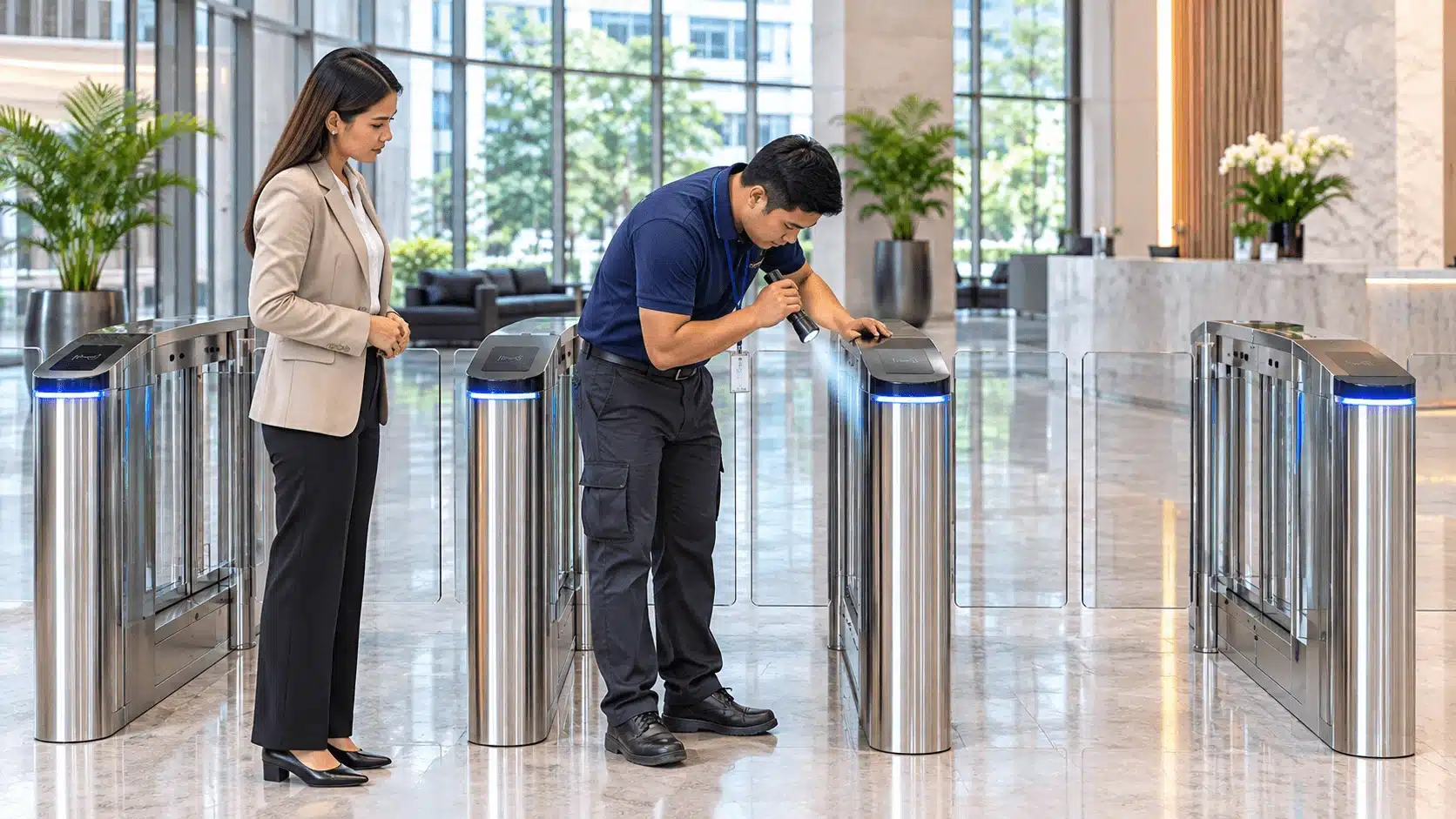
Turnstile systems operate continuously in many office buildings, condominiums, factories and commercial facilities. Their reliability depends on more than the gate mechanism itself. Access readers, sensors, controllers, power supplies, network connections and emergency interfaces must also work together correctly. A structured turnstile preventive maintenance program helps identify developing faults, reduce unexpected downtime and maintain controlled pedestrian access.
This guide outlines practical inspection activities, recommended maintenance intervals, functional testing procedures and documentation practices for facility managers and maintenance teams responsible for speed gates, flap barriers and tripod turnstiles.
MAINTENANCE PRINCIPLE
Inspect the complete access-control lane, not only the moving gate. A turnstile can experience operational problems because of mechanical wear, sensor obstruction, reader configuration, controller communication or unstable power. Daily visual checks can be assigned to trained site personnel, while internal adjustments, electrical inspections and integrated safety testing should be handled by qualified and authorized technicians.
01 / MAINTENANCE OVERVIEW
Why preventive maintenance matters for turnstile systems
Turnstiles combine mechanical movement, electronic access decisions and pedestrian safety functions. A problem in one component can affect the operation of the entire lane. For example, a misaligned sensor may cause repeated passage errors, while a reader or controller communication issue may prevent valid credentials from being recognized.
Without scheduled inspections, minor issues can develop into recurring faults, access delays or equipment downtime. Preventive maintenance provides an opportunity to identify deterioration, verify system behavior and document repairs before a more serious operational disruption occurs.
Operational reliability
Identify unusual noise, inconsistent movement, intermittent faults and access delays before they affect normal building operations.
Access-control performance
Check that readers, controllers, credentials and passage logic continue to work according to the approved access policy.
Pedestrian safety
Verify that sensors, obstruction responses and emergency-release functions behave according to the equipment design and approved site procedures.
Maintenance records
Maintain inspection history, fault reports, corrective actions and replaced-part records for future servicing and warranty coordination.
02 / SERVICE INTERVALS
Sample turnstile preventive maintenance schedule
A practical maintenance program divides inspection activities according to their frequency and the personnel qualified to perform them. The following schedule is a planning reference for building facilities. Actual intervals must be adjusted according to the manufacturer’s manual, operating cycles, environmental conditions, warranty requirements and site risk.
DAILY
Operational observation
- Observe normal lane operation.
- Check for unusual noise or movement.
- Look for visible damage or obstructions.
- Report recurring faults and access issues.
Responsible: Security / facilities staff
WEEKLY
Cleaning and visual inspection
- Clean approved exterior surfaces.
- Inspect sensor and reader windows.
- Check cabinet and glass condition.
- Look for visible movement around floor anchors.
Responsible: Facilities staff
MONTHLY
Functional verification
- Test representative credentials.
- Verify valid and invalid access responses.
- Check passage timeout and lane reset.
- Review available event and fault logs.
Responsible: Facilities / qualified technician
QUARTERLY
Technical inspection
- Inspect mechanical and electrical components.
- Check connections and cable protection.
- Review controller and software condition.
- Document defects and corrective work.
Responsible: Qualified service provider
AS SCHEDULED
Emergency interface testing
- Coordinate with building management.
- Verify the approved emergency sequence.
- Check power-loss behavior where applicable.
- Record test results and system restoration.
Responsible: Authorized building team and relevant contractors
Important: These intervals are sample planning intervals, not universal manufacturer requirements. Some equipment may require different inspection frequencies or service procedures depending on its model, usage and operating environment.
03 / DAILY INSPECTION
Daily checks by building security and facilities staff
Daily checks should focus on visible conditions and normal operating behavior. Security personnel do not need to open the equipment cabinet or perform internal repairs. Their role is to identify unusual conditions and report them to the responsible facilities team.
What to observe during normal operation
- Gate movement: Confirm that the panels, arms or barriers move smoothly and return to their expected position.
- Unusual sounds: Listen for scraping, repeated clicking, grinding or impact noise that was not present during normal operation.
- Reader response: Observe whether authorized credentials are being recognized and whether repeated access failures are occurring.
- Visible fault indicators: Check for warning lights, error displays or recurring alarms, where provided by the model.
- Pedestrian approach: Keep the approach and exit areas clear of objects, wet-floor hazards and obstructions.
- Physical condition: Look for damaged glass, loose exterior covers, bent arms, damaged trim or visible cabinet movement.
Report recurring problems with the affected lane, approximate time, observed symptom and any visible error indication. Do not force the gate, bypass safety sensors or attempt internal electrical repairs.
04 / CLEANING AND VISUAL INSPECTION
Weekly cleaning and physical condition checks
Dust, fingerprints and surface contamination can affect the appearance of the entrance and may interfere with optical sensor or reader performance if the relevant windows become obstructed. Cleaning should follow the manufacturer’s instructions and use materials compatible with the equipment finish.
Cabinet and exterior surfaces
- Clean stainless-steel or coated surfaces using approved products.
- Inspect covers, trim and visible fasteners.
- Check for dents, corrosion or physical damage.
Glass panels and barriers
- Clean glass using suitable materials.
- Check for cracks, chips or unusual movement.
- Inspect visible panel alignment and clearance.
Sensors and reader areas
- Keep sensor windows free from visible obstruction.
- Clean reader surfaces according to vendor guidance.
- Check that reader mounts are secure.
Floor and surrounding area
- Look for visible movement around the base.
- Check for loose floor finishes or damaged anchors.
- Keep nearby furniture from creating bypass routes.
Avoid spraying liquid directly into readers, sensor windows, ventilation openings or cabinet gaps. Do not loosen floor anchors or adjust glass panels as part of routine cleaning.
05 / FUNCTIONAL TESTING
Monthly functional testing of turnstile operation
Functional testing checks whether the turnstile responds correctly to access commands and pedestrian movement. Testing should use approved procedures and representative test credentials. The exact sequence depends on the turnstile model, controller and access-control configuration.
Access authorization and passage logic
- Present an authorized test card or credential and verify the expected access response.
- Present an unauthorized or inactive test credential and confirm that access is denied according to the configured policy.
- Test entry and exit directions where both directions are configured for controlled access.
- Check passage timeout and confirm that the lane returns to its normal ready state after the configured period.
- Verify that the controller records the expected access event, where event logging is supported.
Sensor and obstruction response
Check the sensor functions using the manufacturer’s approved test method. Verify that the gate responds appropriately to detected passage, obstruction or abnormal movement conditions. Never use a person as a test obstruction or deliberately place a body part in the path of a moving barrier. Any test requiring access to the mechanism or controlled movement should be performed by qualified personnel.
Accessible lane verification
If the installation includes a wider accessible lane, test it separately. Confirm that its reader, access authorization, opening behavior and passage clearance remain usable according to the approved layout and operating procedure. Do not assume that the accessible lane shares exactly the same settings or mechanical behavior as standard lanes.
Testing reminder: A successful credential test does not confirm that the mechanical safety functions are operating correctly. Access authorization, passage detection and obstruction response should be treated as separate test items.
06 / TECHNICAL INSPECTION
Quarterly technical inspection by qualified personnel
Technical inspections should go beyond exterior cleaning and basic operation. A qualified technician should evaluate the condition of serviceable components, electrical connections, controller operation and mechanical movement using the procedures specified for the installed model.
Mechanical components
- Inspect panel or arm alignment.
- Check movement for abnormal resistance or noise.
- Inspect manufacturer-specified serviceable components.
- Check for visible wear or loose fittings.
Electrical components
- Inspect power connections and cable protection.
- Check for signs of overheating or damage.
- Verify the condition of accessible power components.
- Inspect grounding and protective arrangements where applicable.
Controller and sensors
- Review controller status and fault indicators.
- Check sensor mounting and alignment.
- Inspect relevant signal and communication connections.
- Verify configured operating behavior.
Software and configuration
- Review firmware and software versions.
- Check configuration and event records.
- Confirm approved administrator access.
- Back up configurations where supported.
Lubrication, belt tension, motor adjustment and replacement of mechanical parts must follow the specific equipment service manual. These procedures are not interchangeable across all speed gates, flap barriers and tripod turnstiles.
Software or firmware updates should be reviewed before implementation. Confirm compatibility, obtain approval, preserve configuration backups and schedule the change to minimize operational disruption. Where a rollback procedure is available, verify that it is understood before proceeding.
07 / LIFE-SAFETY INTERFACES
Emergency release and fire-alarm interface checks
Turnstiles may be connected to a fire-alarm system, emergency-release switch, building management system or other site safety interfaces. These connections must be checked as part of a coordinated maintenance program when they are included in the approved system design.
Before testing, coordinate with building management and the relevant fire-alarm or life-safety contractor. Review the approved cause-and-effect sequence, identify the affected lanes and establish a safe test window. Confirm the intended response to an emergency signal and power interruption based on the installed equipment and approved design.
What should be verified?
- The emergency input or release interface is correctly identified.
- The turnstile performs the approved response when the test signal is activated.
- Power-loss behavior matches the equipment configuration and site design.
- Any connected alarm or monitoring indication is recorded where applicable.
- The system returns to normal operation only after the approved reset and restoration procedure.
- Test results, personnel involved and any outstanding defects are documented.
Life-safety consideration: Do not assume that every turnstile must respond identically during a fire alarm or power failure. The required behavior depends on the approved life-safety design, equipment capabilities and site-specific configuration. Never disable an emergency function or conduct an uncoordinated test that could compromise building safety.
08 / ACCESS READER MAINTENANCE
RFID, QR code and biometric reader maintenance
The access reader is the user’s primary interaction point with a controlled entrance. Reader problems may appear to be turnstile faults even when the mechanical gate is operating normally. Maintenance should therefore include the reader, its mounting, connection and communication with the access-control controller.
RFID card readers
Clean the reader surface, inspect mounting and cable strain relief, and test representative authorized and unauthorized cards. Repeated failures may involve card compatibility, credential configuration or reader communication.
QR code readers
Keep the scanner window clean and inspect for scratches or damage. Verify that valid codes can be read at the intended scanning distance and orientation under normal lighting conditions.
Biometric terminals
Follow the manufacturer’s cleaning guidance for fingerprint or facial recognition terminals. Check mounting, display and response, while observing the site’s applicable biometric data and privacy procedures.
If authentication failures occur repeatedly, check the complete transaction path before replacing the reader. Possible causes include credential enrollment, access permissions, controller configuration, communication delays or a network issue.
09 / POWER AND NETWORK
Network, power supply and software checks
A turnstile installation may rely on local controllers, access-control software, network communication and backup power. These supporting systems should be reviewed because a fault outside the gate mechanism can still interrupt access operations.
Power supply and backup power
- Inspect the condition of accessible power supplies and connections.
- Check for visible signs of overheating, loose connections or damaged cable insulation.
- Review UPS status and battery condition where backup power is installed.
- Verify the intended local operating behavior during a power interruption, using the approved test procedure.
Network and controller communication
- Review controller online status and communication alerts.
- Check relevant network connections and cable condition.
- Verify time synchronization where event timestamps are used for reporting.
- Review event storage and confirm that logs are being retained as configured.
- Confirm that local access behavior during network interruption matches the approved design.
Software administration and configuration backups
Review administrator accounts and disable former personnel accounts according to the site’s access-management policy. Maintain configuration backups in an appropriately restricted location. Do not include passwords, sensitive credentials or unnecessary personal information in maintenance reports.
Where turnstiles are connected to a broader access-control platform, changes to schedules, user permissions or controller settings should be documented and approved. This helps prevent maintenance work from unintentionally changing normal entrance operations.
10 / DEFECT MANAGEMENT
How to document defects and prioritize turnstile repairs
A preventive maintenance report should make it easy to identify the affected lane, understand the problem and determine what corrective action is needed. Avoid general entries such as “gate not working.” Record the actual symptom and the test performed so the service team can investigate more efficiently.
RECOMMENDED MAINTENANCE REPORT DETAILS
- Site name and exact turnstile location or lane number
- Equipment brand, model and serial number, where available
- Inspection date and name of the person conducting the inspection
- Observed symptom, fault code or abnormal condition
- Test performed and actual result
- Corrective action and parts replaced, if applicable
- Outstanding recommendation and responsible person
- Next inspection or follow-up service date
Prioritize defects based on operational and safety impact
Safety-critical issue
Examples include unsafe barrier movement, failed obstruction response or an emergency-release function that does not behave as approved. Follow the site’s isolation and escalation procedures immediately.
Operational issue
Examples include repeated reader failures, intermittent controller communication or a lane that cannot reliably authorize passage. Arrange corrective service and provide an approved alternative access route if required.
Routine maintenance issue
Examples include cosmetic damage, surface deterioration or minor conditions that do not immediately affect safe operation. Record and schedule the necessary corrective work.
If a lane is unsafe, isolate it using the approved site procedure and arrange an alternative accessible route. Do not keep a defective lane in service simply to avoid disruption.
11 / SITE-SPECIFIC PLANNING
How to set a practical turnstile maintenance program
Not every entrance requires the same maintenance frequency. A busy office lobby with several lanes may experience more operating cycles than a small facility entrance. A dusty industrial environment may also require more frequent cleaning and inspection than a controlled indoor lobby.
Before finalizing a maintenance schedule, consider the following site conditions:
- Traffic volume: Estimate daily pedestrian activity and peak-hour usage.
- Equipment type: Identify whether the site uses speed gates, flap barriers, tripod turnstiles or a combination.
- Environmental exposure: Consider dust, moisture, temperature, cleaning chemicals and possible physical impact.
- Operating hours: Identify whether the entrance operates continuously or only during business hours.
- System integration: List connected readers, access-control controllers, fire-alarm interfaces and network components.
- Equipment support: Confirm the availability of manufacturer documentation, replacement parts and qualified service personnel.
- Site risk: Consider the consequences of lane downtime, unauthorized passage or failure of a safety function.
The final program should identify the inspection frequency, responsible personnel, reporting process, escalation contacts and service requirements. Review the schedule whenever equipment, traffic conditions or building operations change.
12 / MAINTENANCE CHECKLIST
Copy-ready turnstile preventive maintenance checklist
Use this checklist as a starting point for recording routine inspection results. Add model-specific checks from the manufacturer’s service documentation and the site’s approved maintenance procedure.
VISUAL AND PHYSICAL CONDITION
- Gate lane identified and approach area free from visible obstruction
- Cabinet, glass panels and barriers visually inspected
- No unusual movement, scraping or impact noise observed
- Visible fasteners, floor anchors and surrounding finishes checked
- Reader and sensor surfaces clean and unobstructed
FUNCTIONAL AND ACCESS-CONTROL TESTS
- Authorized test credential accepted
- Unauthorized test credential rejected as configured
- Configured entry and exit directions verified
- Passage timeout and lane reset checked
- Sensor and obstruction response tested using an approved method
- Accessible lane operation checked where installed
TECHNICAL AND SYSTEM CHECKS
- Mechanical and electrical condition reviewed by qualified personnel
- Power supply and UPS status checked where installed
- Controller, network and communication status reviewed
- Event logs and available fault records reviewed
- Configuration backup and administrator access reviewed where applicable
- Emergency interface tested according to the approved schedule
DOCUMENTATION AND FOLLOW-UP
- Defects and corrective actions recorded
- Safety or operational issues escalated
- Parts replaced and recommendations documented
- Inspection completed by the assigned personnel
- Next inspection or service date assigned
13 / FREQUENTLY ASKED QUESTIONS
Frequently asked questions about turnstile maintenance
How often should turnstiles be serviced?
Follow the manufacturer’s maintenance requirements and adjust the schedule according to traffic volume, operating environment and site risk. Daily visual checks and periodic qualified technical inspections provide a practical starting point, but the final service interval should be equipment- and site-specific.
Can security guards repair a malfunctioning speed gate?
Security guards can observe normal operation, identify visible problems and report faults. They may isolate a lane only according to approved site procedures. Internal electrical, mechanical and controller repairs should be handled by trained and authorized personnel.
Does preventive maintenance include RFID reader testing?
Yes, when RFID readers form part of the maintained turnstile installation. Testing should cover representative credentials, reader condition, controller events and communication. The exact checks depend on the reader and access-control platform.
Should fire-alarm integration be tested during maintenance?
Yes, where the turnstile is connected to a fire-alarm or emergency-release interface. Testing should be coordinated with building management and the relevant contractor, follow the approved life-safety sequence and include confirmation that normal operation is properly restored.
Do all turnstile models require the same maintenance procedure?
No. Speed gates, flap barriers and tripod turnstiles have different mechanical designs and may use different sensors, motors, controllers and serviceable components. Always refer to the installed model’s maintenance documentation rather than applying a generic adjustment or lubrication procedure.
What should be included in a turnstile maintenance report?
Include the site and lane identification, equipment model, inspection date, observed condition, test results, fault details, corrective actions, replaced parts, technician information and recommended follow-up date.
14 / RELATED SOLUTIONS
Related security and maintenance solutions
Turnstile performance is closely connected to the access-control platform and other building systems. These related solutions may be relevant when planning an installation, system upgrade or maintenance program.
Access Control SystemsReview credential management, access permissions and electronic entry-control solutions.
Preventive Maintenance ServicesLearn about planned inspection and maintenance support for installed building systems.
CCTV and Video Surveillance SystemsExplore video surveillance solutions that can complement entrance monitoring and facility security.
Need a turnstile preventive maintenance program?
Infinite Systems Technology Corporation can help facility managers assess installed turnstile systems, review access-control operation and plan maintenance requirements for commercial buildings and other facilities in the Philippines. Share your equipment details, number of lanes and service requirements so the appropriate maintenance scope can be discussed.