
INFINITE SYSTEMS INSIGHTS:
Turnstile and Elevator Destination Control Integration in the Philippines: System Design and Implementation Guide
Turnstile and elevator destination control integration connects building entrance authorization with elevator assignment. Instead of treating lobby access and elevator access as separate processes, an integrated system can coordinate credential verification, permitted floor access and passenger direction within one controlled entry workflow.
For Philippine office towers, commercial buildings and multi-tenant developments, successful implementation requires coordination between the access-control platform, turnstile equipment and the elevator manufacturer’s destination control system (DCS). The available integration method depends on the exact elevator model, controller generation, software version and approved third-party interface.
THE KEY INTEGRATION REQUIREMENT
Verify the complete equipment combination before committing to a one-tap passenger journey. Confirm the elevator model, DCS software, access-control platform, controller interface and OEM-approved integration method. A signal that releases a turnstile does not automatically provide elevator destination requests or car assignment feedback.
01 / SYSTEM OVERVIEW
How Turnstile and Elevator Destination Control Integration Works
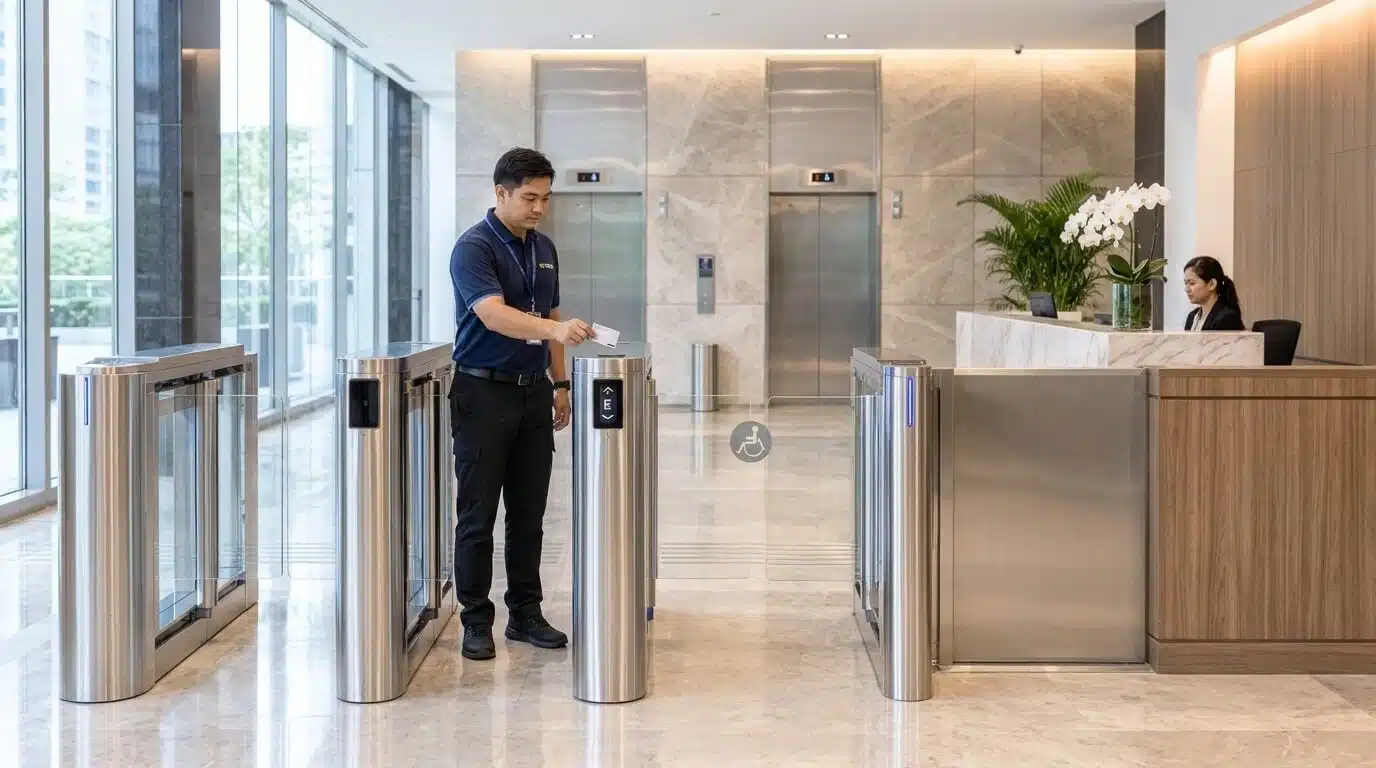
An integrated passenger journey begins when an employee or visitor presents an approved credential at the building entrance. The access-control platform verifies the user’s identity and access permissions. If the credential is authorized, the system can coordinate the turnstile release and, where supported, communicate the passenger’s permitted destination or destination request to the elevator DCS.
The DCS processes the destination information according to its operating logic and assigns an elevator car. A destination terminal or display then provides the passenger with the assigned car or other required instructions.
The actual sequence varies by manufacturer and integration design. Some configurations require users to select their floor at a separate destination terminal after passing through the turnstile. Others may support destination assignment as part of a coordinated credential-based workflow.
Typical integrated passenger journey
STEP 01
Credential Presentation
User presents an RFID card or another supported credential at the entrance reader.
STEP 02
Access Verification
The access-control platform validates the user and permitted access rights.
STEP 03
Turnstile Release
The gate receives an authorized opening command, subject to the configured access rules.
STEP 04
Destination Processing
Where supported, the integration sends the destination request or relevant authorization data to the DCS.
STEP 05
Elevator Assignment
The DCS processes the request and provides the assigned car or destination instructions.
For this workflow to operate correctly, the integration must coordinate authorization, destination information, elevator assignment and passenger feedback. If any of these functions are handled by a separate terminal or platform, the complete passenger journey should be documented before implementation.
02 / FUNCTIONAL DIFFERENCES
Destination Control vs Conventional Elevator Access Control
Conventional elevator access control and destination control are not the same function. Both can help regulate which floors a passenger is permitted to access, but they handle passenger authorization and elevator selection differently.
Conventional Elevator Access Control
The system restricts access to selected elevator functions or floors based on the user’s authorization.
- May enable or restrict floor buttons.
- Can use card readers inside or near the elevator.
- May work with floor relay or controller interfaces, depending on the elevator design.
- Does not necessarily assign an elevator car before boarding.
Destination Control System
The system processes a passenger’s destination request and assigns an elevator car before the passenger boards.
- Receives a destination request through a supported input method.
- Groups passengers according to destination and system logic.
- Assigns an elevator car.
- Provides the passenger with the assigned car or directions.
A simple relay that releases a turnstile is not equivalent to a DCS integration. The project must establish how the passenger’s identity or destination request reaches the elevator system and how the DCS returns the assignment information.
03 / OEM COMPATIBILITY
Verify Elevator Manufacturer and DCS Compatibility
Elevator integration is highly dependent on the manufacturer’s equipment and software configuration. Two buildings using elevators from the same manufacturer may have different controller generations, DCS platforms, interface options and approval requirements.
Before selecting an integration solution, document the following:
- Elevator manufacturer and exact equipment model.
- Elevator controller generation or platform.
- Destination control system model and software version.
- Available third-party integration interfaces.
- Supported communication protocol, API or gateway.
- Required software licenses or OEM integration services.
- Warranty and technical support implications of third-party integration.
For equipment from manufacturers such as KONE, Mitsubishi, Schindler, Otis, Hitachi and Fujitec, confirm the requirements with the relevant OEM or authorized representative. Product families and interface arrangements can differ, so compatibility should never be assumed across an entire brand.
Project recommendation: Request written confirmation of the supported integration method from the elevator OEM or authorized representative before finalizing the access-control design, bill of quantities or project quotation.
Identify the Required Integration Interface
Depending on the selected platform, communication between the access-control system and elevator DCS may use an approved API, software integration service, network gateway or hardware interface.
The interface documentation should establish:
- How user identity or destination information is transmitted.
- Which system validates the user’s floor permissions.
- How destination requests are formatted and processed.
- How elevator assignment results are returned.
- How rejected requests and communication errors are handled.
- Whether the interface supports event logging and status monitoring.
Do not assume that a standard access-control relay output or generic network connection can perform all these functions. The required interface must support the actual data exchange and operating sequence.
04 / ACCESS PERMISSIONS
Configure Employee Access Groups and Permitted Floors
An integrated system needs a clear relationship between a person’s identity, building access rights and permitted elevator destinations. This is particularly important in Philippine office towers with multiple tenants, shared amenities and restricted operational areas.
Define access groups according to actual building requirements. For example:
Employees
Access to assigned office floors and approved shared facilities, based on the employee’s access profile.
Visitors
Time-limited access to an approved destination, subject to registration and host authorization procedures.
Contractors
Restricted access to designated work areas and approved time windows.
Building Personnel
Access to operational, maintenance and management floors according to assigned responsibilities.
Also determine how the system handles employees assigned to multiple floors, tenant transfers, temporary permissions, shared amenities and revoked credentials.
For multi-tenant buildings, identify which platform owns the master user records and access permissions. If employee information is maintained in one system while visitor registration and elevator permissions are managed elsewhere, define how changes are synchronized and who is responsible for resolving inconsistencies.
05 / EQUIPMENT PLACEMENT
Reader and Elevator Assignment Display Placement
Equipment placement affects how smoothly passengers move from the building entrance to the elevator lobby. Readers and displays should be positioned according to the actual passenger route, manufacturer installation requirements and accessibility considerations.
Turnstile Credential Reader
Position the RFID reader or other credential device on the public approach side of the turnstile. It should be mounted on a fixed cabinet or an approved pedestal, where users can present credentials without obstructing the lane or interfering with the moving gate panels.
Elevator Destination Terminal
If the workflow requires a separate destination selection, position the terminal where passengers can comfortably make their selection before reaching the elevator bank. Its location should support the intended passenger sequence without creating queues in front of the turnstiles.
Elevator Assignment Display
The assigned car or destination instructions should be visible before passengers need to choose their direction. Avoid mounting displays on moving glass panels or locations where the information is obscured by people waiting in the lobby.
Coordinate the display locations, cable routes and mounting details with the architectural layout. The goal is to provide a clear route from access verification to the assigned elevator without obstructing the next passenger.
06 / VISITOR AND ACCESSIBLE JOURNEYS
Plan Visitor Access and Accessible Passenger Workflows
Employees and registered visitors may follow different entrance procedures. The integrated design should account for these differences so that security requirements do not create unnecessary delays or confusion in the lobby.
Visitor Registration and QR Access
A visitor management platform may issue a QR credential or temporary access pass after registration and host approval. Where supported, the integration can use the visitor’s approved destination or permission profile to coordinate turnstile authorization and elevator access.
Define the following visitor procedures:
- Host approval and visitor registration.
- Credential validity period and permitted destination.
- Handling of expired, cancelled or revoked visitor passes.
- Reception assistance for visitors without a compatible credential.
- Visitor escort procedures where required.
Accessible Passenger Movement
Provide an appropriate accessible entrance lane and a practical way for passengers to receive elevator assignment information. Consider wheelchair users, people using mobility aids, passengers requiring assistance and visitors who may need additional time to complete credential verification.
The accessible route should remain clear from the entrance barrier to the elevator lobby. Coordinate gate dimensions, reader placement, terminal height, display visibility and assistance procedures with the approved building design.
07 / INTEGRATION AND CYBERSECURITY
Integration Architecture, Network and Cybersecurity Considerations
Turnstile and elevator destination control integration may involve multiple systems communicating across different equipment platforms. The integration design should clearly identify which system is responsible for identity verification, floor permissions, destination requests, elevator assignment and event records.
Depending on the approved architecture, the integration may include:
- Turnstile readers and gate controllers.
- Access-control server and management software.
- Integration gateway or middleware, where required.
- Elevator manufacturer’s DCS interface.
- Destination terminals and assignment displays.
- Network switches, structured cabling and power provisions.
Define Data Exchange and System Responsibilities
Document the supported interface, including required data fields, authentication method, communication direction, time synchronization, error handling and response acknowledgements. The documentation should explain what happens when a request is accepted, rejected, delayed or not received.
Protect System Access and User Information
Apply appropriate network and administrative controls. These may include:
- Restricting integration traffic to approved network paths.
- Using supported authentication and encryption methods.
- Limiting administrator privileges according to responsibilities.
- Transmitting only the personal information required for the integration.
- Maintaining secure configuration backups and change records.
- Defining access to event logs and system audit information.
Coordinate responsibilities between the access-control integrator, elevator contractor, IT team and building management. Each party should understand which system they configure, maintain and support.
For projects that require additional network planning, see our Structured Cabling Systems solution.
08 / FAILURE AND EMERGENCY PLANNING
Network Failure, System Downtime and Emergency Behavior
An integrated passenger workflow depends on several systems working together. A failure in one component may affect elevator assignment even when the turnstile or access-control platform remains operational.
For example, the turnstile may still authorize a credential while the integration gateway or DCS network is unavailable. In that situation, automatic destination assignment may not work as intended.
Define the expected response for the following conditions:
- Access-control server unavailable.
- Integration gateway or API communication failure.
- Elevator DCS network interruption.
- Destination terminal or assignment display failure.
- Power interruption affecting access-control equipment.
- Expired or invalid credentials.
- Loss of synchronization between user permissions and destination access.
Establish an Approved Manual Fallback
Provide an alternative procedure for passengers when automatic destination assignment is unavailable. Depending on the building’s operating policy, this may involve assistance from reception or security personnel, an approved manual destination-selection process or another arrangement agreed with the elevator contractor.
The fallback must not bypass required elevator safety functions or grant unauthorized floor access. Document who can activate the procedure, how it is communicated to passengers and how normal operation is restored.
Fire Alarm and Emergency Operation
During a fire event, elevator emergency operation and turnstile egress must follow the building’s approved fire and life-safety design. Normal destination assignment, access permissions and passenger routing rules must not override the required emergency sequence.
Coordinate the design with the elevator OEM, fire-alarm contractor and relevant building representatives. Emergency modes should be tested by authorized personnel as part of the coordinated commissioning process.
09 / COMMISSIONING
Turnstile and Elevator Integration Commissioning Checklist
Commissioning should verify the complete passenger journey, not just whether the turnstile opens or whether the elevator display responds. Test the equipment under normal, restricted, visitor and failure conditions before accepting the integrated system.
OEM and interface verification
- OEM confirms the approved interface and exact software versions.
- Required licenses, gateway components and interface settings are documented.
- Communication between the access platform and DCS is verified.
Access authorization and destination permissions
- Authorized users receive the correct floor permissions.
- Restricted users cannot access unauthorized destinations.
- Multi-floor users are processed according to the approved rules.
- Expired and revoked credentials are handled correctly.
Passenger journey and elevator assignment
- Gate release and destination requests operate in the intended sequence.
- Elevator assignment appears at the correct display or terminal.
- Passengers can identify the assigned elevator clearly.
- Visitor and accessible passenger workflows are tested.
Failure and emergency testing
- Network interruptions and system recovery are documented.
- Manual fallback procedures are reviewed.
- Emergency modes are tested with authorized contractors.
Documentation and handover
- As-built diagrams and integration records are provided.
- System configuration and support responsibilities are documented.
- Building personnel receive operational training.
- Maintenance and escalation procedures are handed over.
Acceptance criteria should be agreed upon before installation. Record test results, outstanding issues, corrective actions and the party responsible for each item.
10 / PROJECT SCOPE AND COST
Project Scope and Bill of Quantities (BOQ)
A complete quotation for turnstile and elevator destination control integration should cover the equipment, software, interface requirements, installation work and coordination between contractors. The scope must identify which components are supplied by the access-control integrator and which are provided by the elevator OEM or authorized representative.
Depending on the approved system design, the BOQ may include:
- Speed gates, turnstiles or other entrance barrier equipment.
- RFID readers and other supported credential devices.
- Access-control controllers and management software.
- Integration gateway, API service or OEM-approved interface.
- Required DCS software licenses or integration services.
- Destination terminals and elevator assignment displays, where required.
- Network switches, structured cabling and communication provisions.
- Power supplies and associated electrical works.
- Equipment mounting, installation and configuration.
- Joint integration testing and commissioning.
- Documentation, training and system handover.
- Warranty, maintenance and technical support.
Important quotation consideration: Identify OEM approval costs, third-party interface licensing, software customization and cross-vendor troubleshooting responsibilities separately. These requirements can affect the project budget and implementation schedule.
Before submitting a final quotation, confirm the elevator interface requirements and the division of work between the building’s existing elevator contractor and the proposed access-control integrator. This reduces the risk of omitted components, unclear responsibilities and unexpected integration costs.
11 / FREQUENTLY ASKED QUESTIONS
Frequently Asked Questions About Turnstile and Elevator Integration
Can one RFID tap open the turnstile and assign an elevator?
Potentially, if the exact access-control platform and elevator DCS support an approved integration that allows credential authorization and destination processing in the required sequence. The complete workflow should be demonstrated and tested before project acceptance.
Can visitors be assigned only to their host’s floor?
Yes, where the visitor management platform and elevator DCS interface support destination permissions and time-limited access. The building should define host approval, visitor validity periods and procedures for expired or cancelled passes.
Is destination control the same as enabling elevator floor buttons?
No. Conventional elevator access control may restrict which floor buttons a passenger can use. Destination control processes a destination request and assigns an elevator car before boarding. The two functions may be integrated, but they are not interchangeable.
Can an existing elevator system be connected to a new turnstile installation?
Possibly, depending on the elevator controller, DCS software, available interface and OEM approval. A technical assessment should be completed before confirming compatibility, cost or implementation scope.
What happens if the access-control system or DCS network goes offline?
The result depends on the system architecture and failure configuration. Turnstile access may remain operational while automatic elevator assignment becomes unavailable. The project should define an approved manual fallback and recovery procedure.
What happens during a fire alarm?
The building’s approved elevator emergency sequence and turnstile egress arrangement take priority over normal access authorization and destination assignments. The emergency behavior must be coordinated and tested with the responsible contractors.
Who should handle the elevator integration?
The access-control integrator and elevator OEM or authorized representative should coordinate the work. The integrator handles the agreed access-control and integration scope, while the elevator contractor confirms and implements the supported DCS interface and elevator-side requirements.
12 / RELATED SOLUTIONS
Explore Related Security and Building Systems
Explore pedestrian entrance-control options for offices, commercial buildings and controlled facilities.
Access Control Systems
Manage user credentials, access permissions and controlled entry across building facilities.
Structured Cabling Systems
Plan the communication infrastructure required for connected building technologies.
Planning a Turnstile and Elevator Integration Project?
Infinite Systems Technology Corporation helps Philippine property teams assess turnstile access control, elevator destination control interfaces and system integration requirements. Share your building layout, existing elevator details and access-control requirements so the project scope can be evaluated before implementation.
Discuss Your Integration RequirementsBuilding Access Control