
INFINITE SYSTEMS INSIGHTS:
Understand structured cabling cost in the Philippines by looking beyond the data-point price. Cable category, route length, fiber backbone, racks, pathways, installation conditions, testing and documentation can all affect the actual project cost.
PLANNING PRINCIPLE
Define the operating requirement, site conditions and acceptance criteria before comparing equipment prices.
A structured cabling quotation should be based on the complete installed system—not only the cable and outlet count. Point quantities, route lengths, cable category, backbone requirements, pathways, racks, testing and documentation should be clearly defined before comparing proposals.
01 / DEFINE
Network Requirement
Define user points, equipment connections, bandwidth expectations, PoE requirements and backbone needs.
02 / DESIGN
Cabling Architecture
Coordinate Cat6/Cat6A horizontal cabling, fiber backbone, racks, patching and pathways.
03 / INSTALL
Site Conditions
Account for ceiling access, risers, trays, conduits, core drilling, fire-stopping and retrofit restrictions.
04 / VERIFY
Test & Document
Define copper and fiber testing, labeling, port schedules, test records and as-built documentation.
01 / PROJECT CONTEXT
Why Price per Data Point Can Mislead
A per-point rate can be useful for early budgeting, but only when the assumptions behind the rate are comparable. Two quotations may show similar point prices while having significantly different scopes for cable category, average route length, pathways, rack hardware, patching, testing and documentation.
For a more reliable comparison, separate the project into horizontal cabling, backbone cabling, racks and patching, pathways, installation, testing, documentation and other site-specific work. This makes exclusions easier to identify before procurement.
Point Scope
Outlet quantity, cable category, termination, faceplate, patching and average route assumptions.
Infrastructure Scope
Racks, patch panels, fiber enclosures, cable management, trays, conduits and other pathways.
Verification Scope
Copper and fiber testing, labeling, test reports, port schedules and as-built documentation.
02 / CABLE CATEGORY
Cat6 vs Cat6A: Select Based on the Project Requirement
Cat6 and Cat6A have different performance and installation characteristics. The appropriate selection should follow the network requirement, expected equipment loads, PoE requirements, pathway capacity and project specification rather than automatically selecting the highest category.
CAT6
Common Horizontal Cabling Option
Often considered for standard network outlets and equipment connections where its performance meets the project requirement. The final selection should still account for network design, PoE loading and the specified cabling system.
CAT6A
Higher-Performance Requirement
Can be appropriate where the project requires its higher performance characteristics. Its physical size and installation requirements should be considered when sizing pathways, racks and termination hardware.
03 / FIBER BACKBONE
Fiber Backbone Cost Drivers
Fiber backbone cost depends on more than the fiber cable itself. The BOQ should identify the selected fiber type, strand count, route length, construction, termination method and required supporting hardware.
Longer routes, inter-building connections, outdoor sections and difficult pathways can also increase installation requirements. Existing buildings may require additional protection, access work and coordination before a fiber route can be completed.
04 / RACKS & PATCHING
Racks, Patch Panels and Cable Management
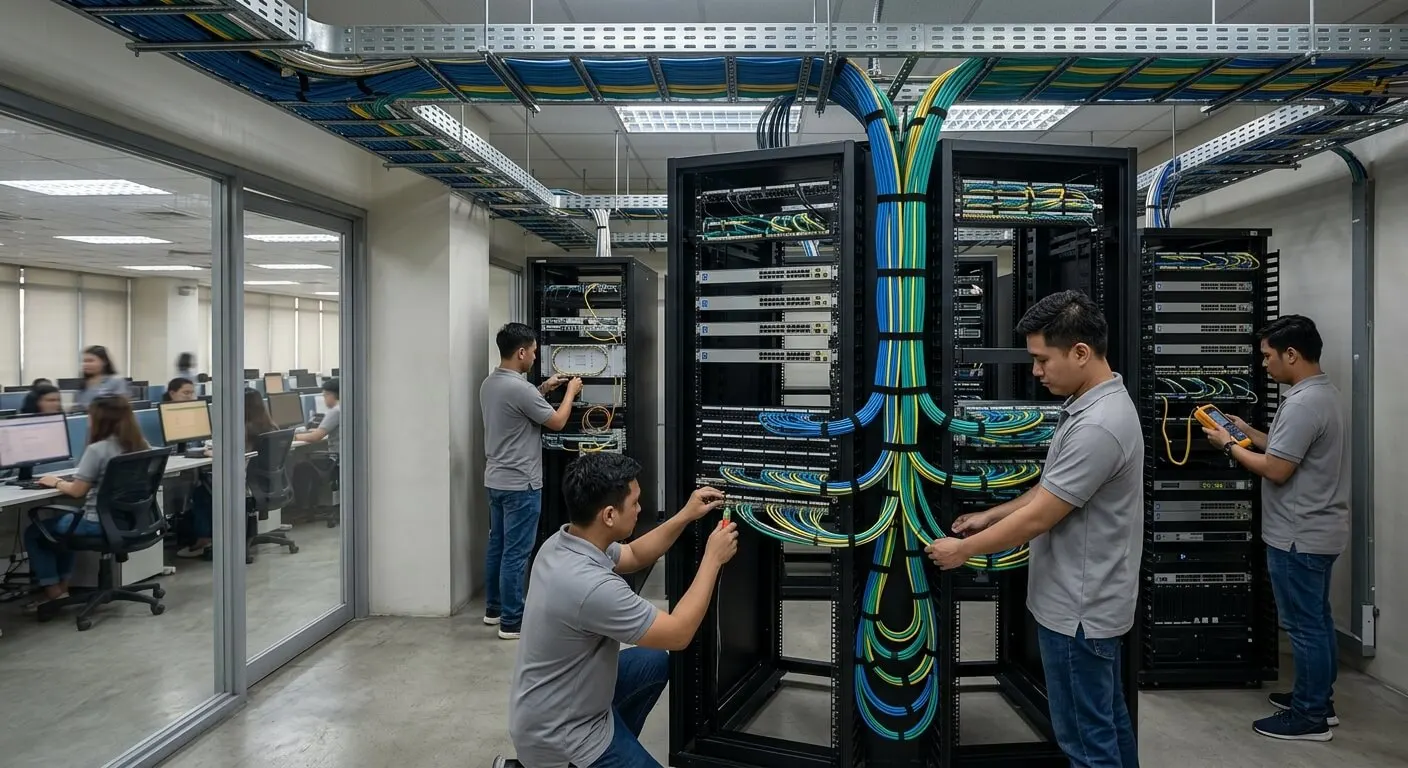
A structured cabling system is more than horizontal cable runs. The telecommunications room or equipment area needs a coordinated rack and patching arrangement that allows cables to be terminated, labeled, managed and maintained.
Racks / Cabinets
Select size and configuration based on equipment, patching and future requirements.
Patch Panels
Coordinate copper and fiber termination with the selected cabling architecture.
Cable Management
Horizontal and vertical management helps maintain organized routing and service access.
Accessories
Include shelves, patch cords, labeling and grounding provisions where specified.
05 / PATHWAYS & SITE CONDITIONS
Pathways Can Change the Installed Cost
Pathway conditions can materially affect labor and installation cost, particularly in existing buildings. Cable tray, conduit, risers, ceiling access, core drilling and fire-stopping should be evaluated during the site survey rather than assumed to be available.
Typical Site Questions
- Are existing cable trays or conduits available?
- Can installers access the ceiling and riser areas during normal working hours?
- Are additional supports or pathways required?
- Will core drilling or wall penetration be required?
- Where are fire-rated barriers or penetrations that require fire-stopping?
- Are there restricted areas or occupied spaces requiring special coordination?
Retrofit Projects Need Additional Allowances
Existing buildings may require cable tracing, removal of abandoned cabling, access through finished areas, temporary protection or after-hours work. These conditions can make a retrofit significantly different from a new-build installation even when the final point count is similar.
06 / TESTING & DOCUMENTATION
Testing Should Be Part of the Structured Cabling Scope
A completed cable installation should be verified against the required performance and acceptance criteria. Testing requirements should be identified in the project specification before installation so the contractor and client have a common basis for acceptance.
Copper Testing
Define the required test method, acceptance limits, point identification and reporting format for installed copper links.
Fiber Testing
Specify the applicable fiber test method, link identification, results and documentation required for acceptance.
Documentation
Include labels, port schedules, test reports and as-built records so the installed system can be maintained after turnover.
07 / BOQ & QUOTATION
What a Structured Cabling BOQ Should Show
A useful quotation should make the scope easy to compare. Instead of providing only one total price or a generic cost per point, the BOQ should identify the major materials, installation requirements and deliverables.
Compare Quotations on the Same Scope
When comparing suppliers, confirm that each quotation uses the same point definition, cable category, route assumptions, backbone requirements, rack and patching scope, pathways, testing and documentation. Exclusions should be visible rather than discovered after award.
08 / PROJECT WORKFLOW
A Practical Structured Cabling Cost and Planning Workflow
01 Survey
Review site conditions and existing infrastructure.
02 Define
Confirm points, network requirements and backbone needs.
03 Design
Coordinate cable, racks, pathways and termination.
04 Quote
Prepare a scope-based BOQ with clear assumptions.
05 Install
Install, terminate and label the cabling system.
06 Test
Verify performance and complete documentation.
09 / PROJECT CHECKLIST
Structured Cabling Cost Checklist for Philippine Projects
- Define the number and type of network outlets
- Confirm Cat6, Cat6A or other required cabling category
- Estimate average and maximum horizontal route lengths
- Identify fiber backbone requirements and route lengths
- Confirm racks, cabinets, patch panels and fiber enclosures
- Check existing trays, conduits, risers and other pathways
- Identify ceiling access, core drilling and penetration requirements
- Include patch cords and cable-management hardware where required
- Define labeling and identification requirements
- Specify copper and fiber testing requirements
- Define required test reports and documentation
- Identify night work, restricted access or occupied-area constraints
- Include lifts, scaffolds or other special access equipment where required
- Identify removal or reuse of existing cabling for retrofit projects
- Document quotation exclusions and assumptions before award
10 / RELATED SOLUTION
Related Infinite Systems Solution
Structured Cabling Systems
Explore structured cabling planning, installation and infrastructure requirements for commercial and building projects.
11 / FREQUENTLY ASKED QUESTIONS
Structured Cabling Cost FAQs
How is structured cabling usually priced?
It is often estimated using installed points plus backbone, racks, pathways and other project components. The assumptions behind the point rate should be clearly defined before comparing quotations.
Is Cat6A always better than Cat6?
Not automatically. The selection should follow the network performance requirement, PoE considerations, pathway capacity, installation conditions and project specification.
When is fiber required?
Fiber is commonly used for backbone, longer-distance, inter-building or higher-capacity links where the project design calls for it. The required fiber type and construction should be defined by the application.
Should testing be included in the quotation?
Yes. Testing should be part of the project scope, with the required method, acceptance criteria and reporting deliverables defined before installation.
Can old structured cabling be reused?
Sometimes. Existing cabling should be assessed for condition, category, labeling, route condition and required performance before reuse is accepted.
What should a structured cabling quotation show?
At minimum, the quotation should make the point schedule, cable type, backbone, racks, pathways, testing, documentation and exclusions clear enough for the client to compare equivalent scopes.
PLAN YOUR PROJECT
Need a Site-Specific Structured Cabling Scope and BOQ?
Infinite Systems can assess your facility, define the structured cabling requirements and prepare a practical implementation or maintenance scope based on the project conditions.