
INFINITE SYSTEMS INSIGHTS
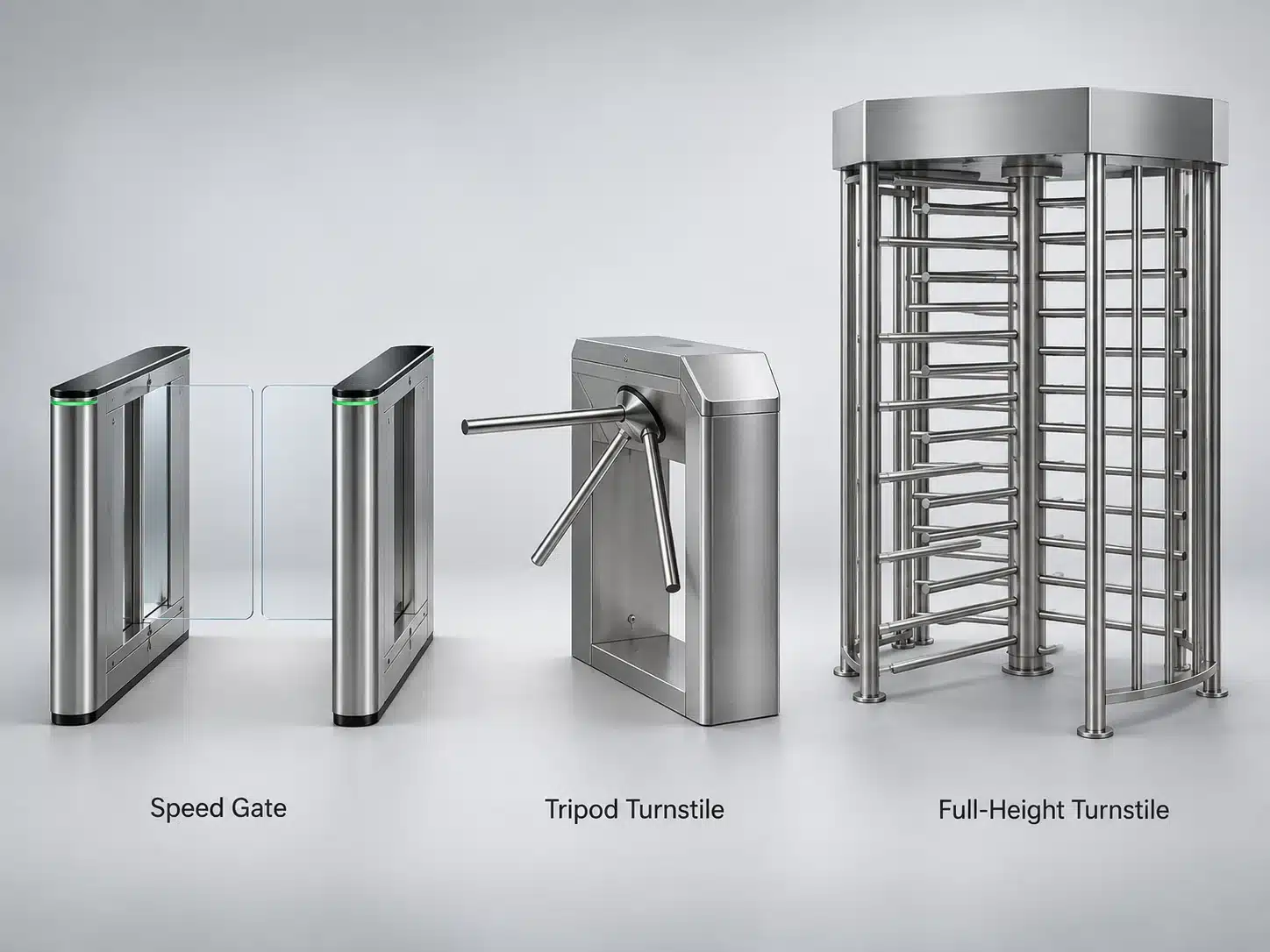
Speed gates, tripod turnstiles and full-height turnstiles can all control pedestrian access, but they are not interchangeable. The right choice depends on where the lane is installed, how many people must pass during peak periods, how much physical deterrence is required, whether accessibility must be accommodated within the turnstile line, and how the entrance must look and operate every day.
Quick Recommendation
Choose a speed gate for premium, high-traffic indoor lobbies. Choose a tripod turnstile when practical one-person control and budget efficiency matter more than architectural finish. Choose a full-height turnstile when the main objective is a stronger physical barrier for industrial, perimeter or restricted-area entry.
The Three Turnstile Types Solve Different Problems
A turnstile specification should start with the security and operating problem, not with a preferred product shape. A corporate tower lobby in Makati or BGC has very different needs from a factory staff gate, school entrance, warehouse perimeter or data-center service area.
Infinite Systems currently positions speed gates for fast, modern pedestrian control in premium and high-traffic environments, tripod turnstiles for reliable and cost-effective one-person passage, and full-height turnstiles for higher-security industrial and perimeter applications.
Premium Lobby Control
Best where appearance, smooth pedestrian flow, sensor-based passage monitoring and an integrated accessible lane are important.
Practical Staff Entry
Best where controlled one-person passage, durability and cost efficiency are more important than a premium architectural presentation.
High-Security Perimeter Entry
Best where the turnstile must act as part of a stronger physical barrier and prevent easy walk-around or climb-over access.
Speed Gate vs Tripod vs Full-Height Turnstile: Specification Comparison
| Decision Factor | Speed Gate | Tripod Turnstile | Full-Height Turnstile |
|---|---|---|---|
| Typical security objective | Controlled lobby entry with sensors and managed pedestrian flow | Basic one-person-per-authorization control | Stronger physical deterrence and perimeter control |
| Typical setting | Corporate offices, commercial towers, condominiums, data centers, hospitals | Factories, schools, staff entrances, transport or back-of-house areas | Factories, warehouses, construction sites, utility areas, perimeter gates |
| Pedestrian experience | Open, fast and visually premium | Mechanical and functional | Deliberate, controlled passage |
| Architectural impact | Lowest visual obstruction of the three | More utilitarian | Highest visual and physical presence |
| Outdoor suitability | Normally indoor or protected unless a specific model is rated for the environment | Typically indoor or covered; verify enclosure and corrosion protection | Commonly selected for outdoor/perimeter applications when appropriately rated |
| Accessibility strategy | Often designed with a wider accessible lane in the same entrance line | Usually needs a coordinated adjacent accessible gate or route | Typically requires a separate compliant accessible route |
| Best fit | Premium high-traffic entrance | Practical budget-conscious control point | High-security controlled perimeter |
1. Security Level: How Much Physical Deterrence Do You Need?
This is the first question because the three technologies create very different physical barriers.
Speed gates control entry effectively in monitored lobbies, especially when their sensors, access-control permissions and guard procedures work together. Their glass barriers, however, are designed to balance security with openness and flow. They should not be treated as the same type of physical barrier as a full-height rotor.
Tripod turnstiles provide a clear one-person passage point and make casual unauthorized entry more difficult than an open doorway. Their waist-height arms are practical, but they are not intended to create a floor-to-head-height enclosure.
Full-height turnstiles provide the strongest physical separation among the three because the rotor occupies the full pedestrian opening. They are particularly useful when the lane forms part of a fence, wall or controlled perimeter and security depends on preventing simple climb-over or walk-around access.
2. Throughput: Design for the Peak 15 to 30 Minutes, Not the Daily Average
A turnstile can feel fast during normal periods and still create a queue at shift change or morning arrival. The relevant design input is therefore the peak arrival or departure window, not total daily headcount.
Speed gates are usually the strongest candidate when a premium office or commercial lobby must process repeated credential transactions while maintaining a smooth walking pattern. Their actual capacity, however, depends on credential read time, sensor logic, barrier movement, user familiarity, visitor processing and the number of lanes operating in each direction.
Tripod turnstiles create a more deliberate physical interaction because the user must move the rotating arm. This may be acceptable for staff entrances with predictable flow, but it should be tested against shift-change demand.
Full-height turnstiles intentionally impose the most controlled passage of the three. At a busy industrial site, multiple lanes or separate entry and exit rotors may be more practical than expecting one full-height lane to handle all movement.
3. Accessibility: Plan the Accessible Route at the Same Time as the Turnstile Line
Accessibility should not be solved after the turnstiles have already been purchased. The entrance layout must provide a suitable route for wheelchair users, people carrying large items, and other users who cannot pass comfortably through a standard narrow lane.
A speed-gate layout can commonly incorporate a wider lane using coordinated cabinets and wider glass leaves. This is one reason speed gates are frequently selected for modern commercial lobbies.
Tripod and full-height arrangements usually require a separate adjacent accessible gate or another controlled accessible route. That route should preserve the same security boundary rather than creating an uncontrolled bypass around the turnstiles. Final dimensions and accessibility provisions should be coordinated with the project architect and applicable Philippine building requirements.
4. Footprint and Lobby Geometry: The Turnstile Is Only Part of the Space Requirement
The equipment footprint is not just the cabinet width. Designers also need approach space, queuing space, reader position, accessible routing, guard/reception sightlines and clearance after the lane.
Speed-gate banks often require careful alignment because several cabinets form multiple lanes. They work best when the reception desk, walls or architectural barriers close the remaining width so users cannot simply walk around the controlled line.
Tripod units can be compact, but the surrounding railings or architectural barriers are still essential. A single tripod placed in an open lobby without side barriers is not a complete security line.
Full-height turnstiles need adequate rotor diameter, structural fixing and integration into a fence, wall or enclosure. Their stronger barrier only works if the perimeter around the turnstile is equally secure.
5. Appearance: Is the Entrance Part of the Building Experience?
In a premium corporate tower, condominium lobby, hotel-related commercial area or executive office, the entrance is part of the interior architecture. Speed gates generally fit these environments best because glass barriers and slim cabinets preserve visibility through the lobby.
Tripod turnstiles communicate function rather than luxury. They are often a better fit for factory staff entrances, school controlled entries, employee areas, service corridors and other locations where reliability and budget are stronger priorities than a premium lobby aesthetic.
Full-height turnstiles have an intentionally secure and industrial appearance. In the correct setting, that is an advantage rather than a drawback because the physical barrier is meant to be obvious.
6. Indoor, Covered or Outdoor Installation?
Environmental exposure changes the specification. Direct rain, humidity, airborne dust, salt air, heat and corrosion can affect cabinets, motors, sensors, bearings, electronics and reader hardware.
Speed gates are generally associated with indoor or protected lobby environments unless the selected equipment is specifically rated for the intended exposure. Tripod turnstiles can be used in practical covered entrances, but environmental rating and corrosion protection still need to be checked. Full-height turnstiles are commonly chosen for perimeter and outdoor applications, but the exact model still needs appropriate construction, finish, ingress protection and foundation details for the site.
For Philippine projects, this check is especially important at open parking structures, coastal sites, industrial compounds and entrances exposed to wind-driven rain.
7. Maintenance: Mechanical Simplicity vs More Sensors and Moving Parts
Different turnstile types create different maintenance priorities.
Require attention to barrier alignment, motor operation, passage sensors, safety detection and cabinet electronics in addition to the access reader.
Use a simpler mechanical passage action, but the arm mechanism, locking components, drop-arm behavior where provided, reader and controller still require inspection.
Need inspection of the rotor, locking mechanism, structural anchoring, corrosion condition and interfaces with the surrounding fence or enclosure.
The better procurement question is not simply which unit has fewer moving parts. Ask who will provide preventive maintenance, whether replacement parts are locally supportable, how faults are diagnosed, and what happens to the entrance when a lane is unavailable.
8. Integration: The Turnstile Must Work with the Access-Control Workflow
The physical barrier is only one part of the system. Any of the three turnstile types can be connected to a broader access control system using supported RFID, biometric, mobile or QR credentials.
For each lane, define which platform makes the authorization decision, where the reader is installed, how entry and exit are logged, what happens when a credential is denied, how visitors are handled and which events are sent to guards or operators.
For office towers, speed gates may also form part of an elevator-access workflow. For factories, tripod or full-height turnstiles may be tied to employee credentials, time-and-attendance rules, visitor processes or contractor access. The correct integration depends on the available controllers, interfaces and software permissions rather than the turnstile shape alone.
9. Fire Alarm, Power Loss and Emergency Egress Must Be Designed Up Front
Emergency behavior is a design requirement, not a commissioning afterthought. The project team should define how the controlled entrance behaves during a fire alarm, power failure, emergency release or controller fault and coordinate the arrangement with the fire alarm system, architect and life-safety requirements.
Speed-gate and tripod systems can be configured with emergency-release behavior depending on the selected equipment and project design. A full-height security rotor, because of its physical enclosure, should not be assumed to serve as the only emergency-egress route. The overall entrance must provide the emergency egress required by the building design and applicable authorities.
Which Turnstile Should You Specify?
You are securing a premium indoor lobby, peak pedestrian flow is important, architectural appearance matters, and you want to integrate an accessible lane into the same controlled entrance.
You need practical one-person control for staff, students, workers or other repeat users and want a more economical solution than a premium sensor-based speed-gate bank.
The entrance is part of a secure perimeter or restricted zone and preventing easy walk-around or climb-over access is more important than maintaining an open lobby appearance.
Common Specification Mistakes to Avoid
- Selecting the turnstile before measuring peak pedestrian flow.
- Leaving an uncontrolled gap beside the turnstile line.
- Adding the accessible route only after the standard lanes are fixed.
- Using indoor equipment in an exposed environment without checking its rating.
- Assuming every reader, controller or software platform will integrate automatically.
- Ignoring visitor flow, deliveries, luggage, carts or contractor traffic.
- Failing to define fire-alarm release, power-loss behavior and emergency egress before installation.
- Comparing proposals only by unit price instead of complete lane design, integration, installation, commissioning and support.
Related Infinite Systems Solutions
Turnstile Systems
Speed Gates
Tripod Turnstiles
Full-Height Turnstiles
Frequently Asked Questions
Which turnstile is best for an office building?
Speed gates are usually the strongest fit for premium office lobbies because they combine controlled access with a more open architectural appearance, sensor-based passage monitoring and the option to build a wider accessible lane into the entrance line.
Is a tripod turnstile less secure than a speed gate?
They solve different problems. A tripod turnstile provides a clear mechanical one-person passage point, while a speed gate adds motorized barriers and passage sensors. The effective security level also depends on lane layout, side barriers, guards, credential rules and monitoring.
When should I use a full-height turnstile?
Use a full-height turnstile when the lane is part of a higher-security perimeter or restricted area where preventing easy walk-around or climb-over access is a major requirement. Typical settings include factories, warehouses, utility areas, construction sites and secure staff entrances.
Can all three turnstile types use RFID or biometric access?
Yes, when compatible readers, controllers and interfaces are selected. RFID, biometric, mobile and QR credentials can be used across different turnstile types, but the exact integration must be verified against the access-control platform and hardware.
Which turnstile is best for outdoor use?
Full-height turnstiles are commonly selected for outdoor and perimeter locations. Tripod or speed-gate equipment should only be used outdoors when the specific model and installation are suitable for the site’s rain, humidity, dust, temperature and corrosion exposure.
How do I know how many lanes my building needs?
Start with the peak arrival and departure window, expected users per minute, credential transaction time, visitor processing, direction of flow, accessible-lane requirements and the effect of one lane being temporarily unavailable. A site-specific traffic assessment is more reliable than choosing lane quantity from total daily headcount.
TURNSTILE SYSTEM DESIGN PHILIPPINES
Need Help Choosing the Right Turnstile?
Infinite Systems can assess your entrance layout, peak pedestrian demand, security level, accessibility requirements, credential technology, fire-alarm interface and required integrations before recommending a speed gate, tripod or full-height turnstile solution.