
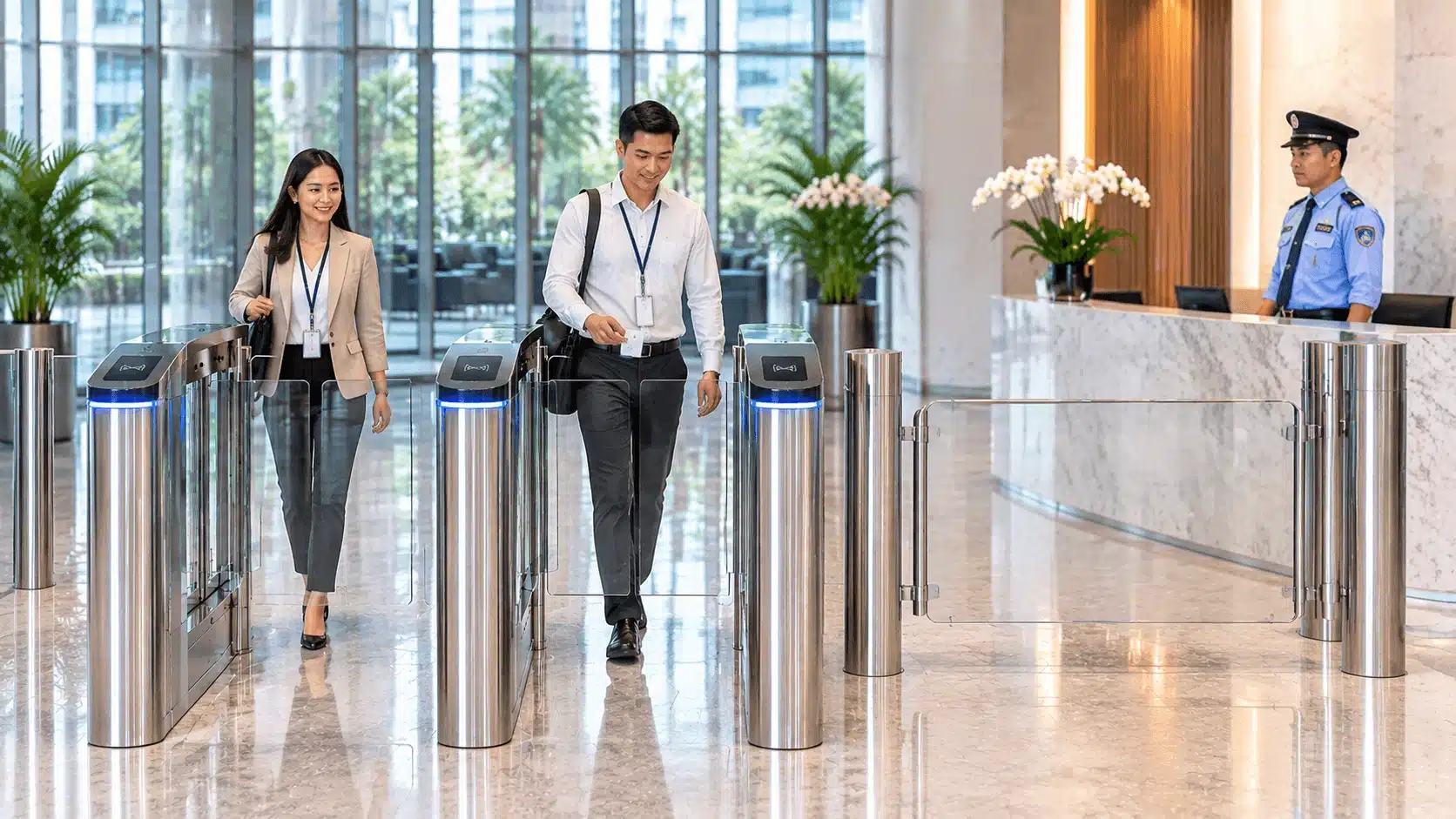
INFINITE SYSTEMS INSIGHTS:
Speed Gate vs Swing Gate in the Philippines: Which Entrance Barrier Is Right for Your Building?
Choosing between a speed gate and a swing gate involves more than appearance. For offices, condominiums and commercial buildings in the Philippines, the right entrance barrier must accommodate available space, pedestrian traffic, accessibility requirements, security procedures and long-term maintenance. Understanding how each gate operates can help property owners and facility managers select a configuration that works with their actual entrance layout.
THE KEY SELECTION PRINCIPLE
Choose based on the entrance requirement, not just the gate design. Speed gates are commonly considered for coordinated lobby lanes and controlled pedestrian flow, while swing gates can provide wider passage options for accessible routes and special-purpose movement. Actual performance, safety and suitability depend on the selected model and installation design.
01 / QUICK COMPARISON
Speed Gate vs Swing Gate: Main Differences
Both systems can control pedestrian access through an entrance, but their mechanical movement, space requirements and typical applications differ. Use the following comparison as an initial guide before evaluating specific manufacturers and models.
Speed Gate
- Typically uses sliding or retracting panels.
- Commonly arranged in multiple controlled lobby lanes.
- Requires sufficient cabinet depth and lane clearance.
- Can use configurable opening timing and detection sensors, depending on the model.
- Suitable for coordinated employee and visitor entrance workflows.
Swing Gate
- Uses one or more hinged panels that rotate open.
- Can provide a wider passage for selected applications.
- Requires sufficient clearance for the panel’s swing arc.
- May be used for accessible lanes, deliveries or special-purpose passage.
- Suitable when the entrance layout requires a different passage arrangement.
02 / HOW THEY WORK
Understanding the Difference in Gate Operation
A speed gate typically controls passage using panels that slide or retract into the gate cabinets. A swing gate uses hinged panels that rotate to create an opening. Both can be configured to receive authorization signals from an access-control system before allowing passage.
However, manufacturer terminology is not always consistent. Some products marketed as speed gates may use swinging panels rather than sliding panels. For this reason, compare the actual mechanical movement, dimensioned drawings, safety sensors and operating sequence instead of relying only on the product name.
SPEED GATE OPERATION
- Pedestrian approaches the controlled lane.
- User presents an approved credential.
- Access-control system verifies the authorization.
- Gate receives the opening command.
- Panels retract or slide to permit passage.
- Sensors monitor movement and the gate returns to its secured state according to its settings.
SWING GATE OPERATION
- Pedestrian approaches the designated passage.
- User presents an approved credential.
- Access-control system verifies the authorization.
- Gate receives the opening command.
- Hinged panel rotates to create the passage.
- Panel returns to its secured position according to its operating settings.
03 / APPLICATIONS
Where Speed Gates Are Commonly Used
Speed gates are frequently considered for high-visibility office and commercial lobbies where coordinated pedestrian movement, a modern entrance appearance and access-control integration are important. Multiple lanes can be arranged to support controlled entry and exit, depending on the building layout and selected equipment.
They may be suitable for:
- Corporate office buildings with employee access credentials.
- Commercial buildings with controlled lobby entrances.
- Business centers with multiple pedestrian lanes.
- Facilities that require integration with visitor registration or access-control platforms.
Before selecting a model, review the available lobby depth, lane width, peak arrival periods, queueing area and provision for an accessible passage. A visually attractive gate may still be unsuitable if it creates congestion or restricts the movement of visitors.
Where Swing Gates Are Commonly Used
Swing gates may be appropriate for entrances that need a wider passage or a separate route for people and items that cannot conveniently pass through a standard narrow lane. Depending on the model and configuration, they may be used for accessible passage, controlled deliveries, luggage movement or other special-purpose access requirements.
Potential applications include:
- Accessible passageways beside standard turnstile lanes.
- Building entrances that require wider controlled openings.
- Delivery or service access points.
- Facilities that need a separate passage for escorted visitors or bulky items.
The panel’s movement must be considered during layout planning. A swing gate needs sufficient space for the opening arc, and its operation should not interfere with pedestrians, furniture, reception counters or neighboring lanes.
Important: A swing gate is not automatically accessible or compliant simply because it can open wider. The actual clear opening, approach space, route and operating arrangement must be checked against the approved building design and applicable requirements.
04 / SITE PLANNING
Compare Footprint, Lane Width and Clear Opening
One of the most important steps in choosing an entrance barrier is reviewing its complete installation footprint. Do not compare equipment based on cabinet width alone. A gate may fit the available floor area but still leave insufficient space for safe pedestrian movement, queuing or maintenance.
Request dimensioned manufacturer drawings and check the following:
- Total installation width, including all cabinets and panels.
- Actual clear passage width when the gate is fully open.
- Cabinet length and depth.
- Swing arc or sliding-panel travel distance.
- Sensor coverage and potential obstruction points.
- Approach and departure space on both sides.
- Access required for servicing and replacement of components.
Measure the surrounding lobby, not just the proposed gate location. Reception areas, waiting zones, columns, doors and pedestrian circulation routes can affect the final layout. A compact-looking installation can become impractical if it creates queues or obstructs nearby movement.
Evaluate Pedestrian Throughput During Peak Hours
The gate’s advertised opening speed is not the same as the number of people who can pass through it in actual operation. Each user needs time to approach the lane, present a credential, receive authorization, pass safely and clear the detection area.
Several factors affect real-world throughput:
- Credential verification and authorization response time.
- Gate opening and closing cycle.
- Reader location and ease of use.
- Pedestrian familiarity with the entrance procedure.
- Visitor registration and security screening requirements.
- Movement of people carrying bags or using mobility aids.
- Number of available lanes and the direction of traffic.
For office buildings, consider actual employee arrival patterns rather than relying on average daily occupancy. A building may experience concentrated pedestrian traffic within a short morning arrival window. Where possible, test the proposed configuration with representative users and realistic peak-hour assumptions before finalizing the design.
05 / SECURITY AND SAFETY
Safety Sensors and Tailgating Detection
Motorized entrance barriers may use sensors to monitor pedestrian movement, detect obstructions and control the opening or closing sequence. The actual sensor arrangement and safety logic vary by manufacturer and model.
During technical evaluation, ask whether the selected equipment can detect or respond to:
- Unexpected movement through the lane.
- Reverse movement or unauthorized passage direction.
- More than one person attempting to pass under a single authorization.
- Incomplete passage or a person remaining within the detection area.
- Obstructions in the panel movement path.
Also confirm what the gate does when a sensor is triggered. Its response may involve stopping panel movement, reopening, sounding an alert or recording an event, depending on the system configuration.
Security consideration: Tailgating detection can help identify unauthorized passage attempts, but no entrance barrier should be treated as a guarantee that tailgating will be eliminated. Gate configuration, sensor coverage, access rules and security staff procedures all contribute to the overall security arrangement.
Accessibility and Visitor Convenience
Accessibility should be part of the entrance design from the beginning. Consider wheelchair users, people using mobility aids, visitors carrying luggage, deliveries and individuals who need assistance when passing through a controlled entrance.
Evaluate the following:
- Required clear passage width.
- Approach and turning space.
- Ease of presenting a credential or receiving assistance.
- Availability of an alternative passage when needed.
- Security staffing and visitor assistance procedures.
A separate manually operated gate may create delays if visitors must wait for a guard to open it. Consider the complete user journey and the building’s staffing policy when choosing between automatic and manually operated arrangements.
Fire Alarm Integration and Emergency Egress
The selected entrance barrier must be coordinated with the building’s approved fire and life-safety strategy. Planning should cover emergency release, power-loss behavior and the requirements for safe pedestrian egress.
Sliding and hinged panels may have different release mechanisms and failure behavior. Confirm the following before installation:
- How the gate responds to a fire-alarm interface signal, where required.
- What happens during normal power loss.
- Whether a manual release or emergency override is provided.
- How the equipment behaves when its controller or communication link fails.
- Whether the arrangement supports the approved exit route and building safety plan.
Coordinate the design with the architect, fire-alarm contractor and relevant building representatives. Test the actual installed configuration rather than assuming that all panels automatically retract or swing freely during an emergency.
06 / SYSTEM INTEGRATION
RFID, QR Code and Biometric Reader Integration
Both speed gates and swing gates may be integrated with access-control systems, provided that the selected gate and control equipment have compatible electrical and software interfaces. The integration should be planned around the building’s actual entry and exit procedures.
RFID Card Reader
Allows authorized employees or registered users to present an access card or credential before entering the controlled lane.
QR Code Scanner
Can support visitor access using a registered or time-limited QR credential, depending on the visitor management platform.
Biometric Reader
Can verify users through supported biometric credentials, subject to device compatibility, mounting conditions and fallback procedures.
Before purchasing the equipment, confirm the following technical details:
- Entry and exit authorization commands.
- Gate status and feedback outputs, where available.
- Controller and reader compatibility.
- Credential reader mounting position and user approach.
- Communication method between the gate and access-control platform.
- Power requirements, cable routes and network connections.
For visitor QR scanning, position the scanner where users can complete verification before entering the controlled passage. Avoid mounting devices on moving panels unless the manufacturer specifically supports that arrangement. Biometric readers also require suitable mounting height, lighting and a practical alternative for users who cannot complete biometric verification.
For a broader system design, see our Access Control Systems solution page.
07 / COST AND MAINTENANCE
Maintenance Requirements and Long-Term Costs
The purchase price is only one part of the total project cost. A lower equipment price may be offset by installation modifications, additional integration work or more demanding maintenance requirements.
When comparing quotations, review the complete project scope:
- Gate equipment, cabinet finish and panel configuration.
- Access-control readers and controllers.
- Software licensing or integration requirements, where applicable.
- Power supply, protection and network provisions.
- Floor preparation, anchoring and civil works.
- Installation, configuration and commissioning.
- Warranty coverage and spare-parts availability.
- Preventive maintenance and local technical support.
Ask the supplier about motor and mechanism access, sensor cleaning, spare parts, firmware support and recommended service intervals. Confirm who will provide technical support after installation and what components are covered by the warranty.
For ongoing equipment reliability, consider a planned Preventive Maintenance Service arrangement based on the installed model and operating conditions.
08 / PROJECT SELECTION
How to Choose the Right Entrance Barrier for a Philippine Building
Before requesting a quotation, prepare a clear picture of how the entrance will be used. The following project workflow can help narrow down suitable gate configurations and reduce changes during installation.
STEP 01
Survey the Entrance
Measure the available area, lane width, ceiling and floor conditions, approach space and possible queueing locations.
STEP 02
Understand Pedestrian Flow
Identify the number of users, peak arrival periods, entry and exit directions, visitor procedures and special passage requirements.
STEP 03
Check System Compatibility
Review access-control equipment, readers, controller interfaces, power supply, network and emergency-release requirements.
STEP 04
Evaluate the Proposed Models
Compare manufacturer drawings, clear openings, operating behavior, sensor coverage, warranty and service support.
STEP 05
Plan Installation and Testing
Confirm floor preparation, cabling, mounting, configuration, integration testing and handover requirements.
Pre-Purchase Checklist
- Obtain a measured entrance floor plan with lane and queueing dimensions.
- Estimate peak pedestrian volumes and visitor processing time.
- Confirm accessible clear passage and safe approach requirements.
- Review reader, controller, network and power compatibility.
- Check panel movement, sensor coverage and obstruction response.
- Confirm emergency release and approved egress arrangements.
- Compare itemized equipment, installation, integration and service costs.
- Request commissioning tests and documentation as part of the project scope.
If the entrance serves multiple tenants, coordinate access permissions, security staffing, visitor management and building management responsibilities before finalizing the gate type.
09 / FREQUENTLY ASKED QUESTIONS
Frequently Asked Questions About Speed Gates and Swing Gates
Is a speed gate always faster than a swing gate?
No. Actual pedestrian throughput depends on credential verification, opening and closing cycles, lane geometry, pedestrian behavior and security procedures. Compare specific models under realistic operating conditions instead of relying only on advertised opening speed.
Which gate is better for wheelchair access?
The better choice is the configuration that provides the required clear opening and safe approach under the approved building design. A suitably selected wide speed gate or swing gate may be considered, but the complete accessible route must be evaluated.
Can speed gates and swing gates use RFID cards and QR codes?
Both may support RFID cards and QR-based access when the gate, reader and access-control platform have compatible interfaces. Confirm the exact equipment models and integration requirements before purchasing.
Can these entrance barriers be connected to a biometric access-control system?
Yes, where the selected biometric reader and gate controller support the required integration. Reader mounting, authorization signals, user approach and fallback procedures should be included in the design.
Which gate costs less in the Philippines?
There is no universal answer. Pricing varies according to brand, dimensions, finish, sensors, controller, installation scope and integration requirements. Request itemized quotations with comparable specifications to evaluate the actual project cost.
Do speed gates and swing gates automatically open during a fire alarm?
Not necessarily. Emergency operation depends on the gate model, release mechanism, electrical design and approved fire and life-safety strategy. Confirm the required interface and test the installed system with the responsible project representatives.
Can a swing gate be installed beside speed gates?
A separate swing gate may be installed beside standard speed-gate lanes to provide a wider passage, subject to the available space, equipment compatibility and approved entrance layout. The combined arrangement should be checked for safe pedestrian circulation and emergency operation.
10 / RELATED SOLUTIONS
Explore Related Security and Access Control Solutions
Manage authorized entry through compatible credentials, controllers and access-management platforms.
Turnstile Systems
Explore pedestrian entrance-control options for offices, commercial buildings and other facilities.
Preventive Maintenance Services
Plan inspections and servicing to support equipment reliability and long-term operation.
Planning a Speed Gate or Swing Gate Installation?
Infinite Systems Technology Corporation helps Philippine property owners, facility managers and project teams evaluate entrance barriers and integrated access-control requirements. Share your entrance dimensions, pedestrian flow and security requirements so the proposed configuration can be assessed based on your actual site conditions.