
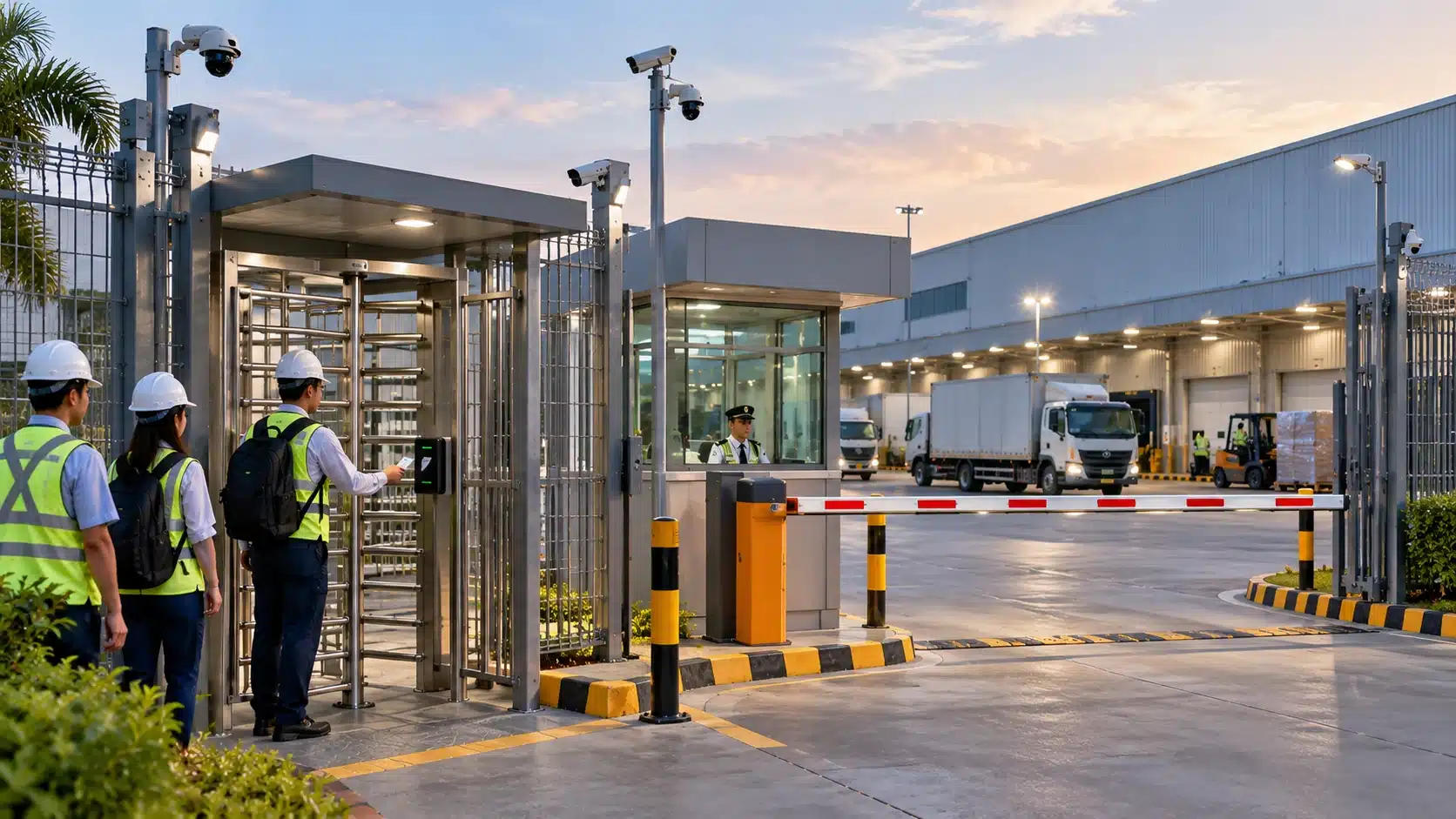
Industrial Perimeter Security: Protecting Factories, Warehouses and Logistics Facilities
Industrial sites need perimeter security that protects both people and assets while keeping employee, contractor, delivery, and vehicle traffic moving. Unlike a typical office building, a factory or warehouse may have a large property boundary, multiple gates, loading areas, storage yards, production zones, and vehicle routes that remain active throughout the day.
Factories, warehouses, and logistics facilities therefore face a perimeter-security challenge that goes beyond simply installing a fence or CCTV camera. Security controls need to work around heavy vehicle traffic, shift changes, contractors, deliveries, restricted areas, and long or difficult-to-monitor boundaries.
A practical industrial perimeter-security plan combines physical barriers, monitored entry points, CCTV, vehicle control, pedestrian access, contractor procedures, intrusion detection, lighting, and trained security personnel.
A Layered Approach to Factory and Warehouse Security
Infinite Systems can assess perimeter fencing, gates, vehicle routes, pedestrian entrances, CCTV coverage, access control, intrusion detection, and restricted internal areas to develop a coordinated industrial security approach.
Manage Entry Points
Maintain Visibility
Identify Perimeter Events
Support 24-Hour Security
Start With the Industrial Site Boundary
Before selecting equipment, map the complete property boundary and identify how people, vehicles, deliveries, and services interact with it. Security weaknesses can occur where the formal fence line meets another physical feature or where a rarely used access point is not consistently monitored.
Check continuity, condition, and vulnerable sections.
Identify vehicle, pedestrian, service, and emergency gates.
Review openings and areas that may create bypass routes.
Map secondary vehicle approaches and service access.
Identify active loading and delivery zones.
Consider vacant lots, easements, and neighboring access routes.
Site survey matters: perimeter equipment should be selected based on the actual boundary, terrain, traffic pattern, environmental conditions, and security objectives rather than equipment specifications alone.
Separate Vehicle and Pedestrian Access
Truck, employee, visitor, and pedestrian traffic should not compete for the same narrow checkpoint where avoidable. Separate workflows can make screening, authorization, and traffic management easier to operate.
Use CCTV to Cover Approaches and Critical Zones
Industrial CCTV should be planned around the actual movement and risk areas of the facility. Cameras may be used to monitor perimeter approaches, vehicle lanes, loading zones, gate transactions, storage yards, production areas, and isolated corners.
Camera selection and placement should consider viewing distance, lighting, weather exposure, mounting height, scene activity, and whether the requirement is general monitoring or identification of people and vehicles.
Control Employees, Contractors and Visitors
Industrial facilities often have different groups requiring different levels of access. Employees may need regular access, while contractors, visitors, delivery personnel, and temporary workers may require limited permissions.
Protect Yards, Warehouses and Loading Areas
Plan for Shift Changes and Night Operations
Many industrial facilities operate multiple shifts or receive deliveries outside normal office hours. Perimeter security should therefore be designed around actual operating schedules rather than daytime conditions alone.
Build Industrial Perimeter Security in Layers
No single perimeter device should carry the entire security function. Each layer should address a different part of the security workflow, from delaying unauthorized entry to detecting, verifying, controlling, and responding to an event.
Industrial Perimeter Security Planning Workflow
Survey Site
Map Traffic
Identify Risks
Design Layers
Install and Test
Maintain
Testing should include actual traffic conditions, gate operations, night visibility, alarm scenarios, access events, and communication between security personnel and the control point.
Industrial Perimeter Security Checklist
- Complete property boundary mapped
- All vehicle and pedestrian gates identified
- Potential bypass routes reviewed
- Employee, contractor, visitor, and delivery workflows separated where practical
- CCTV coverage reviewed for approaches, gates, yards, and critical areas
- Restricted internal areas identified
- Vehicle access-control requirements defined
- Pedestrian access requirements defined
- Perimeter intrusion detection requirements assessed
- Night lighting and camera performance reviewed
- Power and network requirements documented
- Alarm escalation and guard response procedures defined
- Maintenance and testing requirements included in the project scope
Industrial Perimeter Security – Frequently Asked Questions
What is the first priority for factory perimeter security?
A complete site survey is usually the starting point. It can identify uncontrolled gates, weak fence sections, blind spots, vehicle routes, pedestrian routes, bypass opportunities, and critical assets.
Are full-height turnstiles suitable for industrial sites?
They can be considered for controlled pedestrian entrances where stronger anti-bypass protection and one-person passage are required.
Can truck gates use LPR or RFID?
Yes, depending on the selected vehicle-access platform, site workflow, license-plate conditions, RFID policy, equipment configuration, and integration requirements.
Should warehouses use perimeter intrusion detection?
It can be useful for long, remote, or difficult-to-observe boundaries, particularly where continuous guard observation is impractical.
How important is lighting for industrial perimeter security?
Lighting can affect both human observation and CCTV performance. Lighting should be reviewed together with camera placement and the actual night-time operating conditions.
Can industrial perimeter security systems be integrated?
Yes, where supported by the selected equipment and platforms. CCTV, access control, vehicle barriers, visitor management, and intrusion detection can potentially be coordinated into a broader security workflow.
Build a Coordinated Industrial Security System
Planning Security for a Factory, Warehouse or Logistics Facility?
Tell us about your property boundary, gates, vehicle routes, pedestrian entrances, CCTV requirements, restricted areas, intrusion concerns, and operating schedule. Infinite Systems can help develop a coordinated industrial perimeter-security approach based on the actual site and workflow.