
INFINITE SYSTEMS INSIGHTS
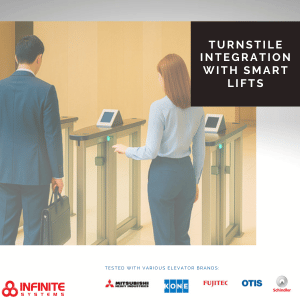
DOAS elevator turnstile integration connects lobby identity verification with a compatible destination-control elevator workflow. When properly engineered, a user can authenticate at a turnstile or access point, the access-control system can determine the user’s permitted destination, and the elevator destination-control environment can process the authorized request according to its own dispatch logic.
What Is DOAS Elevator Integration?
Destination-oriented allocation or destination-control elevator systems collect a passenger’s destination before or as part of elevator assignment. Unlike a conventional elevator where a passenger enters a car and then selects a floor, destination control can group requests and assign passengers to an appropriate elevator according to the elevator system’s traffic-management logic.
When access control is integrated, the user’s identity and floor permissions can be used to support the destination request. This can reduce unnecessary floor access while coordinating the lobby entrance and elevator journey.
How Turnstile-to-Elevator Integration Works
01 – Authenticate
The user presents an approved RFID, smart-card, biometric, mobile or other supported credential.
02 – Authorize
Access control verifies the user, schedule and permitted destination or floor group.
03 – Pass
The turnstile opens when entrance authorization is valid.
04 – Request
The approved destination is transmitted through the supported project interface.
05 – Assign
The elevator destination-control system processes the request and assigns an elevator.
Why Integrate the Turnstile and Destination-Control Elevator?
Controlled Floor Access
A credential can be associated with only the destinations permitted for that user.
Coordinated Lobby Flow
Entrance authorization and the elevator journey can form one planned workflow rather than separate security steps.
Visitor Control
Supported visitor workflows can restrict temporary users to approved destinations and visit periods.
The Interface Must Be Defined Before Procurement
“DOAS ready” should not be treated as a generic compatibility statement. The project team should confirm the actual elevator manufacturer, destination-control platform, controller or gateway, software versions, access-control platform, interface method and responsibilities of each contractor.
Depending on the project, integration may use approved gateways, APIs, relay interfaces, dry contacts, data interfaces or manufacturer-specific methods. A method that works for one elevator generation or project should not be assumed to work identically on another.
Access Authorization Is Not Elevator Dispatch
This distinction is important. The access-control system determines whether the user is authorized for a destination according to configured permissions. The destination-control elevator system receives the supported request and performs elevator assignment according to its own algorithms and operating state.
A security integrator should therefore avoid modifying or representing elevator dispatch logic as an access-control function. Integration boundaries should be documented and coordinated with the elevator contractor.
Plan the Turnstile Layout Around the Elevator Workflow
The physical lobby layout affects system performance. Readers should be positioned so users can authenticate before entering the controlled lane. The selected turnstile should provide suitable throughput, lane width and accessibility, while displays or destination information should be visible where required by the approved elevator workflow.
Reception, visitor processing and accessible routes should be designed so users cannot bypass the controlled entrance unintentionally.
Visitor and Temporary Credential Integration
In a supported visitor-management workflow, reception or a host process can authorize a temporary credential or QR-based identity for a defined destination and period. The visitor can then pass the controlled entrance and request only the destination allowed by the configured workflow.
The actual credential and elevator behavior depend on the visitor platform, access-control system and destination-control interface selected for the project.
DOAS Integration Project Checklist
01 – Elevator platform: Confirm manufacturer, model, destination-control system and software/interface details.
02 – Access platform: Confirm controllers, credential technologies, database and integration capability.
03 – User workflow: Define exactly where authentication occurs and how a destination is selected or derived.
04 – Turnstiles: Confirm lanes, throughput, reader position, accessibility and emergency behavior.
05 – Visitors: Define host approval, temporary credential, destination permission and expiry.
06 – Interface ownership: Document which contractor supplies, configures and tests each side of the integration.
07 – Failure modes: Define behavior for network loss, interface loss, invalid credentials and other agreed exceptions.
08 – Commissioning: Test authorized and unauthorized destinations, user groups, schedules, visitor workflows and agreed exception scenarios.
Commissioning Matters as Much as Integration
A successful demonstration should cover more than one valid card. Testing should include different user groups, different authorized destinations, denied destinations, schedules, visitor credentials, turnstile operation, elevator assignment requests and agreed failure or recovery conditions.
Final documentation should identify configuration responsibilities, interface assumptions, test results and the parties responsible for future software or hardware changes.
Frequently Asked Questions
Is DOAS the same as conventional elevator floor access?
No. Conventional floor access typically enables or disables floor selections. Destination control collects a destination request and assigns an elevator before or as part of the passenger journey. Access control can authorize destinations in either architecture where supported.
Can a turnstile automatically request an elevator destination?
Yes, in a supported integration. The access-control workflow can provide an authorized destination request to the destination-control environment, which then handles elevator assignment.
Can every destination-control elevator integrate with any access-control system?
No. Compatibility depends on the elevator platform, access-control platform, approved interfaces, software versions and manufacturer or contractor requirements. It must be verified for the specific project.
Can visitors use the same integrated workflow?
They can where visitor management, access control and the elevator interface support the required temporary-credential and destination-authorization workflow.
Who should coordinate the integration?
The project should clearly assign responsibilities among the owner or consultant, access-control integrator, elevator contractor, turnstile supplier and other involved parties. Interface requirements and commissioning responsibilities should be agreed before implementation.
Planning Turnstile and Destination-Control Integration?
Infinite Systems can review the access-control architecture, turnstile workflow, elevator interface and destination-permission requirements and coordinate a project-specific integration approach with the relevant project teams.