
INFINITE SYSTEMS INSIGHTS:
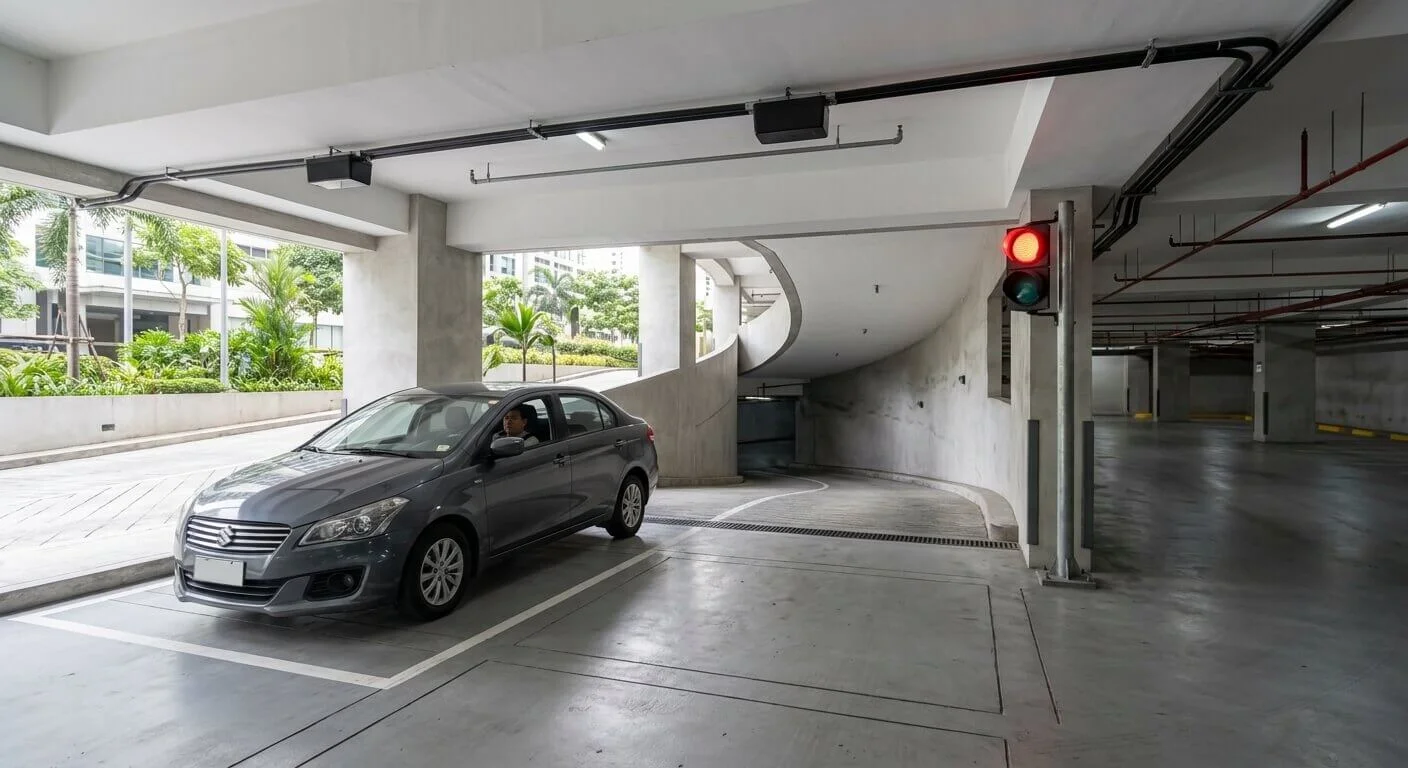
Basement Ramp Traffic Light System: Vehicle Detection, Signal Control and Safety
A narrow basement ramp that carries vehicles in both directions needs a clear right-of-way strategy. Red-green traffic signals and vehicle detection can coordinate movement more consistently than informal guard hand signals alone, particularly where sight distance, ramp geometry and vehicle flow create conflicting movements.
SAFETY PRINCIPLE
Never give opposing directions a proceed indication at the same time. The control sequence should account for vehicles already inside the shared ramp and provide appropriate clearance before changing the right-of-way.
DETECT
Identify approaching vehicles and, where required, occupancy of the shared ramp.
DECIDE
Controller logic determines which direction receives the next movement phase.
CLEAR
Provide appropriate clearance before transferring right-of-way to the opposite direction.
CONTROL
Coordinate signals, barriers, overrides and other lane-control functions.
01 / PROJECT CONTEXT
Why Basement Ramps Need Dedicated Traffic Control
Many buildings have a single-lane or narrow ramp connecting street level and basement parking. Limited width, curves, columns, walls and restricted sight distance can prevent approaching drivers from seeing opposing traffic until both vehicles are already committed to the ramp.
A dedicated traffic-control system establishes a defined right-of-way sequence. Instead of relying entirely on drivers or guards to determine who proceeds, the system can use vehicle detection and programmed signal phases to coordinate movement.
02 / SYSTEM COMPONENTS
Typical Basement Ramp Traffic Control Components
Signal Heads
Red, green or other suitable stop/proceed indications positioned at the approaches so drivers can clearly see the current lane status.
Vehicle Detectors
Loops or compatible presence sensors that detect vehicle arrivals and provide requests or occupancy information to the controller.
Traffic Controller
Runs the interlocked phases, timing, clearance periods, detector inputs and defined priority rules.
Manual Override
Provides controlled security or maintenance operation when required, subject to defined safeguards and operating procedures.
03 / CONTROL SEQUENCE
The Sequence Is the Core of the System
A detector request should not simply turn the opposite signal red and immediately release the waiting vehicle. The controller needs to consider the current phase and allow appropriate clearance for vehicles already inside the shared ramp.
01 — Request
A vehicle is detected at one approach and generates a movement request.
02 — Hold
The controller maintains the existing phase while the current movement is completed.
03 — Clear
A defined clearance period allows the shared section to become available for the next movement.
04 — Release
The opposite direction receives its proceed indication only after the required conditions are satisfied.
Depending on ramp length and geometry, the design may also use occupancy detection, additional sensors or other safeguards to provide better information about vehicles remaining within the conflict zone.
CONTROL NOTE
The exact timing and detection strategy should be established from the site geometry and operating requirements. Clearance timing should not be selected solely from a generic timer value.
04 / VEHICLE DETECTION
Detection Location Matters
Approach detectors should identify vehicles early enough to support orderly stopping and signal changes without creating excessive false calls. The detector location should correspond to the actual stopping position and visibility available to approaching drivers.
If ramp occupancy detection is used, its coverage should reflect the actual shared conflict zone. A sensor positioned too close to an approach may provide insufficient information about vehicles farther inside the ramp.
Approach Detection
Detect vehicles before the intended stopping or decision point to allow the controller to respond appropriately.
Conflict-Zone Detection
Where required, monitor whether a vehicle remains within the shared ramp section.
Site Validation
Confirm detector performance and placement against actual vehicle movement during commissioning.
05 / BARRIER INTEGRATION
Integrate Traffic Signals with Parking Barriers
Where a boom barrier is close to the ramp, the traffic signal should be coordinated with the parking barrier system so that a vehicle is not released into a blocked or unsafe area.
Access authorization, barrier movement, vehicle detection and traffic phase should be considered as one lane workflow. The barrier should not create a condition where a vehicle is authorized to proceed but cannot safely clear the approach or ramp.
Authorization
Confirm that the vehicle is permitted to enter or exit the controlled area.
Barrier Status
Coordinate barrier position and movement with the intended vehicle flow.
Traffic Phase
Release the appropriate direction only when the programmed conditions are satisfied.
06 / BROADER TRAFFIC CONTROL
When a Broader Traffic System Is Needed
A dedicated two-way basement ramp controller may be sufficient for a simple shared lane. However, sites with multiple ramps, internal intersections, pedestrian crossings, loading areas or other vehicle conflicts may require a broader traffic-management strategy.
In these environments, signal phases may need to coordinate with additional detectors, barriers, access-control systems or other traffic-control points. See our guide to traffic light systems for buildings and private roads.
DESIGN PRINCIPLE
As the number of vehicle conflict points increases, the control strategy should be designed around the complete traffic flow rather than treating each signal as an isolated device.
07 / PROJECT WORKFLOW
Basement Ramp Traffic Control Workflow
01 — Survey
Review ramp width, length, geometry, sight distance, grades, vehicle flow and existing equipment.
02 — Define
Establish right-of-way rules, signal phases, detector requirements, clearance conditions and override procedures.
03 — Design
Develop signal locations, detector positions, controller logic, barrier interfaces and required wiring or communications.
04 — Install
Install signal heads, detectors, controller equipment, barriers and associated infrastructure.
05 — Test
Verify detector calls, interlocking, clearance periods, signal indications, barrier coordination and manual modes.
06 — Commission
Observe actual vehicle movement, verify the programmed sequence and document final operating conditions.
08 / PROCUREMENT CHECKLIST
What to Review Before Selecting the System
Traffic Control
Signal heads, controller, phase logic, timing, clearance requirements and manual operating modes.
Detection
Detector technology, quantity, locations, coverage and compatibility with the controller.
Integration
Barrier interfaces, access authorization, security overrides and other equipment connections.
PROCUREMENT NOTE
Compare proposals based on the complete control sequence and site-specific installation scope, not only the number of signal heads or detectors. Controller programming, wiring, integration, commissioning and documentation can materially affect the final system.
09 / RELATED SOLUTIONS
Related Traffic and Parking Solutions
Parking Barrier Systems
Coordinate boom barriers, vehicle access and lane control for parking entrances and exits.
Traffic Light Systems for Buildings
Plan traffic signal control for private roads, intersections, ramps and other controlled vehicle movements.
10 / FAQ
Frequently Asked Questions
Can a basement ramp signal operate automatically?
Yes. Compatible vehicle detectors can generate movement requests automatically according to the programmed control sequence.
What if vehicles arrive from both directions?
The controller should apply an interlocked priority and clearance sequence so that only one direction receives a proceed indication at a time.
Can guards override the system?
A controlled manual mode can be designed where operationally required, with appropriate safeguards and procedures defined for the project.
Can it integrate with a boom barrier?
Yes. Compatible signals, detectors and barriers can be coordinated so vehicle authorization and ramp movement follow the intended sequence.
Does ramp length affect the design?
Yes. Ramp length, geometry and sight distance can affect detector placement, clearance requirements and the overall control sequence.
Is a site survey required?
A site survey is strongly relevant when finalizing detector locations, signal visibility, vehicle paths, barrier interfaces and the required control sequence.
PLAN YOUR TRAFFIC CONTROL PROJECT
Assess the Ramp Before Selecting the Controller
Infinite Systems can review ramp geometry, vehicle detection, signal placement, barrier interaction and control sequencing for private-property traffic applications.