
INFINITE SYSTEMS INSIGHTS:
Turnstile Supplier, Installer or Systems Integrator in the Philippines: What Does Your Project Need?
Looking for a turnstile supplier in the Philippines? Before comparing prices, determine whether your project needs equipment supply, installation services or a complete integrated entrance system. These are different responsibilities, and understanding the distinction can help prevent compatibility problems, unclear project ownership and unexpected costs after installation.
PROJECT PLANNING PRINCIPLE
Evaluate the actual project scope, not just the company label. A supplier provides equipment, an installer handles physical installation, and a systems integrator coordinates the turnstile with access control and other building systems. One company may perform all three roles, but each responsibility should be clearly defined in the proposal.
01 / UNDERSTANDING THE ROLES
Turnstile Supplier vs Installer vs Systems Integrator
These three roles may overlap, especially when dealing with security systems contractors that offer turnkey solutions. However, their typical responsibilities are different.
Turnstile Supplier
Primarily provides the turnstile equipment, accessories and product-related documentation.
Ask: Who will install, configure and test the complete system?
Turnstile Installer
Handles site preparation, equipment mounting, cabling, physical connections and installation testing.
Ask: Who is responsible for software, interfaces and system-level issues?
Systems Integrator
Coordinates equipment, access-control platforms, interfaces, configuration and end-to-end system testing.
Ask: What are the acceptance criteria and post-installation support arrangements?
The most suitable arrangement depends on project complexity, existing infrastructure, internal technical resources and the level of responsibility expected from the contractor.
02 / EQUIPMENT PROCUREMENT
What Does a Turnstile Supplier Do?
A turnstile supplier primarily sources and sells the equipment required for a controlled pedestrian entrance. Depending on the supplier and product arrangement, the quotation may cover the gate cabinets, barrier mechanisms, accessories, spare parts and manufacturer documentation.
Some suppliers also offer delivery, technical assistance, commissioning support or installation services. However, these services should not be assumed to be included simply because the company sells the equipment.
Before purchasing, confirm the following:
- Turnstile model, specifications and operating configuration
- Included accessories, readers and interface components
- Local availability, delivery arrangements and lead time
- Product warranty coverage and warranty exclusions
- Technical drawings, installation manuals and documentation
- Availability of replacement parts and technical assistance
- Whether installation and commissioning are included or separate
Important distinction: A product warranty covers the equipment according to its terms and conditions. It does not automatically mean that the supplier is responsible for the entire installed system, including third-party controllers, cabling, software and integration work.
03 / INSTALLATION WORK
What Does a Turnstile Installer Do?
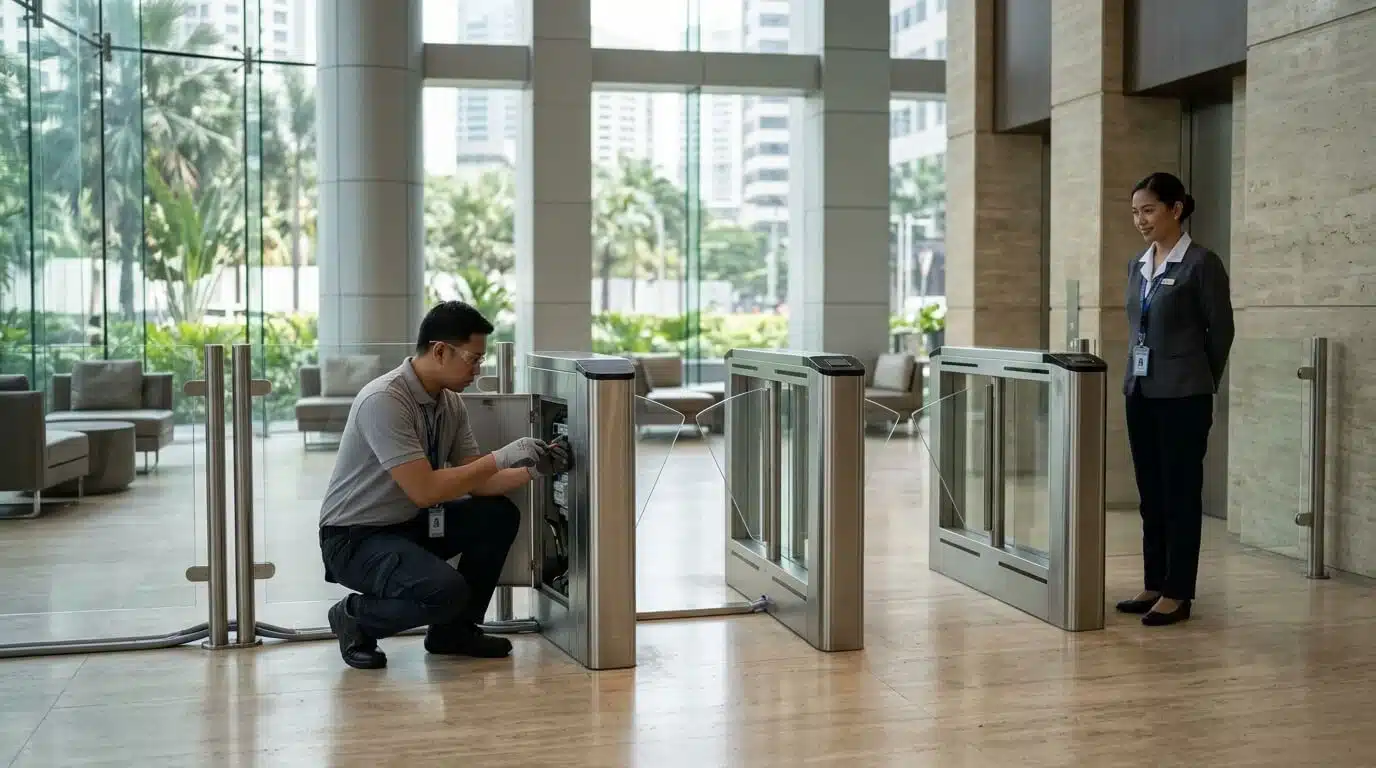
A turnstile installer focuses on the physical installation and connection of the equipment at the project site. The work typically starts with a site inspection to verify the entrance dimensions, floor conditions, equipment positioning and cable routes.
Typical installation activities include:
- Measuring the entrance and verifying the available passage width
- Positioning and aligning turnstile cabinets
- Drilling, anchoring and mounting the equipment
- Installing power, signal and network cabling
- Connecting readers, control interfaces and accessories
- Aligning glass panels or barrier mechanisms, where applicable
- Performing basic operational and mechanical checks
- Coordinating site cleanup and installation handover
Installation quality is especially important in finished commercial lobbies, where floor conditions, conduit routes, pedestrian circulation and surrounding architectural finishes must be considered. Poor positioning or inadequate cable planning can affect both the appearance and long-term serviceability of the entrance.
However, physical installation does not necessarily include the design, programming or administration of the wider access-control platform. These responsibilities should be assigned separately when they are outside the installer’s agreed scope.
04 / SYSTEM DESIGN AND INTEGRATION
What Does a Turnstile Systems Integrator Do?
A systems integrator coordinates how the turnstile operates with the building’s access-control environment and other connected systems. Rather than focusing only on the gate or its physical installation, the integrator considers the complete entrance workflow.
Depending on the project, this may involve the following:
Access Control
Reader configuration, controller programming, credential validation, access permissions and event reporting.
Visitor Management
Visitor pre-registration, QR credentials, host approval and temporary access workflows, where supported.
Elevator Integration
Coordination between lobby access permissions, tenant floor authorization and elevator interfaces.
CCTV Integration
Association of access events with video monitoring or event review, depending on platform compatibility.
Network Infrastructure
Network connectivity, addressing, communication paths and coordination with existing IT infrastructure.
Emergency Interfaces
Coordination of fire-alarm interfaces and emergency release behavior with the approved building life-safety strategy.
A competent integrator should establish the system architecture, equipment compatibility, interface responsibilities, configuration requirements, test procedures, documentation and support arrangements.
Not every company describing itself as a systems integrator provides the same level of service. Ask for specific project deliverables and identify which systems, interfaces and third-party equipment are included in its responsibility.
05 / PROJECT APPLICATION
Why the Difference Matters for Philippine Building Projects
Consider a three-lane entrance for a commercial office building. The owner may initially request only a quotation for three turnstile units. However, making those lanes operational may require additional equipment, installation work and system configuration.
Example: Three-lane office entrance
- Three turnstile lanes with the required passage configuration
- RFID readers and access-control controllers
- Power supplies and network connections
- Floor anchoring, conduits and cable installation
- Access-control software configuration and credential enrollment
- Functional testing, administrator training and handover
If the building also requires visitor pre-registration and elevator floor permissions, the scope may expand to include visitor-management software, additional interface hardware, platform configuration and coordination with the elevator contractor.
Without a clear responsibility matrix, problems can arise when one contractor assumes another party is responsible for a connection, configuration or test. For example, the equipment supplier may refer a controller issue to the access-control vendor, while the installer may identify a network problem outside its contract.
A clearly assigned project lead helps coordinate these responsibilities, resolve interface issues and establish who is accountable for delivering the agreed working system.
06 / PROCUREMENT STRATEGY
Which Arrangement Is Right for Your Project?
When a Supplier-Only Arrangement May Be Enough
Purchasing equipment separately can be practical when the facility already has an experienced engineering team or an established systems integrator responsible for the overall design. The buyer must still coordinate equipment compatibility, delivery, warranty boundaries, installation requirements and acceptance testing.
This arrangement is generally less suitable when the building owner expects one contractor to take responsibility for a fully operational entrance with multiple connected systems.
When an Installer-Led Project Makes Sense
An installer-led arrangement can be appropriate for straightforward equipment replacement or expansion when the equipment specifications, control logic and system interfaces have already been defined and approved.
Before proceeding, confirm who provides the approved drawings, configures the controllers, coordinates interface testing, witnesses emergency-release checks and supports system faults after turnover. Successful mechanical operation alone does not prove that the access-control integration is complete.
When an Integrator-Led Project Is Preferable
An integrator-led approach is often beneficial for new commercial buildings, multi-tenant towers, schools, hospitals, industrial facilities and projects involving visitor management, elevator access or centralized security monitoring.
Look for documented experience with the proposed readers, controllers, software platforms and building interfaces. Where practical, request a factory or staging test, a site acceptance test plan and a defined technical support escalation process.
07 / SYSTEM ACCEPTANCE
Technical Acceptance Checks Before Turnover
Before accepting a completed turnstile installation, the project team should verify that the mechanical equipment, access-control functions and connected interfaces operate according to the approved design and project specifications.
Recommended acceptance checks include:
- Credential validation: Test authorized and unauthorized cards, biometrics or QR credentials, as applicable.
- Direction control: Verify entry and exit behavior, including one-way or two-way access configurations.
- Passage detection: Check anti-tailgating and passage sensors where fitted.
- Obstruction response: Verify the specified response to obstructions and detected passage conditions.
- Communication: Test controller communication, network interruption and event reporting.
- Power response: Verify behavior during power loss and restoration according to the approved configuration.
- Emergency interface: Test the fire-alarm interface and emergency release sequence against the approved life-safety design.
- Accessible passage: Verify the designated accessible lane and its operating procedure separately.
- System administration: Confirm event logs, time synchronization, administrator permissions and recovery after restart.
Life-safety reminder: Fire-alarm response and emergency egress arrangements must be coordinated with the building’s approved life-safety design and applicable Philippine requirements. Do not assume a generic fail-safe or fail-secure behavior is suitable for every turnstile installation.
The final handover should include approved drawings, equipment schedules, configuration records, relevant manuals, warranty details, administrator training and a list of outstanding items, if any.
08 / PROCUREMENT CHECKLIST
Questions to Ask Every Turnstile Bidder
Use a common checklist when evaluating suppliers, installers and systems integrators. The answers should identify the responsible party for every major part of the project.
Design and Equipment
- Who prepares the entrance layout and shop drawings?
- Are turnstiles, readers and controllers included?
- Are the proposed equipment models compatible?
- Is an accessible lane included?
Installation and Integration
- Who provides power and network cabling?
- Are conduits and floor restoration included?
- Who configures software and controllers?
- Who handles visitor, CCTV and elevator interfaces?
Testing and Support
- What acceptance tests will be performed?
- Who coordinates emergency-release testing?
- What are the warranty terms and exclusions?
- Are local spare parts and technical support available?
- Who provides training and handover documents?
Also request an itemized BOQ, a written scope of work, a responsibility matrix and a clear list of exclusions. These documents make it easier to compare proposals and reduce disputes during implementation.
09 / FREQUENTLY ASKED QUESTIONS
Turnstile Supplier and Installation FAQs
Can one company supply, install and integrate turnstiles?
Yes. Some security systems companies provide turnkey services covering equipment supply, installation, configuration and integration. Confirm that all three responsibilities are explicitly included in the quotation and assigned to qualified personnel.
Should I buy turnstiles directly and hire a separate installer?
This can work when the design, equipment compatibility and project responsibilities are clearly established. For multi-vendor installations, document the technical interfaces and identify who leads commissioning and acceptance testing.
Does turnstile installation automatically include access-control integration?
No. Physical installation and system integration are different scopes. Ask for the reader and controller models, communication interfaces, software configuration, credential testing and event-reporting requirements to be identified in the proposal.
What is the best way to request comparable turnstile quotations?
Provide every bidder with the same entrance plan, lane requirements, credential specifications, integration requirements and installation conditions. Request itemized BOQs, exclusions, commissioning criteria, warranty coverage and technical support terms.
Why is a systems integrator important for multi-system projects?
A systems integrator coordinates the equipment, software and interfaces needed to make connected systems work together. This can reduce gaps in responsibility, improve testing coordination and provide a clearer support structure after project turnover.
10 / RELATED SOLUTIONS
Explore Integrated Security Solutions
A controlled entrance may require more than a turnstile. Depending on the facility’s security requirements, the system can be coordinated with access control, visitor registration and video surveillance.
Explore pedestrian entrance control solutions for offices, commercial buildings and secured facilities.
Access Control Systems
Learn about credential management, access permissions and controlled entry solutions.
Visitor Management Systems
Coordinate visitor registration, temporary credentials and lobby access procedures.
CCTV and Video Surveillance
Support security monitoring and review of access-related events through video surveillance.
Need a Complete Turnstile Solution?
Infinite Systems Technology Corporation supports Philippine building projects with entrance planning, equipment selection, access-control integration and commissioning coordination. Share your floor plan, project requirements and existing systems so the appropriate scope can be established before pricing.