
INFINITE SYSTEMS INSIGHTS:
Elevator Access Control for Multi-Tenant Buildings: Floor Permissions, Turnstiles and Visitor Management
Multi-tenant buildings require elevator access rules that separate tenant floors while keeping daily movement convenient for employees, visitors and building personnel. A well-planned system coordinates access credentials, floor permissions, turnstiles, elevator interfaces, visitor registration and property-management procedures to control movement throughout the building.
PLANNING PRINCIPLE
Define who can access each floor before selecting the integration architecture. Multi-tenant elevator security is not simply about restricting elevator buttons. It requires a coordinated access policy for tenants, employees, visitors, contractors and building personnel, supported by compatible access-control and elevator interfaces.
01 / ACCESS REQUIREMENTS
Define Floor Access by User Group
The first step is to establish which users are allowed to access each floor and under what conditions. Multi-tenant buildings often have different requirements for private offices, shared amenities, parking levels, service areas and restricted facilities.
Instead of assigning permissions individually wherever possible, organize users into access groups based on their roles and building responsibilities. This simplifies administration when employees join, leave or transfer between tenant organizations.
Tenants and Employees
Access to assigned office floors, approved shared facilities and designated parking levels.
Visitors and Contractors
Limited access to approved destinations based on host authorization, appointment schedules or work assignments.
Building Personnel
Authorized access to management offices, maintenance areas, service floors and other operational spaces.
Prepare a floor-access matrix before configuration. This provides a clear reference for tenant permissions, shared-area access, restricted floors and special operating schedules.
02 / ELEVATOR INTEGRATION
Coordinate Access Control With the Elevator System
Elevator access control can restrict which floors a user may select or reach after presenting an authorized credential. Depending on the selected platform, the access-control system may communicate with the elevator controller to enable permitted floor selections or provide an approved floor authorization signal.
The actual integration method depends on the elevator manufacturer, controller architecture, available interfaces and approved configuration. Some installations use dedicated interface modules, relay-based connections or other manufacturer-supported integration methods.
Confirm these requirements early
- Elevator manufacturer and controller model.
- Number of elevators and floors requiring access control.
- Available communication or interface options.
- Required access-control hardware and interface modules.
- Credential verification and floor authorization sequence.
- Elevator contractor responsibilities and coordination requirements.
- Emergency operation and life-safety restrictions.
Technical note: Elevator integration must be coordinated with the elevator manufacturer or authorized elevator contractor. Do not assume that a standard access-control relay can be connected directly to any elevator controller. The interface must be approved for the selected elevator system.
Early coordination helps avoid compatibility problems, unclear project responsibilities and unexpected interface requirements during installation.
03 / LOBBY SECURITY
Integrate Turnstiles With Elevator Access Control
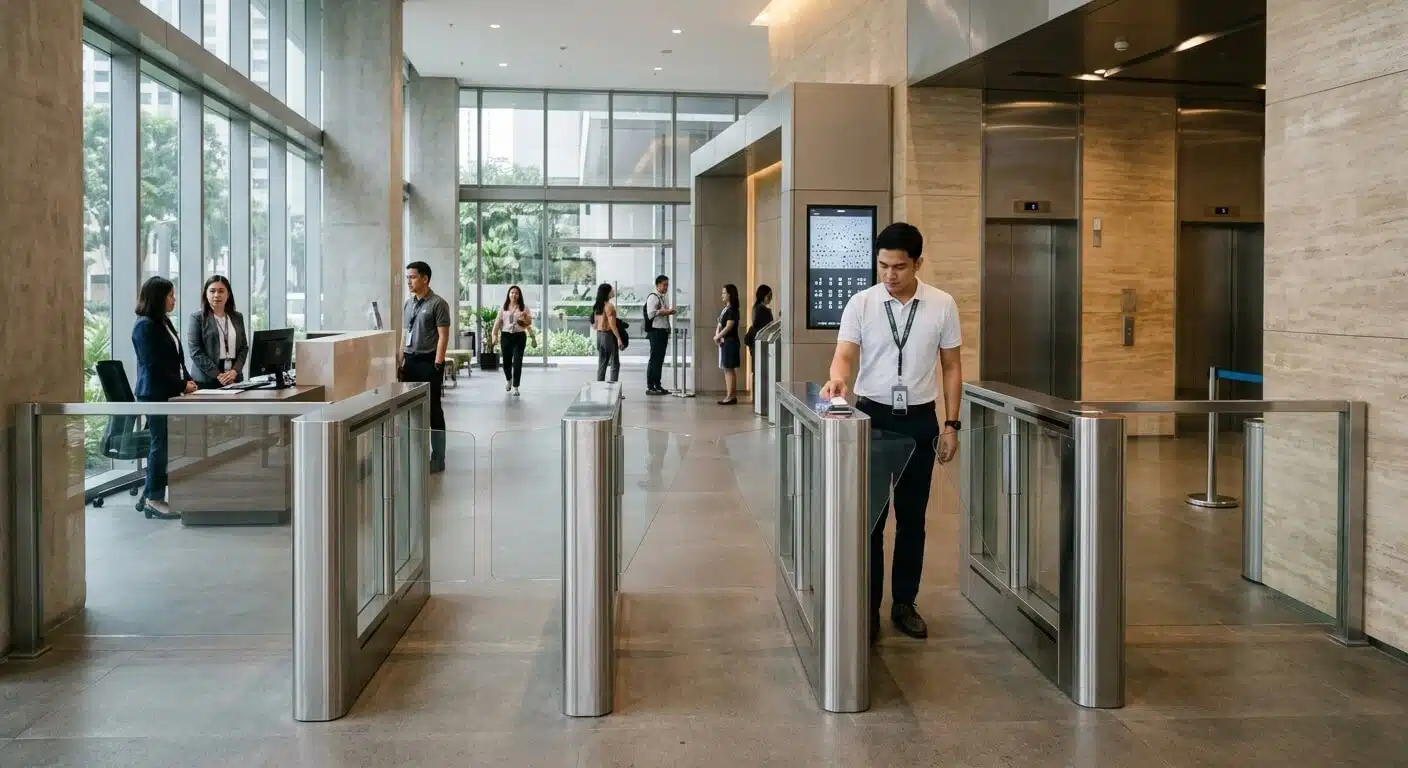
In multi-tenant office buildings, turnstiles can control entry from the lobby into the secured elevator waiting area. A credential presented at the turnstile may also be used as part of the elevator access workflow when the selected access-control and elevator platforms support the required integration.
One common arrangement is to authenticate the user at the lobby turnstile before allowing entry into the secured area. The same credential or associated authorization record may then be used to determine which elevator floors the user can access.
Credential Reader
Install the reader at an accessible position on the turnstile cabinet or designated access point, following the manufacturer’s installation requirements.
Turnstile Controller
Coordinate credential authorization with the gate’s opening and passage logic.
Elevator Authorization
Apply the user’s approved floor permissions through the supported elevator integration.
The physical installation should allow users to authenticate before entering the secured side. Reader placement, turnstile direction, accessible lanes and elevator waiting areas should be coordinated as part of the lobby layout.
Where turnstile and elevator permissions are managed by separate systems, define how authorization records are shared and how user permissions remain consistent across both access points.
04 / VISITOR MANAGEMENT
Plan Visitor Access and Temporary Floor Permissions
Visitors should be able to reach their approved destination without receiving unnecessary access to other tenant floors. A visitor-management workflow can connect reception registration, host approval and temporary access credentials.
Depending on the selected platform, visitors may receive temporary RFID cards, QR codes, mobile credentials or receptionist-issued authorization. The permission should reflect the approved destination and visit duration.
A practical visitor workflow
- Registration: Record the visitor’s details and intended destination according to the property’s registration policy.
- Host confirmation: Verify the appointment or obtain approval from the tenant or authorized host.
- Credential issuance: Provide a temporary credential or approved access method.
- Floor authorization: Limit access to the approved floor and other specifically authorized areas.
- Visit expiration: Disable or expire the temporary permission after the approved visit period.
- Credential return: Recover reusable visitor cards where applicable and close the visitor record.
This process helps maintain controlled visitor movement while giving reception and property-management personnel a consistent way to manage building entry.
05 / SHARED FACILITIES AND SCHEDULES
Manage Shared and After-Hours Floor Access
Not every floor is exclusively assigned to one tenant. Buildings may include shared meeting rooms, gyms, restaurants, parking levels, event spaces and other facilities that operate under different access rules.
These areas may require separate permissions or time-based access schedules. A tenant may be allowed to use a shared amenity during approved hours but may not have permission to enter restricted offices or service floors.
Shared Amenities
Configure access for facilities such as gyms, meeting rooms and common areas based on building policies.
Parking Levels
Coordinate parking access with tenant assignments, authorized vehicles and applicable building schedules.
After-Hours Access
Apply approved schedules for employees, contractors and authorized personnel outside normal operating hours.
Time-based permissions should be tested against the building’s actual operating policies, including weekends, holidays, extended office hours and special events.
06 / TENANT ADMINISTRATION
Manage Tenant Changes and Credential Permissions
Multi-tenant properties change over time. Companies may move between floors, employees may transfer departments and visitors or contractors may require temporary access. The access-control system should support an organized process for updating permissions without affecting unrelated tenants.
Where the platform supports it, delegated administration can allow authorized tenant representatives to manage their own users within property-level restrictions. Building administrators should retain oversight of shared facilities, restricted areas and system-wide policies.
Administrative controls to establish
- Tenant onboarding and initial floor assignment.
- Employee enrollment and credential issuance.
- Employee transfers and changes in access permissions.
- Lost-card reporting and credential revocation.
- Tenant move-out and account deactivation.
- Periodic access-right reviews and audit records.
- Delegated administration and approval responsibilities.
Maintain clear ownership of access records so that tenant administrators cannot modify permissions outside their assigned authority. Regular permission reviews help prevent outdated credentials from remaining active after employees or tenants leave the building.
07 / EMERGENCY AND LIFE SAFETY
Plan for Emergency Operation and Exceptions
Security integration must not interfere with the elevator’s required emergency operation, fire-service functions or approved life-safety arrangements. These functions remain governed by the elevator design, applicable regulations and the responsible elevator contractor.
Access-control planning should identify how the system behaves during power interruptions, fire alarms, emergency conditions, equipment faults and other exceptional situations.
- Coordinate the access-control design with the elevator contractor and building safety team.
- Identify which emergency functions must remain independent of normal credential authorization.
- Confirm the approved behavior of elevator interfaces during emergency conditions.
- Review backup power and equipment-failure arrangements.
- Document the responsibilities of property management, security personnel and technical support.
- Test approved emergency-related interfaces as part of coordinated commissioning.
Life-safety consideration: Access-control permissions must not override required elevator emergency or fire-service operation. Any interface affecting elevator behavior must be reviewed and approved by the responsible elevator and life-safety professionals.
08 / SYSTEM TESTING
Test Floor Permissions and Integrated Access Workflows
Commissioning should verify the complete user journey from credential presentation to authorized floor access. Testing only the card reader or elevator interface separately may not reveal problems in the integrated workflow.
Recommended test scenarios
- Tenant employee: Verify that an employee can enter the lobby and access only the assigned floors.
- Unauthorized floor: Confirm that restricted floors cannot be selected or accessed through the configured system.
- Visitor access: Verify that a visitor receives the approved destination and temporary access period.
- Shared facilities: Test permissions for common areas and amenities.
- Time schedules: Verify access during approved hours and the expected response outside those schedules.
- Credential revocation: Confirm that lost or deactivated credentials no longer grant access.
- Turnstile integration: Test the credential and passage sequence at the lobby entrance.
- Elevator interface: Confirm the approved floor authorization behavior in coordination with the elevator contractor.
- Emergency operation: Verify that approved emergency and fire-service functions remain unaffected by normal access-control restrictions.
Record the test results, configuration settings, exceptions and corrective actions. The final handover should include floor-access schedules, user-group definitions, integration documentation and administrator procedures.
09 / PROJECT PLANNING
Multi-Tenant Elevator Access Control Checklist
Use this checklist when assessing an existing building or preparing a new elevator access-control installation.
Access Requirements
- Tenant and employee groups
- Floor-access matrix
- Shared facilities and parking
- Visitor and contractor access
- Time-based permissions
System Integration
- Elevator manufacturer and controller
- Supported interface method
- Access-control platform
- Turnstile and reader integration
- Network and power requirements
Administration and Safety
- Tenant onboarding and offboarding
- Credential revocation
- Delegated administration
- Emergency operation coordination
- Testing and handover records
For procurement and project planning, the scope should identify elevator interface modules, access-control panels, readers, credentials, turnstiles, software licenses, installation requirements, elevator-contractor coordination, testing and commissioning activities, and any required civil, electrical or network works.
10 / RELATED SOLUTIONS
Related Infinite Systems Solutions
Multi-tenant building security requires coordinated control of pedestrian entry, elevator movement and visitor access. Explore related solutions for an integrated building security environment.
Access Control Systems
Manage user credentials, floor permissions and controlled entry points across your facility.
Turnstile Systems
Control pedestrian movement through office lobbies and secured building entrances.
Structured Cabling Systems
Support the network infrastructure required for building access-control and communication systems.
11 / FREQUENTLY ASKED QUESTIONS
Frequently Asked Questions About Elevator Access Control
Can one access card control both turnstile and elevator access?
Yes, where the selected access-control platform, turnstile and elevator interfaces support the intended integration. A single credential can be used for multiple access points, subject to the system architecture and configuration.
Can visitors be restricted to one floor?
Visitor permissions can be limited to approved destinations where supported by the access-control and elevator integration. Temporary credentials should also have appropriate expiration rules.
Can tenants manage their own employees’ access cards?
Some access-control platforms support delegated administration. Building management can assign tenant administrators limited permissions to enroll users and manage credentials within their organization’s authorized access scope.
Does elevator access control replace lobby turnstiles?
No. They control different access points. Turnstiles regulate pedestrian entry into secured lobby areas, while elevator access control manages authorized floor selection or access. They can work together as part of a coordinated security system.
Can floor permissions follow time schedules?
Many access-control platforms support time-based permissions. These can be used to manage access during office hours, weekends, holidays and approved after-hours periods, subject to system capabilities.
Does security integration control emergency elevator operation?
Required emergency and fire-service operation remains governed by the elevator system and applicable life-safety design. Access-control integration must not interfere with approved emergency functions.
Can any elevator be integrated with an access-control system?
Not automatically. Compatibility depends on the elevator controller, manufacturer-supported interfaces, approved integration method and project requirements. The elevator contractor should be involved during planning and implementation.
INTEGRATE YOUR BUILDING ACCESS
Planning Multi-Tenant Elevator Security?
Infinite Systems can help coordinate access control, turnstiles, visitor workflows and supported elevator integrations for commercial buildings and multi-tenant properties in the Philippines.