
INFINITE SYSTEMS INSIGHTS:
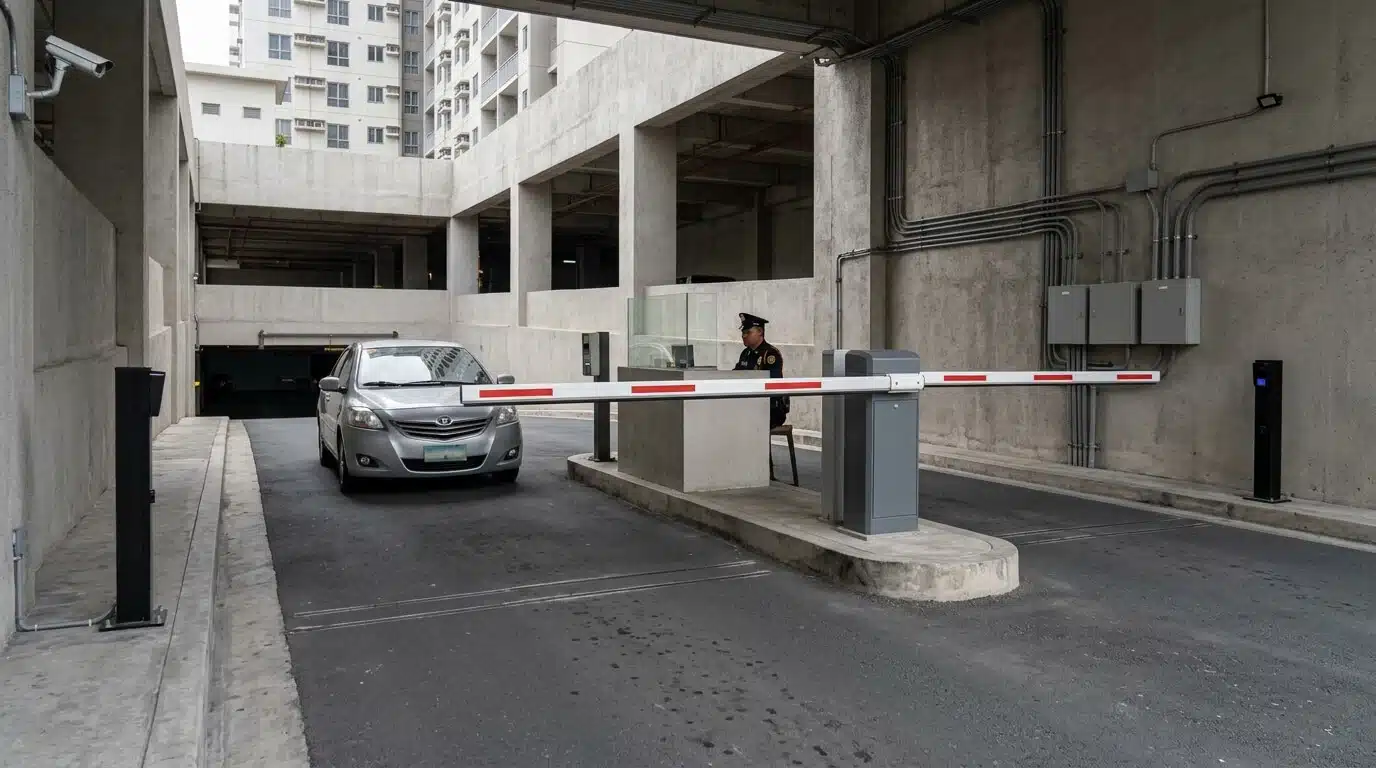
A parking barrier is only one part of a safe vehicle lane. Reliable operation depends on how the barrier controller, vehicle detection devices, safety sensors, access credentials and lane logic work together. For commercial buildings, condominiums, hospitals, offices and industrial facilities, proper planning helps reduce vehicle damage, unnecessary delays and access-control gaps.
PLANNING PRINCIPLE
Separate vehicle authorization from vehicle-presence detection. RFID, LPR and QR credentials may initiate an authorized opening command, but appropriate safety devices and controller logic must manage obstruction detection, vehicle clearance and safe barrier movement.
01 / DETECT
Identify Vehicle Presence
Define approach, under-barrier and clearance detection requirements.
02 / PROTECT
Manage Obstructions
Select suitable sensors and safety inputs for the actual lane conditions.
03 / COORDINATE
Integrate Access Logic
Coordinate barrier commands, credential readers and detection zones.
04 / COMMISSION
Test Safe Operation
Verify normal operation, obstruction response, faults and emergency procedures.
01 / PROJECT CONTEXT
Why Parking Barrier Safety Needs More Than a Boom Arm
A parking barrier controls vehicle passage, but safe operation requires more than raising and lowering the boom arm. The system must respond correctly when a vehicle approaches, enters the protected area, pauses beneath the arm or clears the lane.
A well-planned installation considers the barrier’s control inputs, vehicle detection devices, access authorization, lane geometry, traffic direction and the manufacturer’s operating requirements. These elements should be coordinated before installation rather than treated as unrelated equipment.
For an overview of available parking access technologies, see our Parking Barrier Systems solution.
02 / VEHICLE DETECTION
Core Parking Barrier Safety Devices
Different devices perform different functions. Their suitability depends on the required detection zone, installation conditions and compatibility with the barrier controller.
DEVICE 01
Inductive Loop Detectors
An inductive loop is installed in the pavement and connected to a detector that responds to changes in inductance caused by a vehicle.
Depending on the design, loops may be used for approach detection, vehicle presence beneath the boom or confirmation that a vehicle has passed through a zone.
DEVICE 02
Photocells and Photoelectric Beams
Photocells use a light beam between a transmitter and receiver to detect when an object interrupts the beam.
Mounting position, alignment, environmental conditions and the intended detection area must be considered to reduce blind spots and nuisance activations.
DEVICE 03
Barrier Controller and Safety Inputs
The controller interprets opening commands, position signals, safety inputs and configured operating conditions.
Its programmed behavior should prevent an unsafe closing sequence when the relevant safety input indicates an obstruction, according to the manufacturer’s supported logic.
DEVICE 04
Additional Safety Sensors
Depending on the application, additional compatible sensors or protective devices may be needed.
Selection should account for the hazard zone, vehicle profile, installation environment and applicable manufacturer and project requirements.
03 / SAFE LANE LOGIC
How Safe Barrier Sequencing Works
The barrier controller must distinguish an authorized opening command from a safety condition that requires the arm to remain open or stop closing, as supported by the selected equipment. Timing alone should not be treated as proof that the vehicle has cleared the protected area.
A valid credential or approved access event requests entry.
The controller receives the command and operates the barrier according to its configuration.
Detection devices monitor the designated zones as the vehicle moves through the lane.
The controller closes only when its required operating and safety conditions are satisfied.
The precise sequence must follow the selected barrier’s supported control logic. During commissioning, test the expected response to a vehicle stopping beneath the arm, a blocked sensor, a detector fault and other relevant operating scenarios.
04 / ENTRY, EXIT & TRAFFIC FLOW
Entry, Exit and Anti-Tailgating Logic
High-security or high-volume parking lanes may require multiple detection zones to identify vehicle approach, passage and clearance. The configuration should reflect the lane’s physical dimensions, traffic direction and access policy.
Coordinate credential validation, opening commands, vehicle-presence detection and safe clearance.
Determine whether exit is credential-controlled, free-flow or subject to another approved release method.
Use suitable detection and access logic to manage unauthorized follow-through without compromising safety or emergency access.
Anti-tailgating performance depends on more than a barrier timer. Vehicle spacing, lane length, detection placement, access policy and actual traffic behavior all affect the result. A site survey helps establish a practical design.
05 / ACCESS INTEGRATION
Integrating RFID, LPR and Visitor Access
Long-range RFID, license plate recognition (LPR) and visitor QR workflows can all be used to initiate parking access, but each has different recognition, timing and positioning requirements. Integration should coordinate access events with the barrier controller and vehicle detection zones.
Recognizes an authorized tag or credential within the reader’s operating range.
Reads a vehicle license plate for comparison with configured access records.
Validates a supported visitor credential according to the configured access workflow.
These access technologies establish authorization; they do not replace dedicated safety or vehicle-presence detection. For wider parking automation and connected-city applications, explore our Smart City Solutions.
06 / SITE INFRASTRUCTURE
Civil Works, Power and Installation Requirements
Safety devices need suitable physical installation and reliable connections to the control equipment. Civil works, cable routing and sensor positioning should be coordinated before installation begins.
Confirm lane width, boom length, turning path, vehicle clearance and available queuing space.
Plan the intended approach, presence and clearance zones before pavement cutting or sensor mounting.
Coordinate suitable power, grounding, surge protection and backup requirements according to the design.
Check cable pathways, conduit, termination, environmental exposure and controller interface compatibility.
07 / BOQ & PROCUREMENT
What to Include in a Parking Barrier Safety BOQ
The bill of quantities should capture the equipment, interfaces and installation work required for the approved lane design. Avoid assuming that all safety devices or accessories are included in the standard barrier package.
Barrier unit, boom arm, controller, mounting base and compatible accessories.
Loop detector components, loop cable, photocells and other required compatible protective devices.
RFID readers, LPR cameras, QR readers or other selected credential devices.
Foundations, pavement cutting, conduit, cabling, power and restoration where required.
Controller interfaces, access rules, detection logic and system integration.
Commissioning, safety scenario testing, user orientation and as-built documentation.
08 / COMMISSIONING
Testing and Commissioning Checklist
Commissioning should verify both normal operation and the response to relevant abnormal conditions. Tests must follow the manufacturer’s instructions and the approved safety plan.
- Validate authorized opening commands.
- Confirm vehicle detection and clearance.
- Check expected opening and closing sequences.
- Test applicable obstruction scenarios.
- Verify the configured response to safety-input activation.
- Check detector faults and recovery procedures.
- Validate approved and rejected credentials.
- Check the interface between access equipment and controller.
- Verify event reporting where supported.
- Record test results and approved settings.
- Document wiring and detection zones.
- Provide maintenance and handover instructions.
09 / PROJECT WORKFLOW
Recommended Parking Barrier Safety Workflow
Review lane geometry, traffic and existing equipment.
Identify safety zones, access rules and operating requirements.
Select compatible devices and prepare the BOQ.
Complete mounting, civil works and wiring.
Configure controller and access-system interfaces.
Test operating sequences, safety responses and handover.
10 / PROCUREMENT CHECKLIST
Before Approving Your Parking Barrier Installation
- Lane dimensions and boom-arm clearance
- Vehicle approach and clearance zones
- Loop detector and photocell locations
- Controller safety-input compatibility
- Emergency and manual-release procedures
- Required operating and fault tests
- RFID, LPR or visitor credential requirements
- Power, grounding and surge protection
- Conduit, wiring and civil works
- Integration and event reporting scope
- Commissioning and handover documents
- Maintenance access and future expansion
11 / RELATED SOLUTIONS
Related Parking and Security Solutions
Parking Barrier Systems
Explore vehicle barrier solutions and parking access control integration options.
Access Control Systems
Coordinate credentials, authorization rules and access events across compatible systems.
CCTV and Video Surveillance
Plan video coverage for vehicle lanes, entry points and parking areas.
12 / FAQ
Frequently Asked Questions
Can a parking barrier operate without a loop detector?
Some systems support other detection arrangements, but suitability depends on the barrier, controller, lane and application. A professional design should identify how vehicle presence and relevant hazards will be detected using compatible devices.
Is a photocell enough by itself?
Not necessarily. A photocell detects interruption of its beam, which may not cover every relevant vehicle position or hazard. Additional detection devices may be appropriate depending on the lane layout and the manufacturer’s safety requirements.
Can LPR replace a safety sensor?
No. LPR identifies a license plate for access authorization. It does not replace dedicated vehicle-presence or obstruction-detection devices.
Can existing parking lanes be upgraded?
Often yes, after reviewing the existing barrier and controller, sensor compatibility, wiring, civil works, detection locations and lane geometry. The upgrade scope should be based on a site assessment.
How often should parking barrier safety devices be checked?
Inspection frequency should follow the manufacturer’s instructions, operating conditions and maintenance plan. Checks should include sensor alignment, detector operation, wiring condition, controller response and documented functional testing.
PLAN A SAFER PARKING BARRIER LANE
Infinite Systems can assess vehicle flow, barrier safety, RFID or LPR access, visitor workflows and integration requirements for your parking facility.