
INFINITE SYSTEMS INSIGHTS
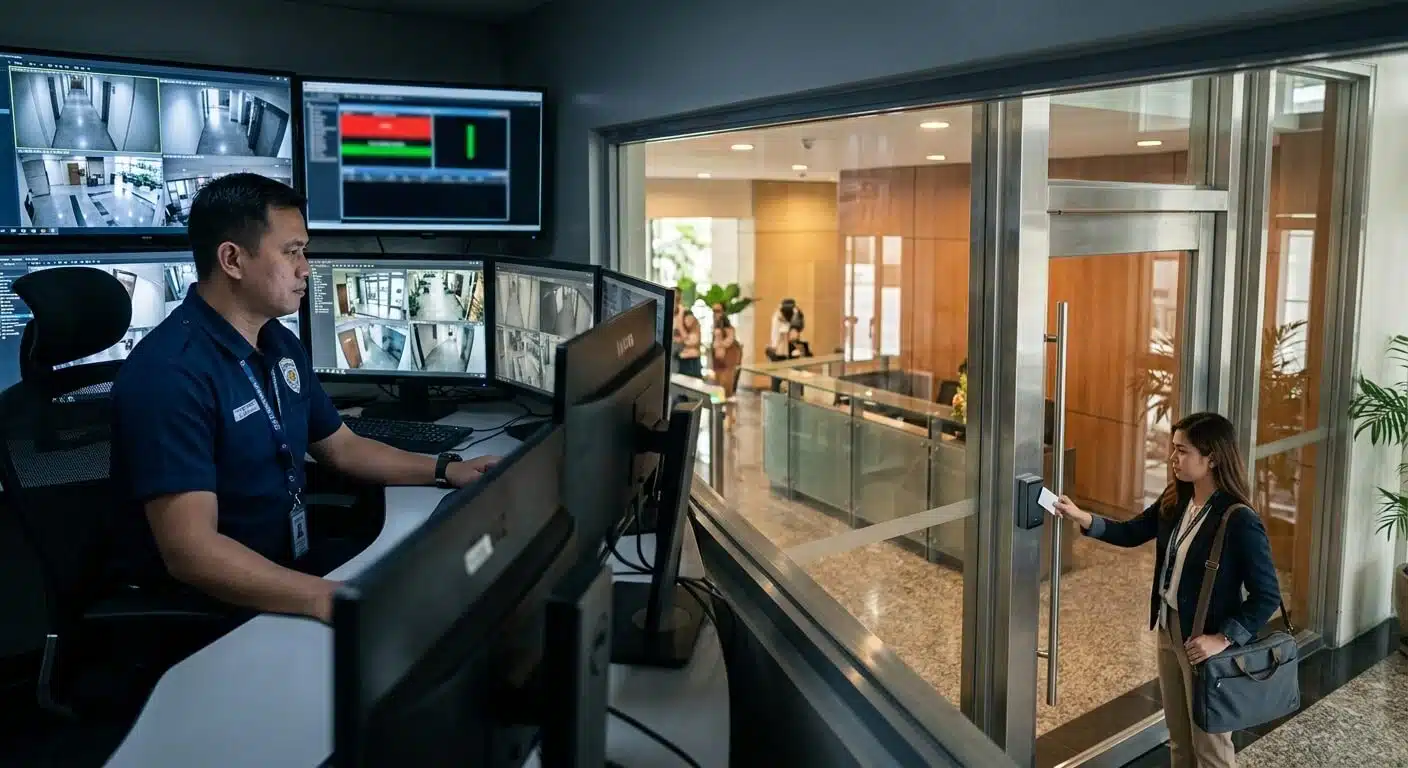
Access control tells a security team what the system recorded at a controlled entry point. CCTV helps show what was physically happening around that event. When the two are properly integrated, a valid card read, denied credential, forced-door alarm, or door-held-open condition can be associated with the relevant camera view so operators can verify exceptions and investigate incidents faster.
INTEGRATED SECURITY
The objective is not simply to place a camera beside a card reader. A useful integration needs consistent event data, synchronized time, suitable camera coverage, a defined operator workflow and enough retained evidence to reconstruct an incident.
What Access Control and CCTV Integration Actually Does
At a standalone controlled door, the access-control platform can record events such as a credential being accepted or denied. The CCTV platform separately records video. Integration creates a relationship between those two sources of information.
Depending on the capabilities of the selected platforms and interfaces, an access event may trigger a camera view, bookmark relevant video, create an alarm for an operator, or make it easier to retrieve footage associated with the event. The exact workflow must be confirmed against the access-control and video-management systems selected for the project.
A controller records a valid, denied or abnormal door event.
The system identifies the door, event type and relevant time.
The relevant camera or recorded video is presented or retrieved.
Security verifies, investigates, escalates or documents the event.
Which Door Events Benefit Most from Video Verification?
Valid Access
A valid credential means the system accepted the presented credential under the configured rules. Video can help establish whether the person passing through the door appears consistent with the event and whether another person followed through the opening. A valid credential by itself does not prove that only the authorized credential holder entered.
Access Denied
Repeated denied attempts can be operationally important. Video can help distinguish between a user presenting the wrong credential, a person attempting entry at an unauthorized location, or repeated activity that warrants closer review.
Door Forced Open
A forced-door condition generally indicates that a monitored door opened without the access-control system seeing the expected authorized release sequence. The event can result from unauthorized entry, a door or sensor problem, emergency activity or another site-specific condition. Nearby video gives the operator visual context before deciding how to respond.
Door Held Open or Open Too Long
A door may be legitimately opened but remain open beyond its configured period. Video can show whether people are moving equipment, a delivery is taking place, the door has been propped open, or the closing hardware is not returning the door properly.
A Practical Operator Verification Workflow
The operator sees the access-control alarm or exception with the controlled point and event type.
The integration or operating procedure brings up the camera covering the approach, door and immediate secured-side area.
Review video immediately before, during and after the event rather than relying on a single frame.
Confirm whether a person entered, the door remained open, someone followed another user, or a hardware issue appears to have occurred.
Follow the site’s escalation procedure, dispatch security when appropriate and preserve relevant evidence according to policy.
Why Timestamp Synchronization Matters
Event-to-video investigation depends on time. If the access-control server, controllers, video recorder and operator workstations are not using sufficiently consistent time, a door event may point an investigator to the wrong section of video. During commissioning, the project team should define how clocks are synchronized and verify timestamps under real operating conditions.
Camera Placement for Access Event Verification
A camera should be designed around the security question it needs to answer. A wide lobby overview may show general movement but limited identification detail. A tightly framed camera may show the doorway but miss the approach path. Designers should consider lighting, backlight from glass entrances, mounting height, field of view, obstructions and whether the camera can observe both the credential interaction and physical passage.
Retention and Investigation Requirements
Integration does not eliminate the need for a video-retention design. Recording duration depends on camera count, resolution, frame rate, compression, recording mode, available storage and the organization’s retention policy. Access-event records and CCTV footage may have different retention requirements. Security teams should define how authorized personnel retrieve events and footage, export evidence when required and protect recorded personal information.
How Can the Systems Be Integrated?
There is no single method for every access-control and CCTV platform. Projects may use supported software integrations, APIs, event interfaces, video-management integrations or other vendor-supported mechanisms. Simpler interfaces may provide an alarm trigger, while deeper software integration may allow richer event information and more direct retrieval of associated video.
Before procurement, confirm the exact platforms, software versions, licenses, interfaces and responsibilities. A specification should state what event is sent, what the receiving system does with it and what the operator should see.
Commissioning: Test the Workflow, Not Just the Devices
- Present a valid credential and confirm the expected event and camera association.
- Present a credential that should be denied and verify the operator workflow.
- Test configured forced-door and door-held-open conditions where applicable.
- Confirm access-control and CCTV timestamps are sufficiently aligned.
- Verify the selected camera view shows the required doorway and approach area.
- Test recorded-video retrieval after the event, not only live display.
- Confirm operator permissions, alarm acknowledgement and evidence-export procedures.
- Document platform versions, licenses, interfaces and final configuration.
Common Integration Mistakes
- Camera coverage exists but cannot answer the investigation question.
- Timestamp differences send operators to the wrong section of video.
- Every alarm is treated as intrusion even though operational or hardware conditions may also create exceptions.
- The specification says “integration” without defining the event-to-operator workflow.
- Individual devices are tested but the complete investigation workflow is not commissioned.
Related Infinite Systems Solutions
Centralized credential, permission and access-event management.
View Access Control Systems
Professional video surveillance for monitoring and investigation.
View CCTV Systems
Control and monitor office, tenant and restricted-area doors.
View Door Access Control
Frequently Asked Questions
Can CCTV automatically show video when an access-control alarm occurs?
It can where the selected access-control and video platforms provide a compatible integration and the required workflow has been configured. Exact behavior varies by platform, version, licensing and interface.
Which access events should be linked to CCTV?
Common candidates include valid and denied access, forced-door conditions and door-held-open events. The most useful events depend on site risk, staffing and operating procedures.
Does a valid card event prove the cardholder entered?
No. It proves the system accepted the credential under its configured rules. Video can add physical context by showing who approached and who passed through the controlled point.
Why do timestamps matter?
Investigators use event time to locate corresponding video. Clock differences can make review slower or misleading, so time alignment should be tested during commissioning.
Can existing access control and CCTV systems be integrated?
Possibly. The integrator must identify the existing platforms, versions, licenses and available interfaces. Some combinations support deeper software integration while others allow only limited event interfacing.
Should video retention match access-log retention?
Not necessarily. Video and access records have different storage characteristics and may be governed by different operational or privacy requirements.
PLAN AN INTEGRATED SECURITY WORKFLOW
Need Access Control and CCTV to Work Together?
Infinite Systems can assess your controlled entrances, camera coverage, access events, software interfaces and operator workflow, then define an integration and commissioning plan appropriate for your Philippine facility.