
INFINITE SYSTEMS INSIGHTS
Plan a turnstile installation in the Philippines with practical guidance on lane space, pedestrian flow, power, data cabling, mounting, access-control integration, fire alarm interfaces, safe egress and commissioning.
TURNSTILE SYSTEMS
A good turnstile specification starts with the building workflow, available space, infrastructure, integration requirements and safety considerations—not simply the selection of a device model. Explore Turnstile Systems.
01 PROJECT PLANNING
Why Turnstile Installation Planning Matters for Philippine Projects
A turnstile is part of an entrance workflow, not an isolated piece of equipment. Its effectiveness depends on how people approach the lane, authenticate, pass through, exit and respond to exceptions.
Security and building-system projects can encounter problems when physical layout, power, cabling, software, access control, life-safety interfaces and actual user flow are considered only after equipment has been selected. Early engineering helps reduce scope gaps and gives owners, consultants, contractors and security integrators a clearer basis for comparing proposals.
Document users, entry rules, peak traffic, exceptions and security objectives.
Confirm space, power, network, access control and other required interfaces.
Install, configure and test the equipment against the approved design.
Provide documentation, training, maintenance planning and future expansion options.
02 SITE & PEOPLE FLOW
Start With the Entrance Layout and User Flow
Before selecting the turnstile type or number of lanes, understand how people actually use the entrance. The design should accommodate normal traffic while providing a controlled process for visitors, accessibility requirements, maintenance and exceptional situations.
Measure the available installation area and confirm that the proposed equipment fits without obstructing surrounding circulation.
Consider employee arrival, shift changes, school or office opening periods, events and other high-volume conditions.
Provide an appropriate access route for users who cannot or should not use a standard turnstile lane.
Review nearby doors, gaps and circulation paths that could allow people to bypass the intended controlled entrance.
Site survey note: Final lane arrangement and equipment quantities should be based on actual site measurements, user flow and the selected equipment dimensions. Do not rely on floor-plan assumptions alone.
03 TURNSTILE SELECTION
Choose the Turnstile Type Around the Application
Different entrance environments may require different turnstile configurations. Selection should consider the level of control required, traffic characteristics, available space, aesthetics, security objectives and the required access-control interface.
Can be considered for controlled pedestrian entrances where a compact lane arrangement is appropriate.
May be suitable for applications requiring a more physically controlled pedestrian boundary.
Can be considered for higher-end lobby environments where controlled access and pedestrian throughput are key design factors.
Other gate or lane arrangements may be considered where site layout, user requirements or architectural conditions call for them.
The final equipment selection should be based on verified product capabilities, site conditions and the required integration architecture.
04 SPACE & MOUNTING
Plan Lane Space, Foundations and Mounting Conditions
Turnstile installation requires more than the footprint of the equipment itself. The surrounding pedestrian lane, reader location, cable routes, maintenance access and mounting surface should be considered during the design stage.
Confirm the manufacturer’s dimensions and required clearances before finalizing the lane layout.
Verify whether the existing floor can support the proposed mounting method and installation requirements.
Place credential readers where users can authenticate naturally without creating unnecessary congestion.
Allow technicians sufficient access to equipment, controllers, power supplies and cable connections.
For retrofit projects, check the existing slab, finished floor, nearby doors, walls and concealed services before drilling or installing foundations. The final mounting method should follow the selected equipment manufacturer’s requirements and the approved project design.
05 POWER & DATA
Confirm Power, Network and Data Cabling Requirements
Infrastructure requirements should be identified before installation begins. The exact requirements vary by turnstile model, access-control controller and project architecture.
Confirm voltage, current requirements, protection, isolation and any backup-power provisions applicable to the equipment.
Determine whether the access-control architecture requires LAN connectivity and coordinate network access with the IT team.
Plan cable types, routes, containment and termination points between readers, controllers, turnstiles and network equipment.
Identify secure and serviceable locations for controllers, power supplies, interface modules and related equipment.
Coordination note: Security, electrical, IT and other relevant trades should agree on cable pathways, power provisions, equipment locations and responsibilities before installation.
06 ACCESS CONTROL INTEGRATION
Design the Turnstile as Part of the Access-Control System
A turnstile normally forms part of a larger access-control workflow. The design should identify where credentials are presented, where access decisions are processed and how the turnstile receives the authorization command.
The user presents an approved credential using the selected authentication method.
The system evaluates identity, permissions, schedules and other configured access rules.
The approved access decision is communicated to the turnstile through the supported interface.
Relevant access events and device status can be recorded by the selected access-control platform where supported.
Integration may involve relays, controllers, communication protocols, APIs or other supported interfaces. Exact capability depends on the selected equipment and vendor documentation.
For broader access-control requirements, see Access Control Systems.
07 SAFETY & EGRESS
Coordinate Fire Alarm Interfaces and Safe Egress
Turnstiles installed in occupied buildings must be considered within the building’s overall life-safety and emergency-egress strategy. The security system should not be designed separately from the approved emergency workflow.
Define how authorized users enter and how the turnstile controls the lane during normal conditions.
Identify any required interface with the fire alarm or other approved emergency systems.
Confirm that the planned entrance arrangement does not create an inappropriate obstruction to the approved exit strategy.
Define and test the process for returning the system to normal operation after an emergency or fault condition.
Important: Emergency release, override and egress behavior should follow the approved building life-safety design and applicable project requirements. The exact behavior should be coordinated with the responsible parties and verified during commissioning.
08 FAILURE MODES
Plan for Power Loss, Network Failure and Equipment Faults
Turnstile specifications should address abnormal conditions before installation. Understanding expected failure behavior helps facility teams prepare procedures and helps integrators test the system properly.
Document the expected equipment behavior when normal power is interrupted.
Confirm how access decisions and local operation are handled if communication with the system is interrupted.
Establish an appropriate procedure for users and security personnel when the authentication device is unavailable.
Plan service access, fault reporting and manual procedures where applicable to the selected equipment.
09 PROCUREMENT
Turnstile Installation Procurement Checklist
Before requesting quotations, prepare a project brief that allows suppliers and contractors to understand the complete installation scope.
Site & Layout
- Entrance dimensions
- Lane quantity
- Pedestrian flow
- Mounting conditions
- Accessible route
System & Integration
- Access-control platform
- Credential type
- Controller requirements
- Required interfaces
- Software requirements
Infrastructure
- Power requirements
- Network connectivity
- Data cabling
- Containment and pathways
- Equipment locations
Safety & Support
- Emergency behavior
- Testing criteria
- Training
- Warranty
- Maintenance support
10 IMPLEMENTATION
Turnstile Installation Workflow
Measure the entrance, inspect existing infrastructure and document physical constraints.
Define users, traffic patterns, accessible routes, exceptions and security procedures.
Finalize turnstile type, lane arrangement, power, cabling, interfaces and equipment quantities.
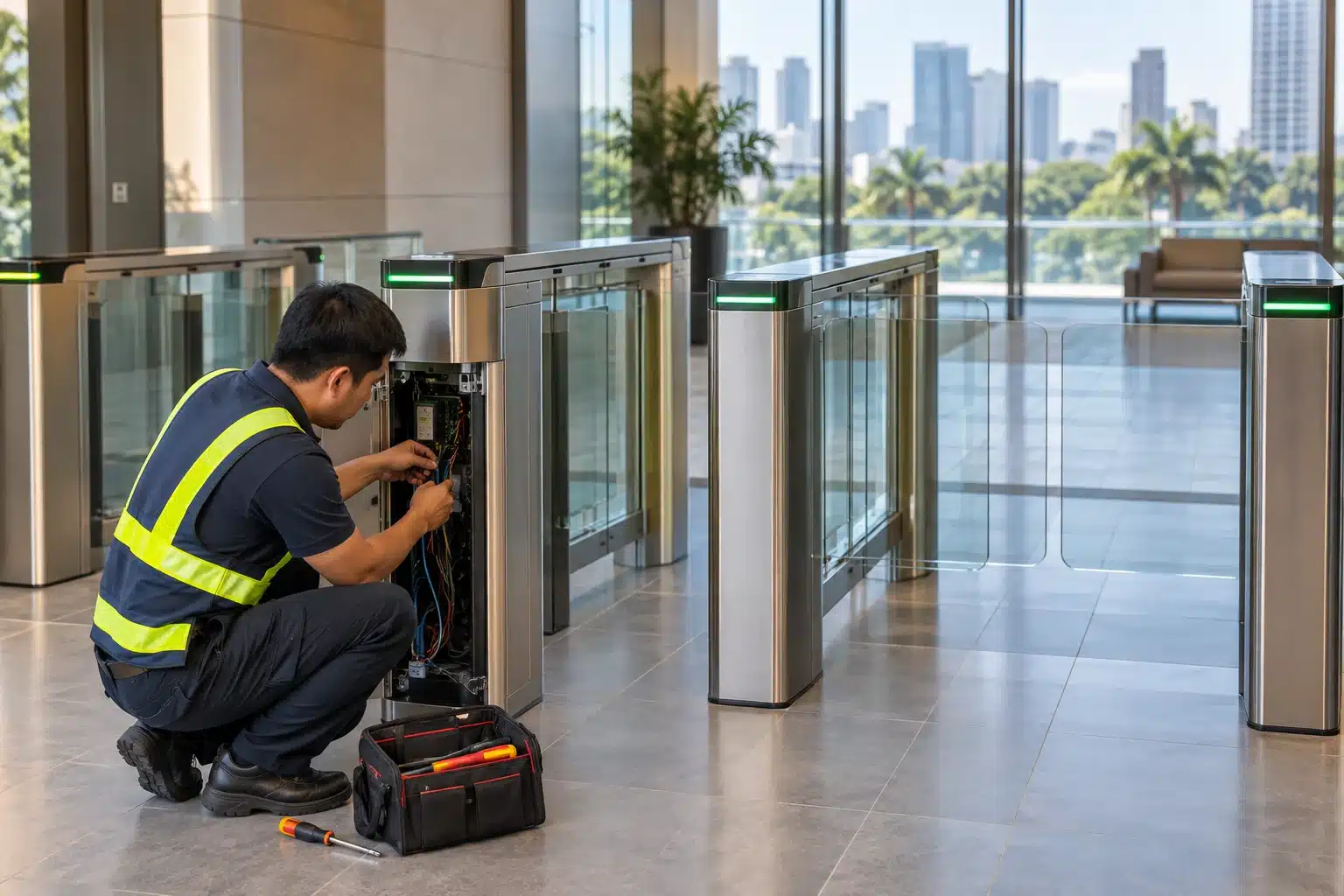
Complete mounting, electrical works, cabling, readers, controllers and system connections.
Program credentials, access groups, schedules, permissions and required system parameters.
Verify normal operation, interfaces, exceptions, approved emergency behavior and documentation.
11 FINAL CHECK
Turnstile Installation Requirements Checklist
- Actual entrance dimensions have been verified.
- Expected pedestrian traffic and peak periods have been identified.
- Required number of lanes has been evaluated.
- Accessible routes and surrounding circulation have been considered.
- Turnstile type has been selected according to the application.
- Mounting and floor conditions have been assessed.
- Power requirements and electrical provisions have been confirmed.
- Network and data-cabling requirements have been identified.
- Controller and equipment locations have been planned.
- Access-control integration requirements have been documented.
- Third-party interface responsibilities have been agreed.
- Fire alarm, emergency and egress requirements have been coordinated.
- Power-loss and communication-failure behavior has been defined.
- Testing, training, documentation, warranty and maintenance requirements have been included.
12 FREQUENTLY ASKED QUESTIONS
Turnstile Installation FAQs
Can turnstiles be installed in an existing Philippine building?
Often yes. A site assessment is needed to confirm available floor space, mounting conditions, power, network connectivity, cable pathways and compatibility with existing security systems.
How much space is required for a turnstile?
The required space depends on the selected equipment, lane configuration, surrounding circulation and accessibility requirements. Manufacturer dimensions should be checked against actual site measurements before installation.
Can a turnstile integrate with an existing access-control system?
Integration is possible where the selected turnstile, controller, reader and access-control platform provide compatible interfaces. Exact capabilities should be verified by equipment model and project requirements.
Does a turnstile need network connectivity?
It depends on the system architecture. Some configurations require network connectivity for controllers or software, while other equipment may use different communication arrangements.
Should turnstiles be connected to the fire alarm system?
Where required by the approved building life-safety design, the relevant emergency behavior and interfaces should be coordinated and tested with the responsible systems and contractors.
Why is commissioning important for a turnstile project?
Commissioning confirms that the turnstile, readers, controllers, software, interfaces and operating procedures work together as intended. Testing should include normal workflows and applicable exception and emergency scenarios.
RELATED SOLUTIONS
Related Infinite Systems Solutions
Controlled pedestrian entry for offices, commercial buildings and other facilities.
Consider controlled pedestrian access for higher-end lobby and entrance environments.
Manage credentials, users, permissions and controlled entry points.
TURNSTILE PROJECT PLANNING
Planning a Turnstile Installation?
Share your site dimensions, expected traffic, existing access-control system, drawings and integration requirements. Infinite Systems can help assess the installation scope and develop a practical approach for design, implementation, commissioning and long-term support.