
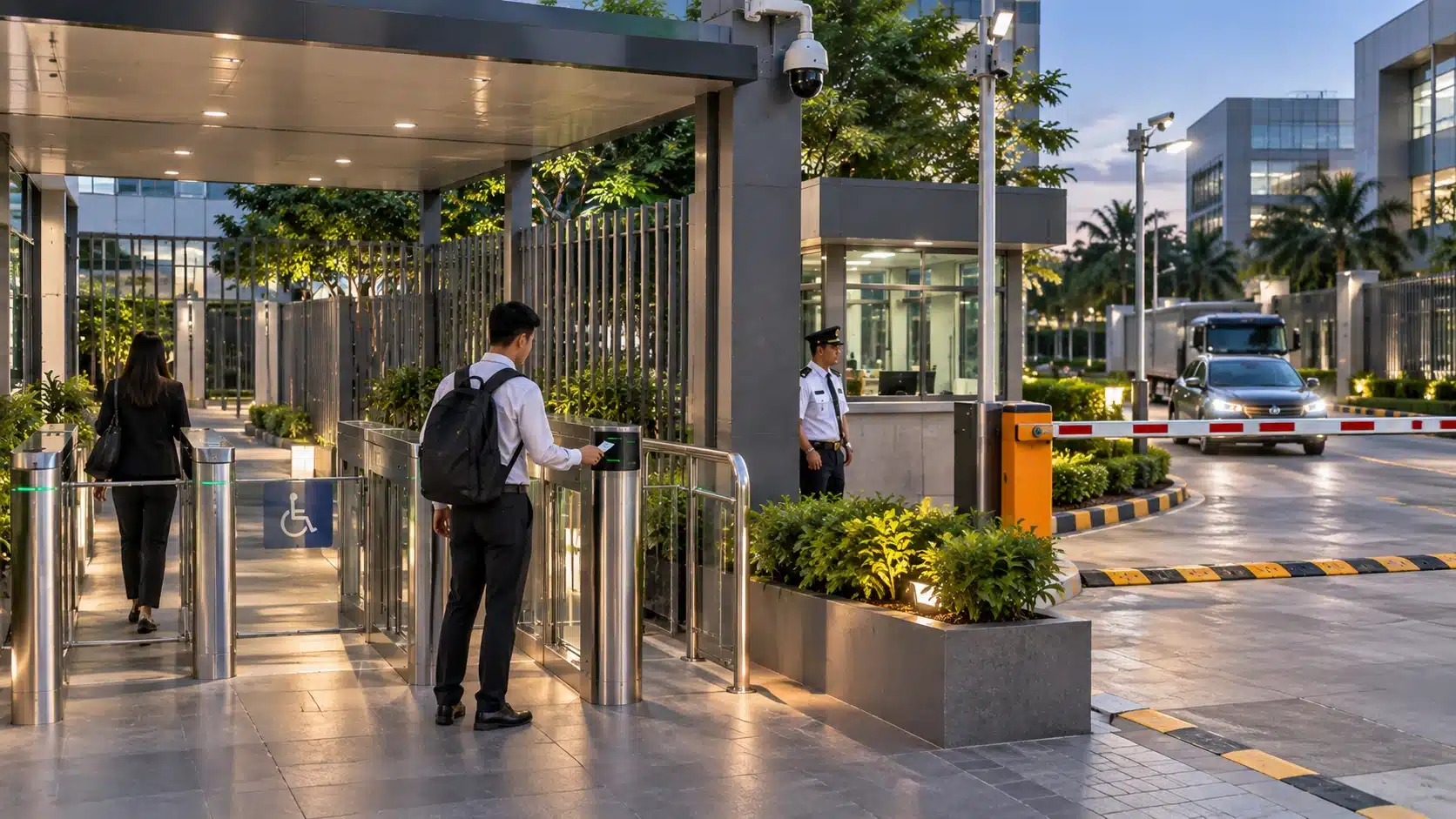
Integrated Perimeter Security: Connecting CCTV, Access Control, Barriers and Intrusion Detection
Many facilities already have cameras, gates, barriers, access control, visitor management, and security personnel. The challenge is that these systems may operate as separate islands. Integrated perimeter security connects these technologies so that events in one system can provide useful context from another.
For a perimeter, integration can mean a gate alarm opening the appropriate camera view, a denied access event being associated with video, or a visitor authorization coordinating pedestrian and vehicle access.
The objective is not simply to connect more devices. A properly planned system should help operators detect, verify, authorize, control, record, and respond with less manual switching between disconnected platforms.
From Separate Security Devices to a Coordinated Workflow
Infinite Systems can assess existing CCTV, access control, vehicle barriers, visitor management, turnstiles, intrusion detection, and alarm interfaces to identify practical integration opportunities for a facility’s perimeter.
Identify Events
Add Video Context
Manage Entry
Guide Operators
What Integrated Perimeter Security Means
Integrated perimeter security connects the systems that detect, verify, authorize, block, record, and respond to activity around the outer boundary. The exact level of integration depends on the products, interfaces, software platforms, and project requirements available.
Core Systems in an Integrated Perimeter
Example: Denied Pedestrian Access
Consider a person presenting a credential at a controlled pedestrian gate. If access is denied, the event can be recorded by the access control system.
Credential Presented
Access Denied
Event Logged
CCTV View
Operator Verifies
Where integration is supported, the relevant CCTV camera can be associated with the access event so the operator can verify the person and determine whether intervention is required.
Example: Vehicle Arrival at a Controlled Lane
A vehicle approaches a controlled entrance. Depending on the facility and selected equipment, the system may use RFID, license plate recognition, ticketing, guard authorization, or another configured method before operating the parking barrier.
Visitor information can provide additional context for expected guests, contractors, deliveries, or other temporary vehicle movements.
Example: Fence Intrusion Alarm
When a fence sensor or video analytics system identifies a potential intrusion, the control room needs more than a simple alarm notification. The useful information includes the location, associated camera view, alarm time, event status, and response instructions.
The value of integration is therefore not the alarm alone. It is the ability to create a clearer path from detection to verification and action.
Where Visitor Management Fits Into the Perimeter
Visitor management connects temporary people and vehicles to an approved host, date, time, destination, or other configured authorization information. Where supported, visitor workflows can coordinate temporary credentials and access across reception, gates, turnstiles, elevators, parking areas, and other controlled points.
Questions to Answer Before Integrating Security Systems
A Practical Approach to Security System Integration
Audit Existing Systems
Map Security Events
Confirm Compatibility
Design Workflows
Configure and Test
Train and Maintain
Integration should be tested using actual operating scenarios rather than assuming that technical connectivity automatically produces a useful security workflow.
Can Existing Security Equipment Be Integrated?
In some projects, existing equipment can remain in service while selected systems are connected to a newer platform. This depends on the equipment’s communication interfaces, software compatibility, licensing, controller capabilities, network architecture, and the integration functions required.
- Available communication interfaces and protocols
- API, SDK, relay, or native integration support
- Software and firmware versions
- Licensing or subscription requirements
- Required event types and commands
- Network and cybersecurity requirements
- Fallback operation when integration is unavailable
Integrated Perimeter Security – Frequently Asked Questions
Does integration require one brand for every security system?
Not necessarily. Multi-vendor integration may be possible through relays, APIs, SDKs, platform-native connectors, or other supported interfaces. Compatibility should be confirmed during design.
What is the main benefit of integrated perimeter security?
Integration can give operators more useful context around security events and reduce the need to manually switch between disconnected systems during verification and response.
Can CCTV integrate with access control events?
Yes, many platforms support event-based video association or camera call-up, subject to product compatibility, configuration, and available interfaces.
Can visitor management connect to parking and turnstiles?
Yes, where supported. Temporary visitor permissions can potentially be coordinated across selected parking, pedestrian, and building access points.
What happens if the network connection between systems fails?
The response depends on the equipment and system architecture. A proper design should define fallback operation, local control, alarm handling, and recovery procedures before implementation.
Should all security systems be integrated?
Not necessarily. Integration should be based on operational value. The priority is usually to connect events and systems where shared information can improve verification, control, response, or reporting.
Build a Connected Perimeter Security System
Need to Integrate Your Existing Security Systems?
Tell us about your existing CCTV, access control, barriers, visitor workflows, turnstiles, intrusion detection, gates, and alarm interfaces. Infinite Systems can help identify practical integration options based on your facility, equipment, and operating requirements.