
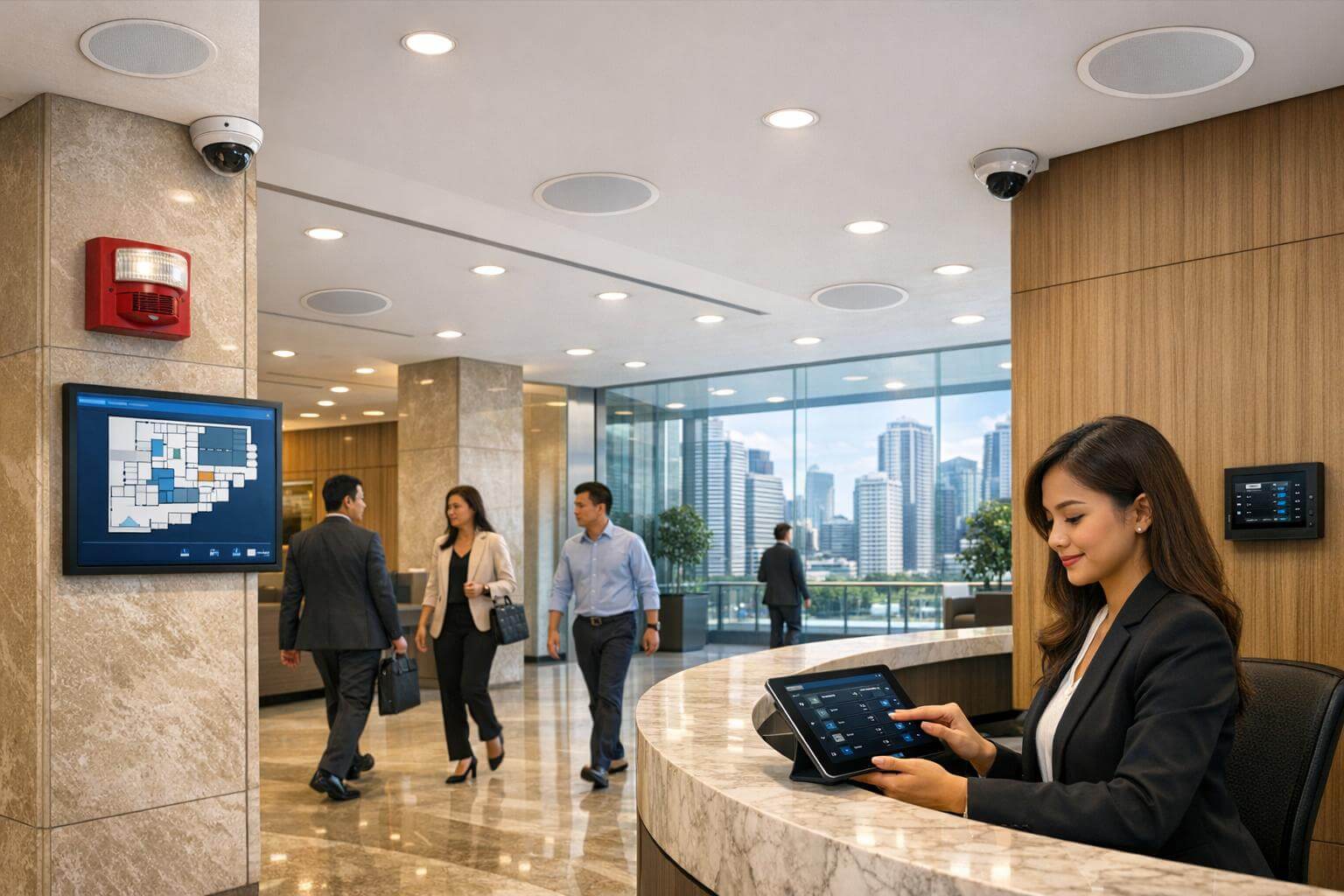
In a high-rise commercial tower in BGC or a sprawling university campus in Quezon City, the difference between a controlled emergency evacuation and life-threatening confusion can come down to one critical system: your public address infrastructure. Yet across many Philippine facilities, PA and background music systems are still treated as afterthoughts — cheaply specified, poorly integrated, and entirely disconnected from the building’s fire alarm and security ecosystem.
Property developers, facility managers, and building engineers across the Philippines are recognizing a fundamental shift. PA and BGM systems are no longer simply speaker boxes for playing music or making general announcements. When properly designed and integrated with life safety, access control, and building management systems, a PA/BGM platform becomes a core operational layer of your building’s intelligence — capable of automatically triggering voice evacuations, zoning music across 50 floors, and guiding hundreds of occupants to safety within seconds of an emergency trigger.
This guide is written for decision-makers overseeing large-scale commercial properties in the Philippines: office towers, shopping malls, hospitals, hotels, universities, and manufacturing facilities. We will break down what PA and BGM systems are, how they integrate with other building systems, and how to design the right solution for your facility — one that meets the Fire Code of the Philippines, satisfies your tenants, and scales with your portfolio.
What Is a PA/BGM System?
A Public Address (PA) system is an electronic sound amplification and distribution network used for announcements, emergency broadcasts, and voice communication across large buildings or multi-building campuses. A Background Music (BGM) system delivers ambient audio — curated music, nature sounds, or branded content — to specific zones within a facility.
In modern commercial buildings, these two systems are combined into a single, unified PA/BGM platform that serves multiple critical functions simultaneously:
- Delivery of zoned background music to lobbies, retail areas, corridors, amenity floors, and F&B outlets
- Broadcasting live or pre-recorded announcements across the entire building or targeted zones
- Automatic integration with fire alarm systems to activate voice evacuation messages
- Connection with PABX and intercom systems for operator-controlled paging
- Centralized scheduling, remote management, and real-time monitoring via a digital control platform
The critical distinction between a basic PA setup and a fully integrated PA/BGM solution is intelligence. A basic system plays audio on demand. An integrated system responds to building events in real time, adapts automatically to emergency conditions, and gives your operations team centralized control from a single interface. For large-scale Philippine facilities — from a 60-storey mixed-use tower to an industrial complex in Laguna — this level of integration is both an operational requirement and a regulatory necessity.
Why PA/BGM Integration Matters for Philippine Buildings
1. Life Safety and Regulatory Compliance
The Fire Code of the Philippines (Republic Act 9514) and its Implementing Rules and Regulations require that buildings of certain occupancy classifications — including high-rise offices, hospitals, schools, and assembly buildings — have functional, intelligible emergency voice communication systems. A properly integrated PA/BGM system with voice evacuation capability is the most efficient way to meet this requirement while simultaneously serving day-to-day operational needs.
2. Emergency Response Speed
In a building emergency, response time is measured in seconds — not minutes. An integrated PA/BGM system can automatically activate a pre-recorded voice evacuation message across all zones within three seconds of a fire alarm trigger, without waiting for a human operator to respond. In a 40-storey building with over 5,000 occupants, this automation can be the difference between an orderly evacuation and a catastrophe.
3. Operational Efficiency and Cost Reduction
A unified PA/BGM platform eliminates the need for separate, standalone audio systems. A single infrastructure investment serves background music, general paging, emergency broadcasts, and intercom — reducing equipment costs, cabling complexity, and ongoing maintenance requirements.
4. Tenant Satisfaction and Brand Experience
For malls, hotels, and mixed-use developments, zoned BGM creates distinct brand atmospheres across different areas of the property. Luxury hotels curate different sonic environments in their lobby, spa, restaurants, and pool areas. Retail podiums use BGM to drive footfall and dwell time. This is not merely aesthetic — it is a revenue-driving operational capability.
System Breakdown: Components of an Integrated PA/BGM Solution
A. Public Address (PA) Systems
A commercial PA system for a large Philippine building typically consists of:
- Central PA amplifier rack or digital matrix audio processor (the brain of the system)
- Zone controllers for granular audio routing — each floor, area, or building section independently addressable
- Speaker arrays including ceiling speakers, pendant speakers, horn speakers, and column speakers positioned according to acoustic engineering specifications
- Operator control interface — a dedicated microphone console, IP controller, or touchscreen panel at the security desk or building management center
- Priority override inputs that allow emergency sources (fire alarm, security) to automatically take control of the audio system
In a 50-storey office tower, a well-designed PA system might serve 60 to 80 discrete zones — individual floor sections, elevator lobbies, parking levels, podium retail, and rooftop amenity areas — each independently controllable, with the ability to address specific zones or all zones simultaneously.
B. Background Music (BGM) Systems
The BGM component operates as a continuously active or scheduled audio layer running beneath the PA system. A digital BGM matrix allows:
- Independent audio playlists or streams per zone — jazz in the lobby, ambient tones in the gym, upbeat retail music in the podium
- Time-based scheduling — morning, afternoon, evening, and closing programs
- Per-zone volume control from a central dashboard or mobile app
- Integration with digital signage systems for synchronized audio-visual marketing campaigns
- Remote content management — update playlists or scheduling without visiting the building
For hospitality and retail environments in the Philippines, BGM is a critical brand touchpoint. Five-star hotels across Manila Bay, luxury retail in BGC, and premium mixed-use developments in Ortigas invest significantly in BGM design as part of their overall tenant and guest experience strategy.
C. Voice Evacuation Systems
Voice evacuation is a specialized, life-safety-critical subset of the PA system. It operates under stricter performance and reliability standards than general PA, and must be designed to the requirements of NFPA 72 or EN 54-16, as applicable. Key components include:
- Dedicated voice evacuation amplifiers with automatic fault detection and failover capability
- Supervised speaker circuits with end-of-line resistance monitoring — the system continuously verifies every speaker in the network is functional
- Pre-recorded evacuation messages in Filipino, English, and other languages as required by occupancy
- Automatic activation through hardwired relay from the Fire Alarm Control Panel (FACP)
- Battery backup and UPS power supply to maintain full system operation during utility power failure
For Philippine high-rise buildings above 15 floors, voice evacuation systems are increasingly specified as a standard requirement by fire protection engineers and mandated by local building officials, especially in Metro Manila and other major urban centers.
D. PABX and Intercom Integration
For buildings with an existing PABX telephone system, the PA/BGM platform can be tightly integrated to allow:
- Zone paging directly from any IP phone or PABX extension — enabling front desk staff, building managers, or department heads to make announcements without a dedicated PA console
- Intercom communication between specific zones, such as basement parking to lobby, loading bay to receiving area, or security station to perimeter
- Automatic transfer of inbound calls to PA broadcast during emergency conditions
This integration significantly expands the operational utility of the PA system while eliminating the need for staff to physically access a dedicated PA control room.
E. Smart Integration Layer: BMS and Centralized Control
The most advanced PA/BGM deployments in Philippine commercial and institutional buildings are fully connected to the Building Management System (BMS) or a centralized integrated platform. This enables:
- Event-driven audio triggers — fire alarm activation, access control events, time-of-day scheduling, and occupancy sensor data automatically controlling audio behavior
- Remote system management via web dashboard or mobile application — manage your building’s entire audio ecosystem from anywhere
- Real-time system health monitoring with instant fault alerts — faults are detected and escalated before they become failures
- Unified operator interface combining PA/BGM, fire alarm, CCTV, and access control into a single workstation
Real Integration Scenarios: PA/BGM Working With Your Building Systems
Scenario 1: Fire Alarm to Automatic Voice Evacuation
A smoke detector on the 22nd floor of a BGC office tower detects an alarm condition. The FACP immediately sends a hardwired relay signal to the voice evacuation system. Within three seconds, background music on all affected zones is muted, and a pre-recorded evacuation message begins broadcasting on the 22nd floor and adjacent floors. Upper and lower floors receive a standby alert. The entire sequence is automatic, audible, intelligible, and compliant with the building’s fire safety plan — without any human operator action required.
Scenario 2: Security Lockdown with Targeted Zone Paging
A security incident occurs at the main lobby entrance. The security team activates a lockdown protocol from the control room. The PA system delivers a targeted announcement to the lobby and ground floor zones only, without disrupting occupants on upper floors. Simultaneously, access control locks down the turnstiles, CCTV focuses on the incident area, and a notification is dispatched to the building’s security operations center. The PA system’s zone granularity prevents building-wide panic while enabling targeted communication.
Scenario 3: Automated Mall Operations
A regional shopping mall in Metro Manila uses its PA/BGM platform to fully automate its daily audio operations. At 9:55 AM, upbeat opening music begins across all retail zones. Promotional announcements play every 30 minutes on a rotation. The Angelus rings at noon across the food court. Tenant-specific BGM plays within anchor tenant areas. At 9:00 PM, a pre-recorded closing announcement begins across all floors in sequence. All of this runs from a pre-programmed schedule with zero operator intervention during normal operations.
Scenario 4: Phased Floor Evacuation Coordination
During a fire drill in a 40-storey mixed-use tower in Ortigas, the voice evacuation system broadcasts floor-by-floor phased evacuation instructions. Floors immediately above and below the alarm floor evacuate first. Other floors receive standby instructions and begin preparing. The system coordinates with the elevator control system, which has recalled all lifts to the ground floor. Stairwell speakers provide continuous evacuation guidance. The building’s emergency response team monitors the process via a centralized BMS dashboard.
Scenario 5: Hospital Code Announcement Integration
A private hospital in Makati integrates its PA system with its clinical workflow platform. When a code alert is triggered from any nursing station, the PA system automatically broadcasts the appropriate clinical announcement to the relevant wing or department — without requiring staff to call the switchboard or use a separate intercom. Code Blue, Code Red, and other emergency codes are pre-programmed for immediate, one-touch broadcast across the relevant zones.
Decision Framework: Designing the Right PA/BGM System for Your Facility
Selecting and specifying a PA/BGM system for a large Philippine facility is a technical engineering exercise that requires careful analysis of several interdependent factors:
- Building Type and Occupancy: Office towers require high-intelligibility speech systems with precise zone control. Malls prioritize BGM quality and marketing flexibility. Hospitals require both soothing BGM and a certified voice evacuation system. Industrial facilities need high-output horn speakers rated for noisy environments.
- Regulatory Compliance: Buildings above certain occupancy thresholds under RA 9514 must have functional emergency voice communication. Your system specification must be reviewed against local building code requirements and submitted to the Bureau of Fire Protection (BFP) as part of your fire safety plan.
- Acoustic Engineering: Large spaces require proper acoustic modeling to ensure speech intelligibility scores (STI/STIPA) meet the thresholds required by the relevant standard. A technically compliant system sounds good, not just loud.
- Integration Requirements: Identify all systems the PA/BGM platform must interface with: fire alarm (FACP model and brand), access control system, BMS, PABX, and digital signage. Compatibility must be verified at the design stage, not the installation stage.
- Scalability: Plan for future expansion — additional floors, phases, or buildings on the same campus. A digital matrix-based system scales far more cost-effectively than analog alternatives.
Real-World Applications Across Philippine Building Types
Office Towers (BGC, Makati, Ortigas, Alabang)
Grade-A office towers require sophisticated PA/BGM systems capable of serving multiple tenants across 30 to 60 floors, with per-floor zone control, tenant override capability within their leased areas, and full voice evacuation integration with the building’s fire alarm system. The system must also support facilities management operations — announcements, background music in common areas, and parking level paging.
Shopping Malls and Commercial Complexes
Malls in Metro Manila and major regional cities rely on PA/BGM for brand ambiance across anchor and specialty tenant areas, emergency broadcasts, promotional campaigns, and operational announcements. Anchor tenants typically require independent BGM within their stores while the mall PA system retains emergency override authority. System design must account for high ambient noise levels and the need for multiple simultaneous zones.
Hospitals and Medical Centers
Hospital PA systems balance clinical sensitivity — low volume, non-disruptive background audio in patient areas — with robust emergency broadcast capability in clinical and public zones. Integration with nurse call systems, code announcement protocols, and fire evacuation are all built into the system design. Speaker placement must account for acoustic isolation between clinical and public areas.
Universities and School Campuses
Multi-building campus PA systems support daily bell schedules, administrative announcements, emergency drills, and large-scale events. Campus-wide integration allows a single control point to address all buildings simultaneously or by zone. Integration with access control, CCTV, and visitor management provides comprehensive campus safety management.
Hotels and Resorts
Luxury hospitality properties in Metro Manila, Cebu, Palawan, and Boracay require multi-zone BGM with premium audio quality, seamless emergency override capability, and integration with the hotel’s property management system. Guest room audio, pool deck sound systems, and F&B outlet BGM are all managed from a unified platform. International brand standards often specify minimum audio quality and system performance requirements.
Manufacturing and Industrial Facilities
Industrial environments in PEZA zones and special economic zones in Laguna, Cavite, and Batangas require robust PA systems with high-output horn speakers and amplifiers rated for high-ambient-noise environments. Announcements for shift changes, safety alerts, emergency evacuations, and production floor paging are all critical operational requirements in these facilities.
Key Benefits of an Integrated PA/BGM System
- Life Safety Compliance: Automated voice evacuation and fire alarm integration ensure your facility meets RA 9514 and applicable DOLE safety regulations, reducing liability exposure for building owners and operators.
- Emergency Response Automation: Real-time system triggers eliminate human latency in emergency broadcasts, ensuring occupants receive clear, accurate instructions within seconds of an alarm event.
- Operational Automation and Cost Savings: Pre-programmed BGM schedules, automated announcements, and scheduled content rotation eliminate the need for dedicated audio operators, reducing recurring staffing costs.
- Centralized Control Across Large Properties: A single dashboard gives your facilities team full visibility and control over all audio zones across the building — from any device, from anywhere.
- Tenant and Occupant Experience: Premium BGM enhances tenant satisfaction, supports retail sales performance, and reinforces brand identity for hospitality and commercial properties.
- Scalability for Portfolio Growth: Modern digital PA/BGM systems add zones, buildings, and capabilities without replacing core infrastructure, protecting your capital investment as your property portfolio grows.
Preventive Maintenance and Managed Services
Like all life-safety-critical building systems, PA/BGM installations require a structured preventive maintenance program to ensure continuous reliability — particularly the voice evacuation components, which must perform flawlessly the moment they are needed.
A comprehensive maintenance program for PA/BGM systems should include:
- Monthly speaker and amplifier inspection, functional testing, and cleaning
- Quarterly end-of-line speaker circuit monitoring and verification
- Semi-annual voice evacuation message playback testing with speech intelligibility measurement (STIPA testing)
- Annual full-system load testing, amplifier performance verification, and battery backup testing
- Firmware and software updates for digital matrix processors, control interfaces, and IP-based components
Partnering with a managed services provider for your PA/BGM system ensures proactive maintenance, early fault detection, 24/7 technical support, and rapid response when
ensures proactive maintenance, early fault detection, 24/7 technical support, and rapid response when system issues arise — keeping your building compliant and your occupants safe year-round.
Related Solutions from Infinite Philippines
Explore how PA/BGM systems integrate with the rest of your building’s infrastructure:
- Access Control Systems — Secure your building’s entrances and coordinate with PA zone control
- Fire Alarm Systems — The primary trigger for your voice evacuation system
- PABX and Communication Systems — Extend PA capability to every IP phone in the building
- Smart Building Solutions — Centralized BMS integration for all your building systems
- Voice Evacuation Systems — Life-safety-grade PA for high-rise and institutional buildings
Ready to Design the Right PA/BGM System for Your Building?
Whether you are developing a new commercial tower in BGC, upgrading an aging PA system in an existing facility, or designing an integrated communication solution for a hospital, campus, or industrial complex — Infinite Philippines is your trusted systems integrator for public address, background music, and voice evacuation solutions across the Philippines.
Our team of building systems engineers provides end-to-end services: system design, specification, supply, installation, commissioning, and ongoing managed maintenance. We integrate PA/BGM systems seamlessly with fire alarm, access control, CCTV, PABX, and building management systems to deliver a unified, intelligent building environment.
Contact us today to schedule a free consultation or site survey. Let’s design the right PA/BGM system for your building.
- Request a System Design Consultation
- Schedule a Site Survey
- Request a Project Proposal
- Book an Integration Planning Session
Contact our Makati office at (02) 8892-9073 or email inquiry.ayala@infiniteph.com to schedule a free site assessment.
Related Pages:
Turnstile Systems https://infiniteph.com/turnstile-systems/
Elevator Access Control Systems: https://infiniteph.com/elevator-access-control-systems/
Video Surveillance Systems: https://infiniteph.com/cctv-video-surveillance-systems/
Fire Alarm Systems: https://infiniteph.com/fire-alarm-life-safety-systems/
Visitor Management Systems: https://infiniteph.com/visitor-management-systems/
PA BGM Systems: https://infiniteph.com/pa-bgm-systems-philippines/