
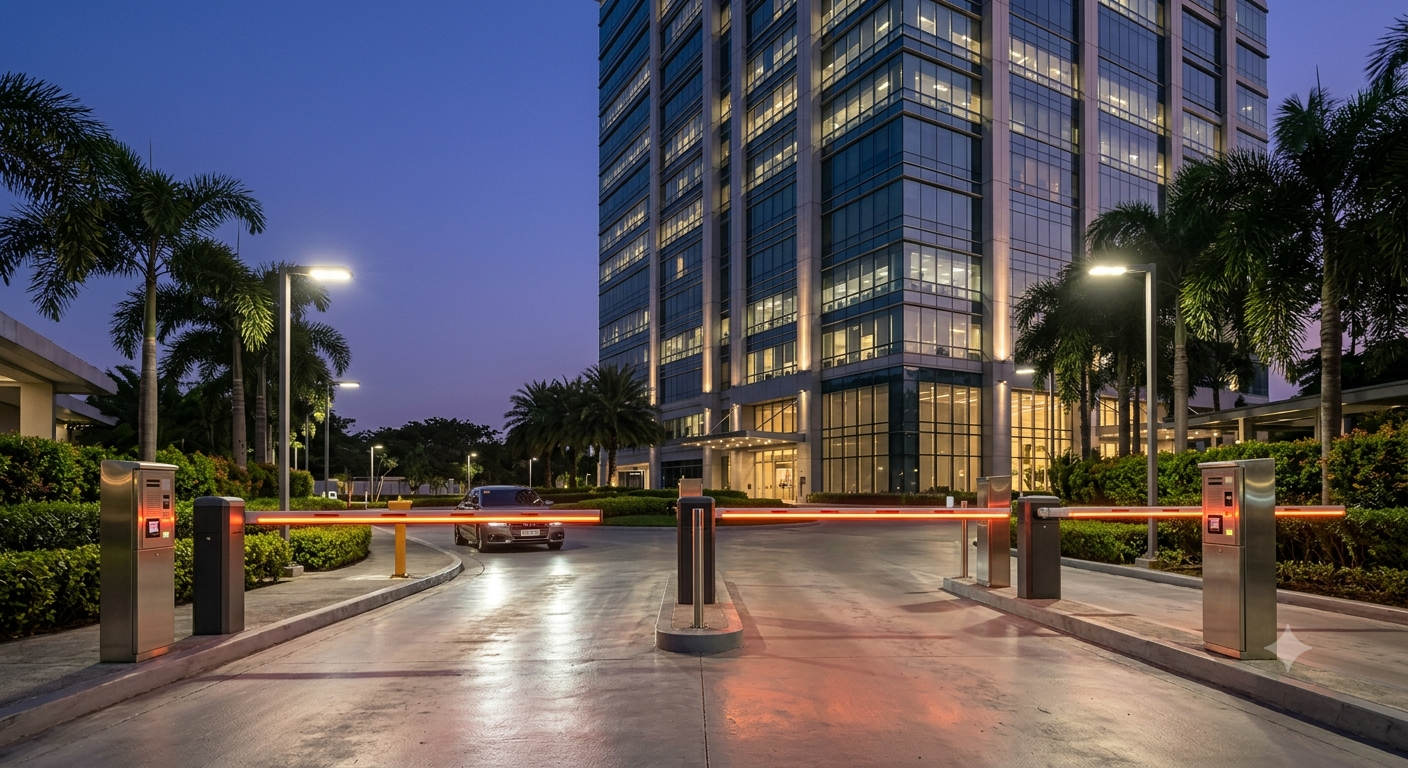
Vehicle Loop Failures Are a Throughput Problem Before They Are a Security Problem
A single boom barrier that mistimes its drop cycle at a Quezon City mall’s peak-hour exit lane can back a vehicle queue past the property line within minutes. That backup triggers complaints to the local traffic enforcement unit. It also exposes the property administrator to liability under municipal ordinances on public right-of-way obstruction. As Access Control Solutions Philippines, we engineer boom gate and barrier arm systems around one constraint most vendors ignore during bidding. Vehicle detection accuracy has to hold up under Metro Manila’s mixed-fleet chaos. Motorcycles weave beside SUVs. Delivery trucks idle on the loop. Tricycles draw negligible ferrous mass, and a poorly tuned loop misses them entirely.
Vehicle Loop Detectors and RFID Under the Hood
Every commissioned installation uses dual inductive loop detectors per lane. A primary safety loop sits directly beneath the barrier arm, and a secondary presence loop sits upstream. Together they prevent arm descent onto a vehicle body, trailer overhang, or pedestrian that has drifted into the barrier envelope. RFID long-range readers, operating in the UHF band with a 3-8 meter read range, handle tenant and reserved-parking vehicle stickers. A separate short-range HF layer processes visitor ticketing at the entry kiosk. This dual-frequency approach avoids the false-read collisions that plague single-protocol systems. The failure point is roughly 40 cars per hour per lane — a threshold most Quezon City commercial hubs cross well before the 6:00 PM exit surge.
- Loop response time: under 100ms from vehicle presence to controller signal, sufficient to abort a false-triggered arm drop
- RFID read range: long-range UHF tags for tenant/reserved vehicles; contactless HF cards for validated visitor exit
- Barrier arm cycle: full raise-lower cycle rated at 3-6 seconds under continuous-duty motor specification, not the lighter-duty residential-grade actuators sometimes substituted during value-engineering passes
- Anti-tailgate logic: secondary loop denies pass-back and flags a controller alarm when two vehicles pass on a single validated transaction
Fail-Safe Engineering and Fire Code Interfacing
Boom barriers positioned across designated fire lanes or building egress routes must fail to the open position — raised, or auto-drop-clear — on loss of power. The same fail-safe applies on a signal from the property’s Fire Alarm Control Panel. This is consistent with the emergency vehicle access provisions under the Fire Code of the Philippines (RA 9514). We hard-wire barrier controllers into the FACP relay output during commissioning, rather than relying on a battery-backup default state alone. Battery degradation over a 3-5 year service window is the single most common cause of barrier-related fire lane obstruction findings. That shows up during Bureau of Fire Protection inspections. Vehicular gate placement, clearance widths, and fire lane marking are further coordinated against the National Building Code of the Philippines (PD 1096) parking and circulation requirements.
Data Handling for Plate Capture and RFID Logs
Automated barrier systems log vehicle plate images and RFID tag ownership records. Under the Data Privacy Act of 2012 (RA 10173), that constitutes personal data processing. Our deployments segment plate-capture footage and RFID transaction logs into access-restricted database partitions with defined retention schedules. We also provide mall administrators with a documented data flow diagram, so they can satisfy their own National Privacy Commission registration obligations where applicable.
Extending the Lane: Facial Recognition for Tenant and VIP Vehicle Access
Some malls and mixed-use hubs run a reserved or valet lane for anchor tenants and premium shoppers. For these, we frequently pair the boom barrier controller with a facial recognition system mounted at the lane entry. A pre-enrolled vehicle owner then clears the barrier without presenting a card or waiting on RFID handshake latency. That speed matters most where the reserved lane sits close to a drop-off zone with strict dwell-time limits.
Regional Deployment and Maintenance Coverage
Installations across Quezon City and the broader NCR corridor are serviced out of our Makati Head Office. Technicians are dispatched for scheduled loop calibration, actuator lubrication cycles, and FACP interface testing. Property administrators and procurement teams can reach the Luzon service desk directly at (02) 8892-9073 to scope a bid package that specifies loop detector count, barrier duty rating, and fire lane fail-safe wiring ahead of the tender.
Related Topics:
Solutions: CCTV and Surveillance Solutions
Other Topics:
Blog: Benefits of Advanced Access Control Solutions