
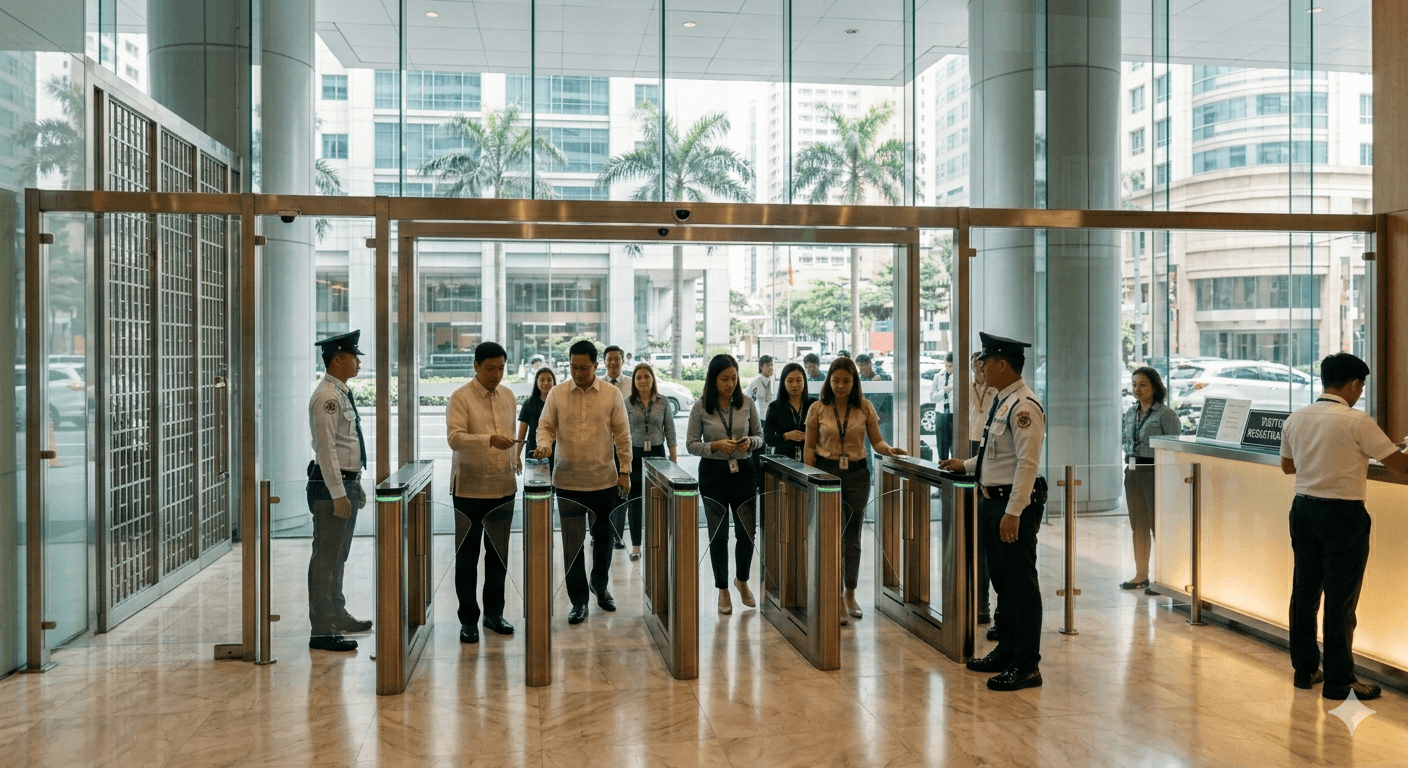
Every day, thousands of employees, visitors, and contractors walk in and out of Philippine commercial buildings — offices in Makati, malls in Cebu, factories in Davao. Without a proper access control system, building managers have no reliable way to know who enters, who shouldn’t, and when.
This guide covers everything a property manager, building owner, or facilities team in the Philippines needs to know about access control systems: how they work, the different types available, what they cost, how to choose the right one, and which compliance standards apply locally.
Infinite Systems has been designing and installing access control solutions across the Philippines for decades. This is the guide we wish existed when our clients first came to us.
What Is an Access Control System?
An access control system is a security infrastructure that governs who can enter or exit a building, floor, room, or restricted area — and when. It replaces traditional lock-and-key systems with electronic, programmable, and auditable controls.
At its core, every access control system has three components:
- Credential — what the person presents (RFID card, fingerprint, face, PIN, QR code)
- Reader — the device that scans or reads the credential at the entry point
- Controller — the brain that decides whether to grant or deny access based on programmed rules
When all three work together, you get a secure, trackable, and manageable entry system that scales with your business.
Why Philippine Buildings Need Access Control Now
The Philippines’ commercial real estate sector has grown significantly over the past decade. PEZA-accredited zones, BPO offices, mixed-use developments, and residential condominiums all face rising security demands. Several factors make access control essential in the Philippine context:
- High employee turnover in BPO and retail sectors creates constant credential management challenges
- Multi-tenant buildings must restrict access to specific floors and areas per tenant
- Fire Code of the Philippines (RA 9514) requires emergency egress integration with security systems
- PEZA regulations require audit trails of all personnel entering economic zone buildings
- Rising incidents of office intrusion and internal theft across Metro Manila, Cebu, and Davao
Types of Access Control Systems in the Philippines
Not all access control systems are the same. The right type depends on your building size, security requirements, budget, and the number of access points you need to manage.
1. Card-Based Access Control (RFID / Smart Card)
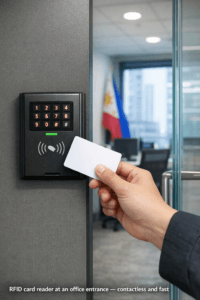
RFID card reader at an office entrance — contactless and fast
The most widely deployed type in Philippine commercial buildings. Employees carry proximity cards (RFID) or smart cards that are read by a card reader at each access point.
Best for: Medium to large offices, BPO floors, corporate buildings
Pros: Affordable per door, fast entry, easy card replacement
Cons: Cards can be lost, shared, or cloned if low-security RFID is used
2. Biometric Access Control (Fingerprint / Palm)
Biometric systems verify identity using physical characteristics — most commonly fingerprints. They eliminate the risk of lost cards and are ideal for high-security areas.
Best for: Server rooms, finance departments, HR records rooms
Pros: Cannot be shared or forgotten, high accuracy
Cons: Slower throughput, hygiene concerns post-COVID, requires enrollment
3. Facial Recognition Access Control
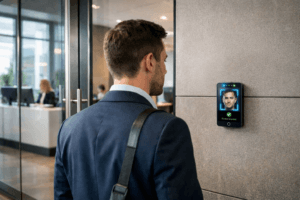
Facial recognition access terminal — touchless, fast, and increasingly common in Philippine offices
The fastest-growing category in the Philippines. Face ID terminals provide touchless, high-speed identity verification at entry points — ideal for post-pandemic building operations.
Best for: High-traffic lobbies, factories, healthcare facilities
Pros: Touchless, fast, doubles as time and attendance system
Cons: Higher upfront cost, requires good lighting and proper camera positioning
4. PIN Code / Keypad Access
Simple, low-cost access control using numeric codes. Common in small offices, storage rooms, and areas with low security risk.
Best for: Small offices, storage areas, meeting rooms
Pros: No credential hardware needed, low cost
Cons: Codes can be shared, no audit trail per person
5. Mobile Access Control
Uses smartphones as credentials via Bluetooth or NFC. Increasingly popular in modern Philippine co-working spaces and tech-forward offices.
Best for: Modern offices, co-working spaces, tech companies
Pros: Convenient, no physical card needed, remote management
Cons: Dependent on smartphone battery and connectivity
Access Control System Components Explained
Understanding each component helps you evaluate quotes from suppliers and ask the right questions during a site assessment.
| Component | Function | Example |
| Card Reader / Biometric Terminal | Reads credential at the door | RFID reader, fingerprint scanner, face ID terminal |
| Access Controller | Grants or denies entry based on rules | Panel connected to multiple doors |
| Electric Door Lock | Physically locks/unlocks the door | Electromagnetic lock, electric strike |
| Door Contact Sensor | Detects if door is open or closed | Magnetic sensor on door frame |
| Request-to-Exit Button/Sensor | Allows exit without credential | PIR sensor, push button |
| Access Management Software | Central system to manage users and view reports | Web-based or desktop platform |
| Power Supply / UPS | Keeps system running during outages | Battery backup with 4–8 hour capacity |
Access Control System Integration in Philippine Buildings
Modern access control systems do not operate in isolation. In Philippine commercial buildings, they integrate with multiple other systems to create a unified security and building management environment.
Integration with Turnstile Systems
Turnstiles at building lobbies are controlled by the access control system. When a valid credential is presented, the access controller signals the turnstile to open. This prevents tailgating — one of the most common physical security breaches in Philippine office buildings. Learn more in our guide to Turnstile Systems Philippines.
Integration with Elevator Access Control
Elevator access control, also called Destination-Oriented Allocation System (DOAS), limits which floors a person can access after being authenticated. The turnstile or lobby reader sends a signal to the elevator system, which allocates the correct car and enables only the permitted floors on the panel. This is now standard in Makati CBD and BGC high-rise towers.
Integration with CCTV and Video Surveillance
Linking access control events with CCTV footage allows security teams to instantly pull up video of who entered a specific door at a specific time. This is essential for incident investigation and compliance auditing in PEZA zones and healthcare facilities.
Integration with Fire Alarm Systems
Philippine law (RA 9514, the Fire Code of the Philippines) requires that all access-controlled doors release automatically during a fire alarm event. Infinite Systems ensures all installed access control systems include fire alarm relay outputs that trigger automatic lock release, in compliance with NFPA 101 and local fire code.
Access Control System Cost in the Philippines

Cost planning for access control deployment — budgeting by number of doors and credential type
Pricing for access control systems in the Philippines varies depending on the number of doors, credential technology, software requirements, and integration needs. Here is a general guide:
| Setup Size | Typical Range (PHP) | Notes |
| 1–3 doors (small office) | ₱30,000 – ₱120,000 | Basic RFID, no integration |
| 4–10 doors (mid-size office) | ₱120,000 – ₱400,000 | Card + biometric, software included |
| 10–30 doors (large building) | ₱400,000 – ₱1,500,000 | Multi-reader, elevator integration |
| 30+ doors (high-rise / campus) | ₱1,500,000+ | Enterprise platform, full integration |
Note: prices may vary based on project scope, features and brand preference
These are supply-and-install estimates. Annual preventive maintenance contracts typically add 10–15% of the system cost per year. Request a free site assessment from Infinite Systems for an accurate quotation.
How to Choose the Right Access Control Supplier in the Philippines
With dozens of suppliers in Metro Manila, Cebu, and Davao, selecting the right partner is as important as selecting the right hardware. Here is what to evaluate:
- Local engineering team — can they do the installation and provide on-site support?
- After-sales service — is there a preventive maintenance program?
- Brand partnerships — do they supply from recognized global brands?
- Integration experience — can they connect access control to your existing CCTV, elevators, or fire alarm?
- Compliance knowledge — do they understand NFPA, RA 9514, and PEZA requirements?
- References — do they have a portfolio of comparable projects in the Philippines?
Access Control Brands Available in the Philippines
Infinite Systems supplies and integrates access control systems from globally recognized brands, selected for reliability, parts availability, and long-term support in the Philippine market:
- Hikvision — one of the most widely deployed brands in the Philippines, strong integration with CCTV
- Sensor Access – enterprise-grade access control, highly recommended for residential and commercial buildings, smart elevator integration
- Rosslare — enterprise-grade access control with broad controller compatibility
- ZKTeco — popular for biometric and facial recognition, cost-effective for SMEs
- Dahua — strong choice for high-volume facilities requiring fast throughput
- HID Global — premium RFID credentials and readers for enterprise clients
Frequently Asked Questions: Access Control Systems Philippines
What is the difference between access control and CCTV?
CCTV records who is in a space. Access control determines who can enter a space. In a well-secured building, both systems work together — access control grants entry, CCTV records it.
Do access control systems work during power outages?
Yes, if properly specified. Infinite Systems designs all access control installations with battery backup (UPS) that maintains system function for 4–8 hours during power interruptions — common in the Philippines during typhoons and brownouts.
Is access control required by law in the Philippines?
Not universally, but specific regulations apply. PEZA-accredited buildings must maintain audit logs of all personnel access. The Fire Code of the Philippines (RA 9514) requires fire alarm integration. Healthcare facilities have additional patient privacy requirements.
Can access control work with biometrics and cards at the same time?
Yes. Most modern systems support multi-factor authentication — for example, requiring both a card and a fingerprint to enter a high-security area, while using card-only access for standard doors.
How long does installation take?
A small office with 3–5 doors can be installed in 1–2 days. A mid-size building with 20+ doors and elevator integration typically requires 1–2 weeks, depending on cabling and civil work conditions.
Get a Free Site Assessment from Infinite Systems
Infinite Systems has offices in Makati, Cebu City, and Davao City. Our engineering team conducts free site assessments across the Philippines, producing a system design, bill of materials, and project timeline tailored to your building.
Contact us at inquiry.ayala@infiniteph.com or call (02) 8892-9073; Globe/Viber: (0917) 406-0366 to schedule your assessment today.
Related Pages:
Turnstile Systems https://infiniteph.com/turnstile-systems/
Elevator Access Control Systems: https://infiniteph.com/elevator-access-control-systems/
Video Surveillance Systems: https://infiniteph.com/cctv-video-surveillance-systems/
Fire Alarm Systems: https://infiniteph.com/fire-alarm-life-safety-systems/
Visitor Management Systems: https://infiniteph.com/visitor-management-systems/
PA BGM Systems: https://infiniteph.com/pa-bgm-systems-philippines/